The World in Time

Simon Winchester

Friday, August 04, 2017

Maris Pacifici, the first printed map to depict the Pacific Ocean, Abraham Ortelius, 1589.

Until the fifteenth century the only sea that mattered (politically, socially, and economically) was the Mediterranean. As sixteenth-century European explorers set sail in search of land and opportunity, it was the Atlantic that carried them from old worlds to new. Since the middle of the twentieth century, argues Simon Winchester, it’s been the Pacific Ocean that dominates trade, travel, and scientific research, and it’s on, in, and under the Pacific that the future of the world will be forged.


Lewis Lapham talks with Simon Winchester, author of Pacific: Silicon Chips and Surfboards, Coral Reefs and Atom Bombs, Brutal Dictators, Fading Empires, and the Coming Collision of the World’s Superpowers.


Read an excerpt from Simon Winchester’s Pacific in Disaster


Thanks to our generous donors. Lead support for this podcast has been provided by Lisette Prince through the EJMP Fund for Philanthropy. Additional support was provided by James J. “Jimmy” Coleman Jr.
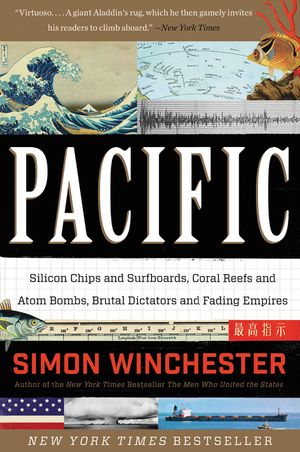

Discussed in this episode

Cover of Pacific

More Podcasts

The Cantino planisphere, made by an anonymous cartographer in 1502, shows the world as it was understood by Europeans after their great explorations at the end of the fifteenth century.

May 26, 2017

The World in Time:

Ian Mortimer

Lewis Lapham talks with Ian Mortimer about the past millennium of human innovation. More

June 01, 2011

The World in Time:

What a Prince

Lewis Lapham talks with historian Miles Unger about the Florentine father of modern political science. More

August 31, 2018

The World in Time:

Jim Holt

Lewis H. Lapham talks with Jim Holt, author of When Einstein Walked with Gödel: Excursions to the Edge of Thought. More

September 27, 2019

The World in Time:

William Dalrymple

Lewis H. Lapham speaks with the author of The Anarchy: The Relentless Rise of the East India Company. More