Illustration: Arms of the Foundling Hospital with an admission ticket [to a performance of Handel's “Sacred Oratorio”], after William Hogarth, 1750. The British Museum.
“Handel gets to Dublin and he’s trying to put together musicians. He’s looking for singers and lo and behold, there is Susannah Cibber who has turned up in Dublin to try to restart her career at exactly the time that Handel is there,” says Charles King in this week’s episode of The World in Time. “Handel enlists Cibber in the cast, but she doesn’t read music. Anything she sings has to be plunked out on the harpsichord for her. The place of the premiere is at a charitable event; it’s going to support the indigent and folks in the hospital, the jail—it is not in a cathedral. The premier of Messiah is not even in a church but in a music hall and this new music hall is also trying to develop its own reputation. There were some well-established, very famous theaters in Dublin. This is not it. This is an up-and-comer but they’ve booked Handel for this new piece of music that he’s going to premiere.”
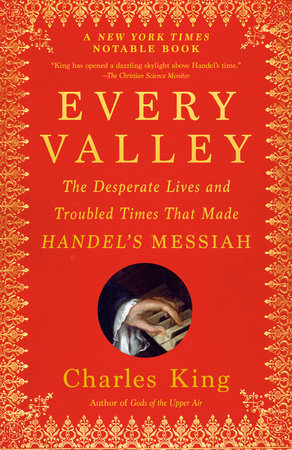
This week on the podcast, Donovan Hohn speaks with Charles King about his latest book, Every Valley: The Desperate Lives and Troubled Times That Made Handel’s Messiah. King recounts the history—both sacred and profane, but mostly profane—of the composer’s famous oratorio, tracing its humble origins and eventual renown to a series of unlikely collaborations. Among Handel’s collaborators: the actor Susannah Cibber, choristers from the church run by Jonathan Swift, and Charles Jennens, the depressive heir to an iron fortune who conceived of the Messiah and compiled the devotional libretto that Handel immortalized with music influenced by Italian opera..
WORKS CITED
(In order of mention.)
Rivka Galchen. “Hallelujah: An economic companion to the Messiah,” Harper’s Magazine, December 2012.
Christopher Hogwood. Handel. London: Thames & Hudson, 2007.
Charles King. Every Valley: The Desperate Lives and Troubled Times That Made Handel’s Messiah. New York: Vintage, 2025.
Charles King. Gods of the Upper Air: How a Circle of Renegade Anthropologists Reinvented Race, Sex, and Gender in the Twentieth Century. New York: Vintage, 2020.
Charles King: Odessa: Genius and Death in a City of Dreams. New York: W.W. Norton & Company, 2012.
George Frideric Handel. The Messiah. BBC Chorus and Symphony Orchestra, conducted by Sir Thomas Beecham, 1928.
Edward Gibbon. Memoirs of My Life. New York: Penguin Classics, 1984.
Jonathan Swift. A Modest Proposal and Other Writings. Edited by Carole Fabricant. London: Penguin Classics, 2009.
Book of Isaiah. In The Bible: Authorized King James Version with Apocrypha. Edited by Robert Carroll and Stephen Prickett. Oxford: Oxford University Press, 2008.
Martin Luther King Jr. I Have a Dream. Foreword by Amanda Gorman. San Francisco: HarperOne, 2022.
Jonathan Swift. Gulliver’s Travels. Edited and introduced by Robert DeMaria Jr. New York: Penguin Classics, 2003.
Alexander Pope. The Major Works. Edited by Pat Rogers. Oxford: Oxford University Press, 2009.
John Gay. The Beggar’s Opera. Edited by Bryan Loughrey and T.O. Treadwell. New York: Penguin Classics, 1987.
William Shakespeare. Romeo and Juliet: A Norton Critical Edition. Edited by Gordon McMullan. New York: W.W. Norton & Company, 2016.
Thomas Arne. Rule, Britannia. Royal Choral Society and The Philharmonia Orchestra, conducted by Arnold Grier, 1953.
George Frideric Handel. Zadok the Priest, HWV 258 (audio recording). Paul McCreesh, Gabrieli Consort and Players, 2019.
George Frideric Handel. Handel: The Complete Water Music (audio recording). Robert Hayden Clark, Consort of London, 2011.
The Bible: Authorized King James Version with Apocrypha. Edited by Robert Carroll and Stephen Prickett. Oxford: Oxford University Press, 2008.
The Book of Common Prayer. Cambridge: John Baskerville, 1762.
Jonathan Swift. “An Exhortation Addressed to the Sub-Dean and Chapter of St. Patrick’s Cathedral, Dublin.” In The Prose Works of Jonathan Swift, D.D., Volume VII: Historical and Political Tracts—Irish. Edited by Temple Scott. London: George Bell and Sons, 1905.
George Frideric Handel. “He Was Despised.” Messiah, HWV 56 (audio recording). Carolyn Watkinson, Christopher Hogwood, Academy of Ancient Music, 1980.
George Frideric Handel. Anthem for the Foundling Hospital, HWV 268: VIII. Hallelujah! (audio recording). Choir of Christ Church Cathedral, Oxford, Academy of Ancient Music, Simon Preston, 1978.
William Cabell Bruce. Benjamin Franklin: Self Revealed, A Biographical and Critical Study Based Mainly on His Own Writings. New York: G.P. Putnam’s Sons, 1917.
George Frideric Handel. “Every Valley.” Messiah, HWV 56 (audio recording). Academy of Ancient Music, conducted by Christopher Hogwood, 1980.