Illustration: Detail from Large Sunflower (Flos Solis Maior), plate 1 from part 5, B. Besler, Hortus Eystettensis, 1713 edition. Museum of Fine Arts Boston, bequest of George P. Dike—Elita R. Dike Collection.
“The Cold War laboratory research identified something real about humans: that we can focus on a stimulus on a screen. But it is hardly an adequate account of what it is to be a human person,” says D. Graham Burnett in this week’s episode of The World in Time. “For instance, giving your mind and time and senses to the world and using your mind and time and senses to receive the world and other human beings, properly understood, that’s human attention. It also involves daydreaming and taking care of a child and burying your dead—those are attentional activities. It’s been hard for us to keep track of that fact about ourselves as we have increasingly asked ourselves to be more and more seamlessly integrated into these continuous, twenty-four seven data flows and communication entertainment networks. We worry about machinic attention—that it is inextricable from the way we feel bad; that there are authentic pandemics of loneliness, isolation, anxiety, despair; and that our politics is weirdly fractious and dysfunctional.”
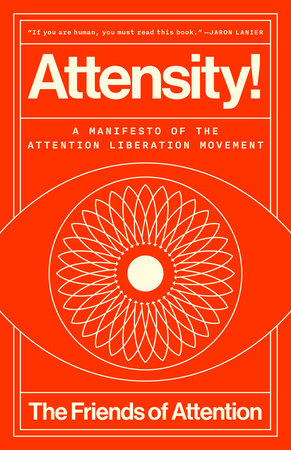
This week on the podcast, Donovan Hohn speaks with D. Graham Burnett, historian of science, and Alyssa Loh, writer and filmmaker, about a new book, Attensity! A Manifesto of the Attention Liberation Movement, collectively authored by Burnett, Loh, and other members of the Friends of Attention (among them Peter Schmidt, program director of the Strother School of Radical Attention). The Friends of Attention are a coalition of artists, writers, and scholars committed to liberating human attention from the extractive technologies of the “attention economy.” Hohn, Burnett, and Loh discuss the history of, and possible remedies to, the attentional crisis that Attensity! diagnoses and describes.
WORKS CITED
(In order of mention.)
D. Graham Burnett. Trying Leviathan: The Nineteenth-Century New York Court Case That Put the Whale on Trial and Challenged the Order of Nature. Princeton, NJ: Princeton University Press, 2007.
D. Graham Burnett. The Sounding of the Whale: Science and Cetaceans in the Twentieth Century. Chicago: University of Chicago Press, 2011.
D. Graham Burnett, Alyssa Loh, and Peter Schmidt. “The Multi-Trillion-Dollar Battle for Your Attention Is Built on a Lie,” New York Times, January 10, 2026.
“Twelve Theses on Attention,” The Friends of Attention, August 20-24, 2019.
Alyssa Loh and Lane Stroud, curators. “Twelve Theses on Attention,” film series.
The Friends of Attention. Twelve Theses on Attention. Edited by D. Graham Burnett and Stevie Knauss. Princeton, NJ: Princeton University Press, 2022.
D. Graham Burnett, Alyssa Loh, and Peter Schmidt. “Powerful Forces Are Fracking Our Attention. We Can Fight Back.” New York Times, November, 24, 2023.
Alyssa K. Loh. “I Feel You: Alyssa K. Loh on Virtual Reality and Empathy,” ARTFORUM, November, 2017.
Alyssa Loh. “The Fight for Our Eyeballs: Alyssa Loh explores a critique of the attention economy from ex-Google strategist James Williams,” Los Angeles Review of Books, September 25, 2018.
Alyssa Loh, Uzoamaka Maduka, Jac F. Mullen, and Jonathon Kyle Sturgeon. “On Surveillance: A Conversation,” In Conversation from The American Reader, Vol. 2 No. 2.
The Friends of Attention. Attensity! A Manifesto of the Attention Liberation Movement. New York: Crown, 2026.
D. Graham Burnett. “Funhouse Goddess,” Lapham’s Quarterly, Summer 2008: Book of Nature.
D. Graham Burnett. “A Little Travel Is a Dangerous Thing,” Lapham’s Quarterly, Summer 2009: Travel.
Nathan Heller. “The Battle for Attention,” The New Yorker, April 29, 2024.
Lewis H. Lapham. “Old Relics in New Bottles,” Harper’s Magazine, March 1984.
Neil Postman. Amusing Ourselves to Death: Public Discourse in the Age of Show Business. Introduced by Andrew Postman. New York: Penguin Books, 2005.
Simone Weil. “Attention and Will.” In Gravity & Grace. Translated by Arthur Wills and introduced by Gustave Thibon and Thomas R. Nevin. Lincoln, NE: University of Nebraska Press, 1997.
Robert D. Putnam. Bowling Alone: The Collapse and Revival of American Community. New York: Simon & Schuster, 2020.
“A Global Turning Point: Why Youth Well-Being Is in Crisis—and What We Must Do About It.” A Global Symposium Co-hosted by Dartmouth and the United Nations Development Programme, Sunday, October 26-Tuesday, October 28, 2025.
Michel Foucault. The History of Sexuality, Vol. 2: The Use of Pleasure. Translated by Robert Hurley. New York: Vintage Books, 1990.
G.W.F. Hegel. Elements of the Philosophy of Right. Edited by Allen W. Wood. Translated by H.B. Nisbet. Cambridge: Cambridge University Press, 1991.
Herman Melville. Moby-Dick: A Norton Critical Edition. Edited by Hershel Parker. New York: W.W. Norton & Company, 2017.
Vladimir Nabokov. Speak, Memory: An Autobiography Revisited. Introduced by Brian Boyd. New York: Everyman’s Library, 1999.
Friedrich Nietzsche. The Gay Science: With a Prelude in Rhymes and an Appendix of Songs. Translated by Walter Kaufmann. New York: Vintage Books, 1974.
Audre Lorde. The Selected Works of Audre Lorde. New York: W.W. Norton & Company, 2020.
Guy Debord. The Society of the Spectacle. Translated by Donald Nicholson-Smith. New York: Zone Books, 1994.
Galway Kinnell. “Saint Francis and the Sow.” In Three Books: Body Rags; Mortal Acts, Mortal Words; The Past. Boston: Mariner Books, 2002.