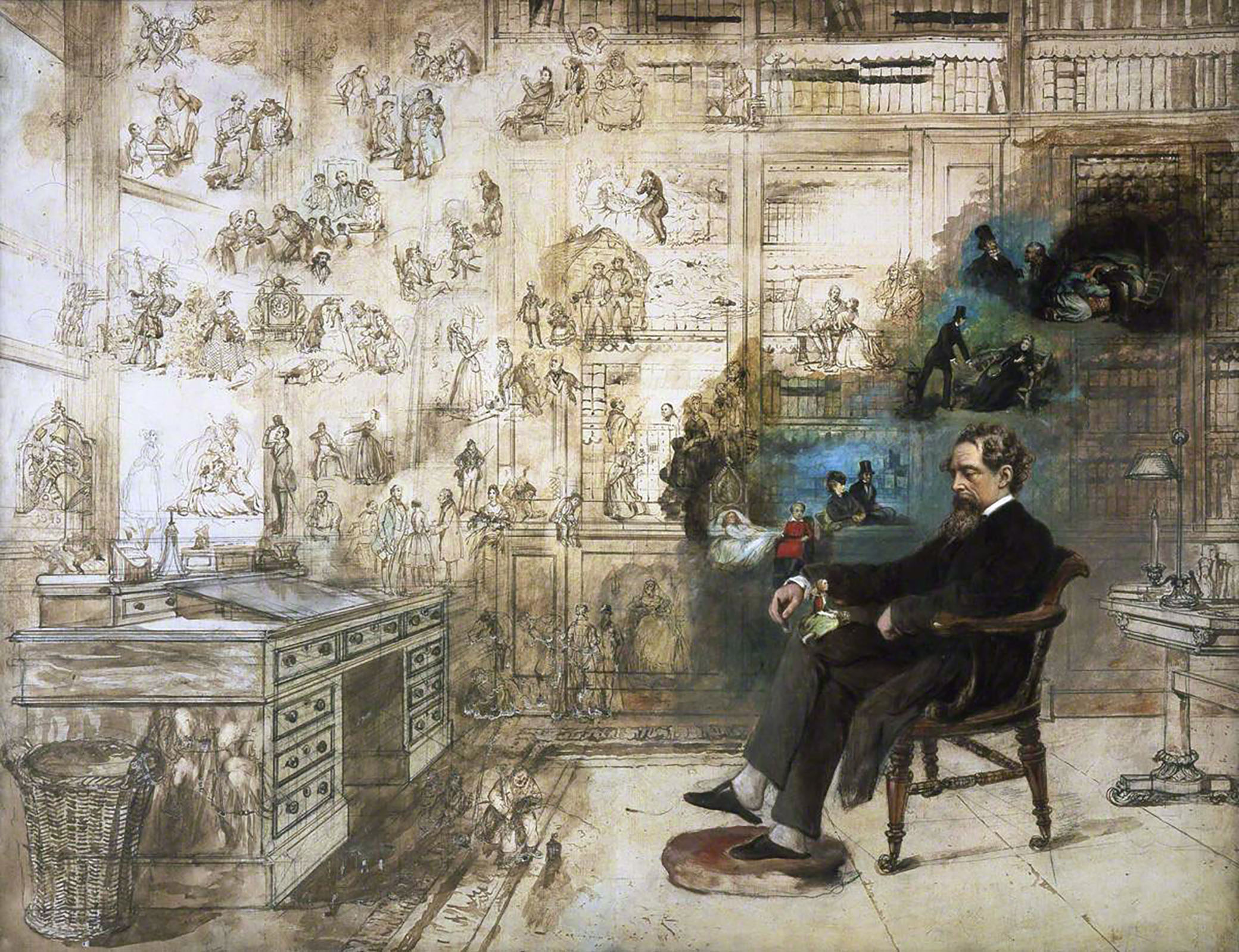
Dickens’ Dream, by Robert William Buss, 1875. Wikimedia Commons.
Lapham’s Quarterly has always included, among the Voices in Time it collects, excerpts from works of fiction. The novels of Charles Dickens have made frequent appearances. In his Preamble to our first issue, States of War, published in the winter of 2008, Lewis H. Lapham informed readers that future numbers might include original works of fiction—what he called “Counterfactual Speculations,” by which he likely had in mind thought experiments resembling the one he’d conducted in an essay, “Furor Teutonicus,” published in 1999. In that essay, Lapham imagined how history might have unfolded had Varus defeated Arminius at the first-century Battle of the Teutoburg Forest. In her new book, Five Weeks in the Country, excerpted here, editor-at-large Francine Prose conducts a different sort of historical thought experiment, novelistic rather than counterfactual. “Five Weeks in the Country,” she writes in an author’s note, “includes real people and documented events but takes significant liberties with detail and chronology.” The novel reproduces letters, one of which is fictional, written by Prose, the rest of which, including the two quoted here, are primary sources preserved in the historical archives and written by their signatories.
On the night Charles Dickens first met Hans Christian Andersen, he had drunk a few drops over his usual habit, but only because his hostess, Lady Blessington, had asked him to make the punch and he’d had to keep testing his product. Past a certain point, he had a tendency to invite strangers to visit him at home, regardless of whether he wanted to see them or not. Sometimes, the next morning, he awoke afraid that someone whose name he’d forgotten was about to knock on his door.
It was an argument for moderation. Or it would have been if those invitations hadn’t burbled up from such a deep well of feeling. By the end of those dinners, he loved his new friends. He wanted them to meet his family and see his home.
If he regretted his impulsiveness later, he reminded himself that, though his close friends were frequent visitors, no strangers had ever taken him up on his offer. He’d certainly never invited the lunatic who invaded his London home, talked his way past the servants, and left only when Dickens threatened to summon the police.
He couldn’t be blamed for seeing his household as a shining light, a source of warmth that could brighten the desolate soul and melt the frozen heart. He liked the image of himself—humble, unspoiled by fame, ridiculously generous—that his reckless hospitality painted.
He and Andersen met at a dinner party at Lady Blessington’s London home. He never knew if the Danish writer understood that it was scandalous just to be there. A popular hostess, a cultured widow, Lady Blessington was said to be living in sin with her young son-in-law, the charming Count d’Orsay, who used to be married to Lady Blessington’s stepdaughter.
He could never put that in a novel. His readers would turn against a British writer who could even imagine something so French.
No one was sure what kind of sin the couple were living in. The sins of business fraud seemed likelier than the sins of the flesh. So many mysteries surrounded their choices. It was useless to ask Lady B. why portraits of Napoleon decorated every room. She’d say, He was a hero.
The other recurring art theme was the myth of Danaë, pictured naked, sprawled in bed, beneath a shower of gold.
He welcomed Lady Blessington’s invitations. If there was anything he enjoyed, it was the spectacle of an impecunious, crooked couple fooling their friends into thinking that they were wealthy and honest. He would use what he’d seen in these drawing rooms for Mr. and Mrs. Merdle, Little Dorrit’s dishonest financier and his wife.
Count d’Orsay and his former mother-in-law spent way beyond their means. It made their parties more enjoyable, brighter, and more intense, like bacchanals in Pompeii before Vesuvius erupted. Marvelous wine, marvelous food. Absolute abundance. Scandal added bubbles to the champagne, sweetness to the puddings. It was far more exciting than the homes of one’s married friends, the threadbare sitting rooms smelling of baby sick and curdled milk. No one brought his wife to Lady Blessington’s. No one admitted to going there, though everyone went, if he could.
He had been happy the night he met Andersen. It never failed to amaze him, the speed and grace with which good food and drink erased his worries, obligations, and commitments, not gradually but all at once and without his even knowing. It was like a painless operation, like the disappearance of a worrisome twinge you forget as soon as it’s gone.
By the second cup of punch, the pressure in his chest had vanished. Why had he been so gloomy? Something good was about to happen—if not tonight, then soon. The future promised days when whole pages wrote themselves, days when his love for his children justified the worry, the responsibility, the time, and the expense. When strangers complimented him on his productivity, he wanted to show them the files and folders stuffed with bills from the butcher, the baker, the tutors, and the schools.
That night, he was Lady Blessington’s honored guest, which made everything nicer. His hostess loved fame and reputation, witty and slightly improper gossip. Best of all, she liked rivalries, insults (not to her), secrets accidentally revealed. She orchestrated scenes for her guests to whisper about, a shiver of excitement that made them feel that they had been through something together.
She enjoyed introducing people who, she predicted, would instantly love or hate each other. As a girl, she had tracked down Lord Byron and written a book about him. She was grief-stricken when her husband died, but it helped that he’d left an inheritance, a house, and a handsome son-in-law.
On the night Dickens and Andersen met, the count was in Italy. The hostess announced that the author of The Pickwick Papers had kindly agreed to assume some of the host’s duties.
She asked Dickens to be her sommelier, to concoct his own poison. After making sure that she meant it—that she and the others would drink whatever he made—he requested a bottle of the best brandy, the best rum, the best claret. He mixed it in a large glass bowl, with a cup of sugar and a large pinch of lemon zest. He tasted it several times to make sure the proportions were right.
He told the guests to stand back as the punch bowl was wheeled into the parlor on a cart. Back, everybody, please, against the walls! He wished he had a cape and top hat, a lovely young assistant, a magic wand that doubled as a flint to ignite the fire. He’d done marvelous tricks for his children—producing a plum pudding boiled in a top hat, turning pocket handkerchiefs into sugar-coated almonds, extracting a live guinea pig from a tin of flour.
The crowd drew back. He looked from one to another, lingering, almost against his will, on the pretty female cousins and nieces with whom Lady Blessington decorated her parties. He knew most, if not all, of her guests. They all knew who he was. He opened his arms as if to embrace them. The crowd applauded. He nodded and waved. God would forgive him for how much he loved and needed their adoration.
“Tonight we are Lady Blessington’s lucky guests. She is the one we should thank.” The men whistled and cheered and made noises they would never have made at home.
Abracadabra. He lit a match and touched it to the punch. He jumped back, almost singeing his eyebrows. A woman screamed when a flash appeared to set the chandelier on fire, but it was only a reflection in the crystals. For a moment, he feared for the ceiling, but it was higher than the wisps of black smoke could reach. He would feel awful if Lady Blessington needed her ceiling repainted.
The flames died down, but the party kept applauding. He insisted on filling the guests’ cups himself, ladling the steaming punch that he realized, only now, might be a bit warm and heavy for an unseasonably humid September evening.
He had made a Christmas punch. Christmas was what he was known for. The heat sped up the effects of the rum, the brandy, and the claret. He served the first few guests, then filled his own cup and filled it again when no one was looking.
A line formed, each guest holding a crystal cup as if Dickens were the officiant in a sacrament involving alcohol, lemon peel, and sugar. He had underestimated the size of the crowd and was beginning to regret his offer to serve the punch. He hoped that Lady Blessington would send a servant to take over.
Halfway down the line was a man so tall that his head was visible above the others.
Dickens had seen him somewhere before. The beaky nose, the fleshy lips, the tufts of hair winging out from his long, back-sloping forehead. If he’d imagined that face and described it in a book, his critics would call it a caricature, another loathsome phantom of his cruel imagination.
It took a moment to recognize Hans Christian Andersen from his portrait in the frontispiece of the volume of his fairy tales, which had appeared in English. The face was memorable, partly because it had too much of everything—too much nose, too much eyelid, excessive melancholy. As he waited for his punch, his expression conveyed the same dreamy abstraction as the image in his book.
Dickens had read a couple of Andersen’s stories. “The Little Mermaid” and…one other. He’d mostly forgotten them. They were fine for what they were. Not his cup of tea. Fanciful and moralistic, they ignored the world of grime and joy and suffering, the humor and ambiguity that he worked so hard to get on the page. They made poverty seem romantic. As a child, he’d enjoyed The Arabian Nights, but he was no longer a child. Andersen’s book had been sent to his office. He’d meant to bring it home to his children, but he kept forgetting.
Lady Blessington plucked Andersen out of the line and brought him forward. “The great Hans Christian Andersen, meet the great Charles Dickens! The greatest writer in England, meet the greatest writer in Denmark!”
Not just in England, he thought. He wondered if Andersen was thinking: Not just in Denmark.
Lady Blessington took the ladle and gave it to a servant, who smirked at Dickens as if he knew something that Lady Blessington didn’t. If Dickens were a different person, if he had been born into a different class, he might have asked his hostess if her servant was always so rude. No one but Catherine, his parents, and his siblings knew that his grandparents were in service. He looked away and said nothing.
What followed was one of those spells that he hadn’t suffered for a while. He felt nearly faint with the fear that he was about to be exposed as one of the confidence artists he wrote about, swindling their victims out of fortunes. Their deceit was about money, but his was about love, the love of his readers. His was about origins, about childhood, about suffering, about fear and despair. He’d soon be found out. He was not the man he pretended to be. He was the son whose father had gone to prison for debt, the boy who’d been forced to work filling bottles of blacking in the window of a factory that made polish for boots and stoves. He’d sat there, his face streaked with black, as the passersby—young pretty girls—stopped and stared at him as if he were a zoo animal who knew one clever trick.
These stylish, wealthy, titled guests would take a closer look and see the furious, anguished boy living with his parents in the Marshalsea. They would spot the bitter, shrunken homunculus inside the well-dressed, successful writer. He shivered as if a cool breeze from the terrace had sliced through the warm perfumed night.
Mr. Andersen, Mr. Dickens, Lady Blessington repeated. Pleasure to meet you. My pleasure. They shook hands. The other guests were watching or trying not to watch. They would tell their friends, who would be jealous. His fame and Andersen’s somewhat lesser fame, together with their hostess’s love for social theater, had made their meeting an event.
Andersen’s palm was damp. The handshake lasted too long. Dickens dropped Andersen’s hand. Andersen bowed and smiled. “Welcome,” Dickens said. “I’m a great admirer of your work.” He said that to every writer he met, whether or not it was true. It hurt no one. No one had ever asked what particular work he admired.
Andersen said, “Me too. But…English.” He shrugged, shook his head, and pointed at his mouth. Then they just stood there.
Dickens liked awkward moments. They were amusing to write. But he feared that this one might last forever. Andersen raised his cup. He pinched the air. Another drop.
Dickens wanted another cup too. Lady Blessington’s attention had shifted to some minor disturbance in another part of the room. Dickens signaled the waiter—not the one who had smirked—for a refill for Andersen, and he exchanged his empty cup for a full one.
He took a deep swallow. The punch was tastier than he’d thought. There. That was better.
He guided Andersen onto the terrace where the men went to smoke and talk.
It seemed a sort of miracle, how alcohol erased background, class, and culture, enabling conversations in languages he didn’t speak. Royal visits, diplomatic meetings, charity dinners—everything went more smoothly. Everyone was interesting, all friendliness and smiles. There were those who got angry or stupid when they drank. He put men like that in books but avoided them in life.
That night, he and Andersen understood each other. The drink, the fresh air on the terrace, his excellent cigar (Andersen didn’t smoke), the flickers of distant lightning, his awareness that the other guests were trying not to stare.
Andersen drained his cup. He must not have been much of a drinker because they were both thoroughly pickled.
It was a riotous conversation. A friendship was forged. What did they talk about, these new pals? Everything and nothing. Audiences, publishing, editors. Their loneliness, their work. Shakespeare and fairy tales.
Andersen told a story about his father having made his cradle from some wood he got from the local coffin-maker. Dickens reminded himself to make a note of it when he got back to his study and give it to one of his characters. He liked the idea of lumber from a casket repurposed as a baby bed after a bereaved husband refused to pay his bill. He assumed it meant that Andersen had come from the lower class, as he had. The rich did not economize by rocking their infants in coffins. He was drawn to, and alarmed by, men who shared the secret of their origins and of what they had taught themselves to be.
Andersen’s English was better than he’d said. Or were they speaking Danish? Who cared? They communicated.
Andersen said, “‘The Little Mermaid’?”
Dickens nodded, meaning: He’d read it. Andersen pantomimed how much scribbling and crossing out, how many failures and shredded pages had gone into that story. He mimed tearing out his hair.
Dickens said he was amazed that something so natural, so simple, so seemingly effortless—he was improvising here, he had no idea how much Andersen understood—had been such a challenge. He hoped Andersen couldn’t tell how little he remembered about “The Little Mermaid.”
In any case, it was annoying, hearing Andersen carry on about one little story while he uncomplainingly churned out hundreds of pages of fiction, essays, plays, novels crowded with characters and stuffed with plot turns and subplots. He didn’t want to feel superior, or he didn’t want to show it. He had so many responsibilities, so many claims on his time, while Andersen, lucky man—unmarried, childless, they’d established that—had only himself to provide for.
He tried to think of a weakness or fault to confess, as penance for putting himself above a brother writer. He mentioned a few chapters of Little Dorrit that he regretted. He wished he’d sent his characters in another direction.
Andersen said, “Everything you write…perfect.” When dinner was served, their hostess came to collect them and, hooking one arm through each of theirs, marched them into the dining room. He liked Lady Blessington, but her bossiness bothered him. In her glittering dress, her peacock-feather hat, she floated toward the table with the two famous writers attached to her shoulders like wings.
She sat at the head of the table and motioned for him and Andersen to sit opposite each other. It was noisy and uncomfortable. His new friend’s English deteriorated. His lips moved, but not one word was comprehensible or audible, or maybe alcohol’s gift for translation had worn off.
Dickens downed a glass of wine and asked for another, until he no longer minded the noise or his inability to speak to Andersen. An expansive spirit came over him. He felt hopeful and generous. Every problem had a solution.
When dinner ended, he said to Andersen, “You must visit some time. See my house, meet my family. They would love you, and you would love them. And let’s have lunch tomorrow at my club.”
“Would love yes,” Andersen said.
They would agree on a date for Andersen to come. Dickens repeated his invitation, in case Andersen hadn’t understood. He meant it with all his heart.
The next morning, he remembered the commitments that would take up his day and prevent him from dining with Andersen. He arranged to have him sent the twelve-volume set of his work, adding a dedication to his new friend to the already autographed flyleaf.
Ten years passed.
His life was no longer the same. Something had ended, something had been lost, and nothing had come along to take its place. The pains in his side and his face recurred more frequently, at the worst possible times. Black spiders crawled across his visual field, his punishment for writing for so many hours in flickering, feeble light.
Awake at night, he realized that the picture of blissful domesticity he offered his public was not so much an outright lie as a well-meaning exaggeration. He used to think he could love his work and his life, but now he mostly loved his work, and only some of the time. Supporting a giant household, consulting with Georgina, writing books, sometimes two at once, meeting deadlines, editing the journal—it weighed on him, but he needed the weight. He couldn’t breathe without it.
He no longer loved Catherine. He didn’t much like her, and he wasn’t sure that he ever had. Her awful parents had arranged the marriage. The existence of so many children might have suggested a certain . . . closeness, but human need had bridged the lack of common ground. He and Catherine should never have wed. They were unsuited. They made each other unhappier with each new child, with each passing year.
Catherine should have married someone else. If only a more kindly, more unselfish fellow had applied for a position at her father’s odious journal. Their coming together had been a coin toss with an unfortunate outcome. He was sorry they’d grown so far apart—if they’d ever been close. He regretted the pregnancies, the births, and especially the long recoveries that had reduced the plucky docility he imagined he’d seen in her to grief, jealousy, fear, and weakness. Of course he saw the irony: He had so much sympathy for his characters, so little for the mother of his children.
He was famous, successful, and confident except for the self-doubt with which he would never burden Catherine. She, however, felt quite free to wake him from a deep sleep with her worries about the children’s characters, their futures, and his fidelity. In the darkness, she accused him of being in love with women he hardly knew.
In fact, he did fall in and out of love with young women, sometimes several a week, more than Catherine imagined and only rarely with the women she accused him of liking. He blamed his marriage for the pains (fleeting but sharp) of hopeless secret love. His frustration and disappointment drove him to ridicule Catherine. He criticized her, in front of the children, for overeating. It wasn’t as if he had no pity, no conscience. After each of his mistakes, he retreated to his study and scourged himself for how he’d treated his wife. He delayed going to bed, knowing that Catherine had every reason to awake in tears.
He was a little afraid of Catherine because, at some besotted honeymoon moment, doubtless around the time when Charley was conceived, he confessed the truth about his childhood and about how he’d misled his public into thinking he came from comfortable, literary folk. If the Missus ever turned against him, he would have to make sure that his readers knew that her diseased imagination had fabricated his term in the debtors’ prison to which his father had been sentenced. The humiliation he’d endured when pretty girls gawked at him in the blacking factory window was likely, in Catherine’s view, the punishment he deserved.
His wife annoyed him. His children annoyed him. His editors and publishers annoyed him. Surely he was being too harsh, too impatient, too unsympathetic. It was agonizing, this new distance from the children he had loved with all his heart. A burning pain lodged under his ribs when he recalled how he had carried them in his arms, how he’d slipped into a sweet, dreamless sleep when they’d fallen asleep on his chest, how proudly he’d held their hands in the street, how high he’d thrown them in the air. The love and care with which he’d tended every scratch and scrape! He’d worked harder for their giggles than for the applause of a crowd.
He still felt that way about Baby, but the rest made too much noise, talked too loudly, gobbled their food, and left messes for the servants to straighten up. His disillusion with them had come on slowly, like an illness, and like an illness, it erased the memory of good health.
One of the women he fell in love with was Evangeline Harkness—the beautiful wife of an aged member of the House of Lords. He met her at dinner at her palatial home in Knightsbridge, where he was sat on his hostess’s right, a fact that seemed to imply a high level of trust on the part of His Lordship. The lovely Evangeline flirted with him over the chilled soup, while the roast was being carved, and after the last bite of pudding was consumed.
She claimed to have read everything he’d written and begged him to tell her how Little Dorrit would end. It would be their secret.
Just before the men retired for brandy and cigars, she asked if he knew the fairy tales of the Danish writer Hans Christian Andersen. All her friends adored his stories, which she found enchanting. She knew enchanting was a silly word to use about fairy tales, but she did feel that they were transporting her to another world, which, as gruesome as it was, she much preferred to the horrors of this one. She smiled sweetly at him. Was she hinting that he could dispel, or at least distract her from, whatever horrors she was enduring?
Ordinarily, he might have been annoyed when someone praised another writer whom all her friends were reading. But now he said, “The melancholy Dane is not only one of my dearest friends, but he is due to visit my home in the very near future.”
“Oh, Mr. Dickens, will you promise to bring him to see me when he arrives?”
A decade ago, he’d invited Andersen to visit. Now he would ask him again. He would bring Andersen to see Lady Evangeline. How impressed she would be. And then he would arrange things so that Andersen would “mysteriously” fail to show up for a second visit, thus leaving him alone with his pretty hostess. Perhaps, with just the two of them there, they would agree that they were meant for each other.
It was a young girl’s fantasy, he knew. Shaming, but so distracting that he had to ask Lady Evangeline to repeat her question. How did he meet Andersen? He pretended not to remember because Lady Blessington’s name would not endear him to a parliamentarian’s wife.
That night, lying awake beside Catherine, he worried that his hostess might discover that he’d lied about Andersen’s imminent visit. More important, he hoped to play out the delightful scenario he’d imagined: first the visit to Lady Evangeline’s with Andersen, then—if things went as he hoped—the second visit without him.
He composed a letter to Andersen in his head. Then he went to his study, wrote it, and sent it off the following day. By that afternoon, he had already begun to regret his middle-of-the-night impulse. But his invitation was already on its way to Denmark.
April 3, 1857
My Dear Hans Andersen,
We shall not be at home here in London itself, but we shall be at a little country house I have, only twenty-seven miles away . . . You shall have a pleasant room there, with a charming view, and shall live as quietly and wholesomely as in Copenhagen itself…
So pray make up your mind to come to England. We shall be at the place I mention, within an hour and a half’s ride, all through the summer, and if you will let me know when we will expect you, we shall look forward to that time with most cordial pleasure…
Little Dorrit at present engages me closely. I hope to finish her story by about the end of this month, and that you will find me in the summer quite a free man, playing at cricket and all manner of English open-air games.
We have children of all ages, and they all love you. You will find yourself in a house full of admiring and affectionate friends, varying from three feet high to five feet nine…You must come to us.
With kind regard from all my family,
Believe me.
My Dear Andersen, Affectionately,
And Cordially Yours,
Charles Dickens
Andersen wrote back:
Copenhagen, April 14, 1857
My dear, good Charles Dickens,
Your letter made me extremely happy. I am completely thrilled with joy at the thought of being for a short time together with you, nay, to stay in your house and belong to your circle. You do not know how I appreciate it, how in my heart I thank God, you and your wife. Tell her, tell the children, large and small, what days of rejoicing there will be for me. And yet, in the midst of my great joy I have a care, yes, I may as well say it outright, for it is a thing which will of itself be immediately noticeable when we meet: I speak very bad English…I haven’t been (to England) for ten years, have had not practice here at home in speaking the language, and I come straight from my Danish fatherland to you…I shall express myself like a true Kaspar Hauser, and on account of this I am a little despairing, but my love and longing to see and speak with you, to the best of my ability, overcome both my fear and my vanity in being able to speak well. I am convinced that I shall hourly make great progress with the language when I am with you…Will you please, in the course of the first weeks of May, give me the address where I shall alight on the railway line between Dover and London, and how I shall find your house there…
Your grateful, faithful friend,
Hans Christian Andersen
Adapted from Five Weeks in the Country by Francine Prose. Copyright © 2026 by Francine Prose. Published by Harper, an imprint of HarperCollins Publishers. Reprinted by permission.