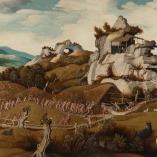
Detail from Views of Instructions for Bonsai along the Fifty-three Stations of the Tōkaidō, by Utagawa Yoshishige, 1848. The Metropolitan Museum of Art, Mary and James G. Wallach Foundation Gift.
“The tree is this living skin wrapped around a dead core,” says Robert Moor on this week’s episode of The World in Time. “You have this skin of living wood that’s being produced by the cambium, and it’s growing outward and inward simultaneously. Like a series of matryoshka dolls, each layer is encased within the next over time, which is why trees continue thickening. And that also leads to this mechanism of gnarling: trees lock their errors in place. If a tree takes a strange turn, it can’t straighten out its wood. There are ways in which our lives are like that as well. We can’t choose to fix our past mistakes. We have to learn to grow beyond the past rather than hoping to travel back in time to make it something different.”
This week on the podcast, Donovan Hohn speaks with journalist and essayist Robert Moor, author of In Trees: An Exploration, a follow-up and companion to Moor’s bestselling debut, On Trails, published in 2016. Their conversation—like Moor’s book—branches, and roots, and gnarls. We meet the neuroscientists researching the arborescence of the human brain, a tree-climbing expert in the Lake District of England, a renowned Japanese bonsai artist, a master Korowai woodsman living in a tree house in Papua New Guinea, and while considering the leafy, treetop nests of chimpanzees, Moor and Hohn explore the deep, distant evolutionary history of humanity’s relationship to trees.
WORKS CITED
(In order of mention.)
Robert Moor. In Trees: An Exploration. New York: Simon & Schuster, 2026.
Robert Moor. On Trails: An Exploration. New York: Simon & Schuster, 2017.
Michel de Montaigne. What Do I Know?: Essential Essays. Translated by David Coward and introduced by Yiyun Li. London: Pushkin Press Classics, 2025.
Peter Wohlleben. The Hidden Life of Trees: What They Feel, How They Communicate—Discoveries from a Secret World. Translated by Jane Billinghurst. Vancouver, BC: Greystone Books, 2016.
Richard Powers. The Overstory. New York: W.W. Norton & Company, 2019.
Suzanne Simard. Finding the Mother Tree: Discovering the Wisdom of the Forest. New York: Alfred A. Knopf, 2021.
Merlin Sheldrake. Entangled Life: How Fungi Make Our Worlds, Change Our Minds & Shape Our Futures. New York: Random House, 2021.
William Wordsworth. The Major Works: including The Prelude. Edited by Stephen Gill. Oxford: Oxford University Press, 2008.
Gilles Deleuze and Felix Guattari. A Thousand Plateaus: Capitalism and Schizophrenia. Translated by Brian Massumi. Minneapolis: University of Minnesota Press, 1987.
Michael Marder. The Philosopher’s Plant: An Intellectual Herbarium. Illustrated by Mathilde Roussel. New York: Columbia University Press, 2014.
Jared Farmer. Elderflora: A Modern History of Ancient Trees. New York: Basic Books, 2025.
Richard P. Feynman. “Surely You’re Joking, Mr. Feynman!”: Adventures of a Curious Character. Edited by Ralph Leighton and introduced by Bill Gates. New York: W.W. Norton & Company, 2018.
“2026 10th World Bonsai Convention.” Pavilion Bukit Jalil, Kuala Lumpur, August 28-31, 2026. World Bonsai Friendship Federation.
Italo Calvino. A Collection of Sand. Boston: Mariner Books, 2014.
Robert Moor. “The Beautiful, Brutal World of Bonsai,” The New Yorker, November 14, 2022.
Ralph Waldo Emerson. Essays and Lectures. New York: Library of America, 1983.
John Muir. The Wilderness World of John Muir: a selection from his collected work. Edited by Edwin Way Teale. Boston: Mariner Books, 2001.
Simon Schama. Landscape and Memory. New York: Vintage Books, 1996.
Richard Wrangham. The Goodness Paradox: The Strange Relationship Between Virtue and Violence in Human Evolution. New York: Vintage Books, 2019.
Bruce Chatwin. The Songlines. Introduced by Rory Stewart. New York: Penguin Classics, 2012.