The American historian Gordon S. Wood died at age 92 on June 7, 2026. In the foreword he wrote for Ted Widmer’s new book, The Living Declaration, from which this essay has been adapted, Wood reflected, one final time, on the Declaration of Independence, returning to a theme that he pursued throughout his career, across many books on the American Revolution: the primacy of creed over blood in America’s national story. That theme animates the conversation Wood recorded with Lewis H. Lapham about his 2018 dual biography of Thomas Jefferson and John Adams, Friends Divided. The July 3, 2026, episode of The World in Time includes audio from that conversation and is dedicated to Wood’s memory. Of Wood—his teacher, collaborator, and friend—Ted Widmer in a tribute published on the Library of America website recently wrote: “He was an Argonaut, as Jefferson phrased it, in a late letter to Adams, and his lifelong journey brought light to all of us.”
To be an American is not to be someone, but to believe in something. And the something that Americans most readily believe in can be found in the Declaration of Independence. By itself it makes the United States a nation.
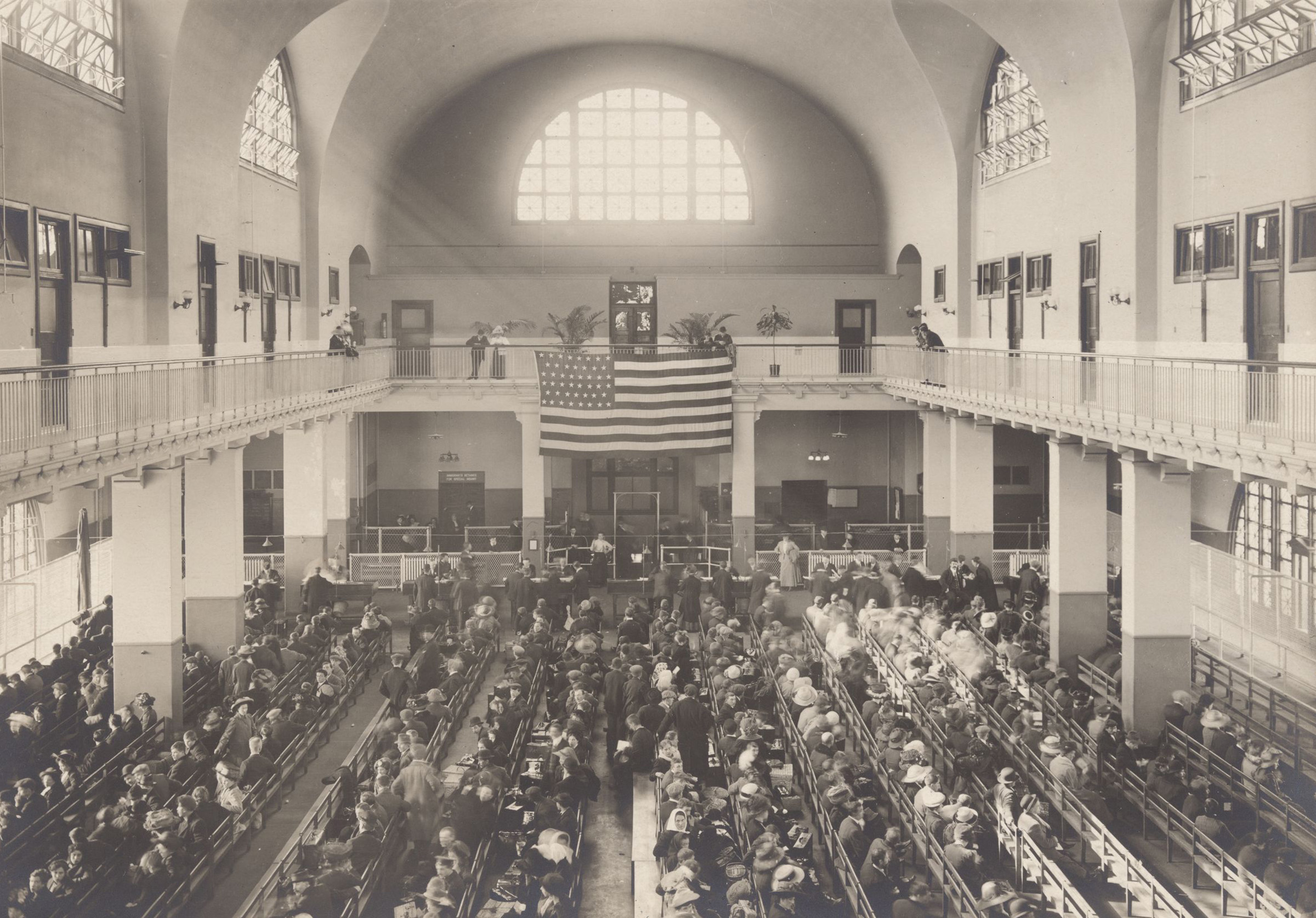
The U.S. has not been a nation in any traditional meaning of the term, that is, a political body composed of a people with common ancestry or cultural heritage. There is no American ethnicity that corresponds to the state called the United States, and there was no such distinctive ethnicity even in 1776 when the U.S. was created. Although the first sentence of the Declaration of Independence holds out the promise of Americans becoming “one people,” at the end of the text the members of the Continental Congress could only mutually pledge “to each other” their lives, their fortunes, and their sacred honor. There was nothing else but themselves they could dedicate themselves to—no patria, no fatherland, no nation as yet.
Even at the time of the founding America already had a diverse society. In addition to seven hundred thousand people of African descent and tens of thousands of native Indians, nearly all the peoples of Western Europe were represented in the country. In the census of 1790 only sixty percent of the white population of well over three million could claim English ancestry. The rest were composed of a variety of ethnicities—Germans, Scots, Irish, Scotch-Irish, Dutch, and several others.
For eighteenth-century enlightened reformers, ethnic diversity and multiculturalism were not good things. The revolutionary leaders’ idea of a modern nation, shared by enlightened British, French, and German eighteenth-century thinkers as well, was one that, as David Ramsay said, was composed of “a homogeneous people,” a society that was not broken up by differences of dialects, ethnicity, religion, and local customs.
Thus many of the revolutionary leaders were desperate to think of themselves as a homogeneous people. John Jay lived in New York, the most diverse city in the country, and was himself three-eighths French and five-eighths Dutch with no English ancestry whatsoever. Nevertheless, in Federalist No. 2 Jay had the nerve to declare that “Providence has been pleased to give this one connected country to one united people—a people descended from the same ancestors, speaking the same language, professing the same religion, attached to the same principles of government, and very similar in their manners and customs.”
Jay’s statement was based on hope, not reality. Many other revolutionary leaders had little of his confidence in America’s homogeneity and instead wondered whether America could ever be a real, honest-to-goodness nation. John Adams certainly had his doubts. In America, he said, there was nothing like “the patria of the Romans, the Fatherland of the Dutch, or the Patrie of the French.” All he could see was an appalling diversity of religious denominations and ethnicities. At one point he counted at least twenty different religious sects in the U.S. “We are such a Hotch potch of people,” he concluded, “such an omnium gatherum of English, Irish, German, Dutch, Swedes, French, etc. that it is difficult to give a name to the country, characteristic of the people.”
In the aftermath of the War of 1812, the rematch with Great Britain that some Americans called the second War of Independence, Secretary of the Treasury Albert Gallatin, himself a Swiss immigrant, thought that the people had become “more American; they feel and act more as a nation; and I hope that the permanency of the Union is thereby better secured.” The war had the effect of diminishing the country’s sense of being English. The war tied Englishness exclusively to a Federalist Party that was on its last legs and about to disappear.
Yet immigration from Europe continued, and the country was even more ethnically diverse and farther away than ever from being a traditional nation. Hezekiah Niles, the most important journalist of the early nineteenth century, saw the problem and offered a new solution to the establishing of “National Character” for Americans. Despite the victory over Britain in the War of 1812, Niles knew that eliminating the old English habits of mind would never be enough to make America a real nation. If we were to have a new nation, Niles declared in a public appeal in 1817 addressed to the two former Republican presidents Thomas Jefferson and James Madison, we needed new principles, new ideas, new ways of thinking. “We seek a new revolution,” he said, “not less important, perhaps, in its consequences than that of 1776—a revolution in letters; a shaking off of the fetters of the mind.” To do this, he said, “we should begin with the establishment of first principles,” principles that were close at hand in Jefferson’s Declaration of Independence. Thus, the Declaration, said Niles, “shall be the base of all the rest—the common reference in cases of doubt and difficulty.”
It was Abraham Lincoln who decisively developed Niles’s insight and argued for the unifying importance of the Revolution and the Founders to all Americans. When Lincoln declared in 1859 “all honor to Jefferson,” he paid homage to the Founder who he knew could explain why the U.S. was one nation, and why it should remain so. Half the American people, said Lincoln, had no direct blood connection to the revolutionaries of 1776. These German, Irish, French, and Scandinavian citizens either had come from Europe themselves or their ancestors had, and they had settled in America, “finding themselves our equals in all things.” Although these immigrants may have had no actual connection in blood with the revolutionary generation that could make them feel part of the rest of the nation, they had, said Lincoln, “that old Declaration of Independence” with its expression of the moral principle of equality to draw upon. This principle, which was “applicable to all men and all times,” made all these different peoples one with the Founders, “as though they were blood of the blood, and flesh of the flesh of the men who wrote that Declaration.” This emphasis on liberty and equality, Lincoln said, shifting images, was “the electric cord that links the hearts of patriotic and liberty-loving men together, that will link those patriotic hearts as long as the love of freedom exists in the minds of men throughout the world.”
In Jefferson’s Declaration Lincoln found a solution to the great problem of American identity: how the great variety of individuals in America with all their diverse ethnicities, races, and religions could be brought together into a single nation. As Lincoln grasped better than anyone ever has, the Revolution and its Declaration of Independence offered us a set of beliefs that through the generations has supplied a bond that holds together the most diverse nation that history has ever known.
Since now the whole world is in the U.S., nothing but the ideals coming out of the Revolution and their subsequent rich and contentious history can turn such an assortment of different individuals into the “one people” the Declaration says we are. That is why the Declaration of Independence is the most important document in American history.
Adapted from the foreword to The Living Declaration: A Biography of America’s Founding Text, by Ted Widmer. Copyright © 2026. Published by Library of America. Reprinted by permission of Library of America.