
In the spring of 1634, smallpox spread across southern New England. It began, reported William Bradford, governor of Plymouth, near a trading house. The afflicted, Bradford wrote, “died most miserably; for a sorer disease cannot befall them, they fear it more than the plague.” The characteristic symptom was the eruption of small lesions on the skin. Bradford observed that those who had the pox “have them in abundance; and for want of bedding and linen, and other helps, they fall into a lamentable condition, as they lie on their hard mats, the pox breaking and mattering, and running one into another; their skin cleaving (by reason thereof) to the mats they lie on.” He claimed that just by rolling over, a victim might lose all of the skin on one side of their body. “And then being very sore,” he added, “what with cold, and other distempers, they die like rotten sheep.”
Normally, Indigenous communities had individuals who stepped in to heal the ill. Europeans might have doubted the efficacy of Indigenous cures, taking them for heathen devotions to dark forces. But even in their skepticism colonists knew that members of a native town tended to rally around to cure someone who was sick. In 1634, the normal practices fractured. There were not enough healthy Indigenous people available to bring water to the sick, maintain fires, or bury the dead. Unable to gather new firewood, native peoples, Bradford wrote, would eventually “burn the wooden trays, and dishes they ate their meat in, and their very bows and arrows.”
Some were so weak they could not make it back to their houses after having crawled out to find water. Bradford claimed that the colonists, after getting over their initial fear, “seeing their woeful, and sad condition, and hearing their pitiful cries, and lamentations,” felt enough compassion that they brought firewood, food, and water, and buried the dead. Even still, a local sachem and almost everyone in the town died. “But by the marvelous goodness and providence of God,” Bradford wrote, employing the characteristic rhetoric of dissenters who believed in predestination, “not one of the English was so much as sick, or in the least measure tainted with this disease,” even though they visited the Indigenous daily.
During the 1630s, infectious diseases killed thousands in North America, territory that, with the notable exception of the epidemic in coastal New England from 1616 to 1619, had been spared the kinds of catastrophic epidemics of hemorrhagic fevers that had taken the lives of millions in New Spain the previous century. But no more. The increased volume of shipping across the Atlantic amplified the chances that contagious individuals might land in North America, enhancing the possibility of Old World diseases killing individuals whose bodies may have already been weakened by stress induced by physical displacement and relentless attacks on their culture and beliefs.
At the same time, the number of colonists increased dramatically, especially in territory claimed by the Massachusetts Bay Company. The opposite demographic profiles of shrinking native towns and growing immigrant communities contributed to rising tensions in eastern New England. The tensions erupted in the cataclysmic Anglo–Pequot War of 1637. Even after its bloody conclusion, anxieties continued. Authorities in English colonial towns believed they could solve some of their problems by expelling malefactors. Native leaders were more circumspect. Narragansetts who sided with the English to reduce the authority of the Pequots—the once-dominant population in modern southeastern New England—came to realize that relentless, westward-moving colonists would destroy them unless they found a way to keep their communities safe.
In September 1636, John Winthrop—governor of the Massachusetts Bay Colony, who just six years earlier had written his famous “city upon a hill” lay sermon, “A Model of Christian Charity”—wrote in his journal that the Narragansetts had made a truce with the Pequots, who had been telling the Narragansetts that the colonists planned to kill all natives. When the Narragansett headman, Canonicus, sent a message to the puritans that Pequots had killed some colonists at Saybrook (and possibly also on Block Island), Winthrop sent for the Narragansett sachem Miantonomi, who arrived in Roxbury around noon on October 21. Twenty armed guards escorted the headman to Boston, where the governor had already assembled most of the colony’s ministers and magistrates to help find a way forward to prevent further troubles.
After dinner that evening in Boston, Miantonomi tried to reassure the colonists of the Narragansetts’ loyalty. He claimed, Winthrop reported, that they “had always loved the English, and desired firm peace with us,” and that they stood ready to oppose the Pequots. The next morning the two sides signed an agreement, whose terms Winthrop summarized in his journal. The allies hoped to preserve trade and promised that neither would agree to terms with the Pequots unless the other approved. To minimize tensions, the Narragansetts agreed not to approach colonial settlements during time of war with the Pequots “without some Englishman or known Indian.” The natives also agreed to return runaway servants who had come to live with them.
Hopes for peace soon faded. In late January 1637, Winthrop wrote in his journal that Lion Gardiner of Saybrook, a military veteran who had traveled to New England in 1635 to help defend English settlements, had been out with nine armed colonists near the mouth of the Connecticut River when they came up on three Ninnimissinuok, who fled. The colonists gave chase—right into what Winthrop saw as an ambush by fifty natives. Soon enough, four of the English lay dead.
A month later, the churches in Massachusetts Bay participated in a general fast, a communal day of prayer to seek their god’s protection. Much was on their mind. The English in Massachusetts heard story after story of the persecution that dissenters kept experiencing at the hands of the Church of England. They worried too about a downturn in their own economic prospects. Colonists in Connecticut and Massachusetts faced dissension within their own congregations, in part because of intense religious debates relating to the doctrines of justification and sanctification. As Winthrop saw the situation, “it began to be as common here to distinguish between men, by being under a covenant of grace or a covenant of works, as in other countries between Protestants and Papists.”
Just as they feared divisions among their own relating to doctrine and practice, so the dissenters grew more nervous about their Indigenous neighbors. In March, Miantonomi, trying to retain positive relations, sent forty fathoms of wampum to the English. (A fathom was a string of shells about six feet long, which was worth nine to ten shillings in Massachusetts at the time.) The natives also sent the hand of a Pequot.
The colonists sent gifts back, presumably pleased to see that tensions divided one group of Ninnimissinuok from another. But the newcomers’ fear of the Pequots grew during the spring, with colonists convinced that the Indigenous could soon overwhelm their small towns. Stories of Pequot attacks on the English spread through the colonies. Plymouth and Massachusetts formed an alliance for their mutual protection.
In mid-May, Winthrop was reelected governor, in an election marked by “fierce speeches” and “great danger of tumult” due to doctrinal disputes. Rumors swirled within colonial towns about local natives blaming colonists for spreading disease among them. Colonists heard reports that the Pequots had sent away women and children “to an island for their safety.” Sensing rising danger, the puritans dispatched forty men to the Narragansetts. Miantonomi augmented that force with sixteen of his own men. Then the colonists decided to enlist another 160 men “to prosecute the war.” Soon afterward, armed English killed eight Pequots along the Connecticut River and captured seven women with the idea that they would trade them for two young English women whom the Pequots had recently taken.
In the autumn of 1637, a combined force from Massachusetts and Plymouth, along with Narragansett allies, set a Pequot town on the banks of the Mystic River on fire, consuming houses that contained women and children. By the time the fighting ceased, the English had killed or captured 400 to 700 of the Pequots and suffered only sixteen casualties.
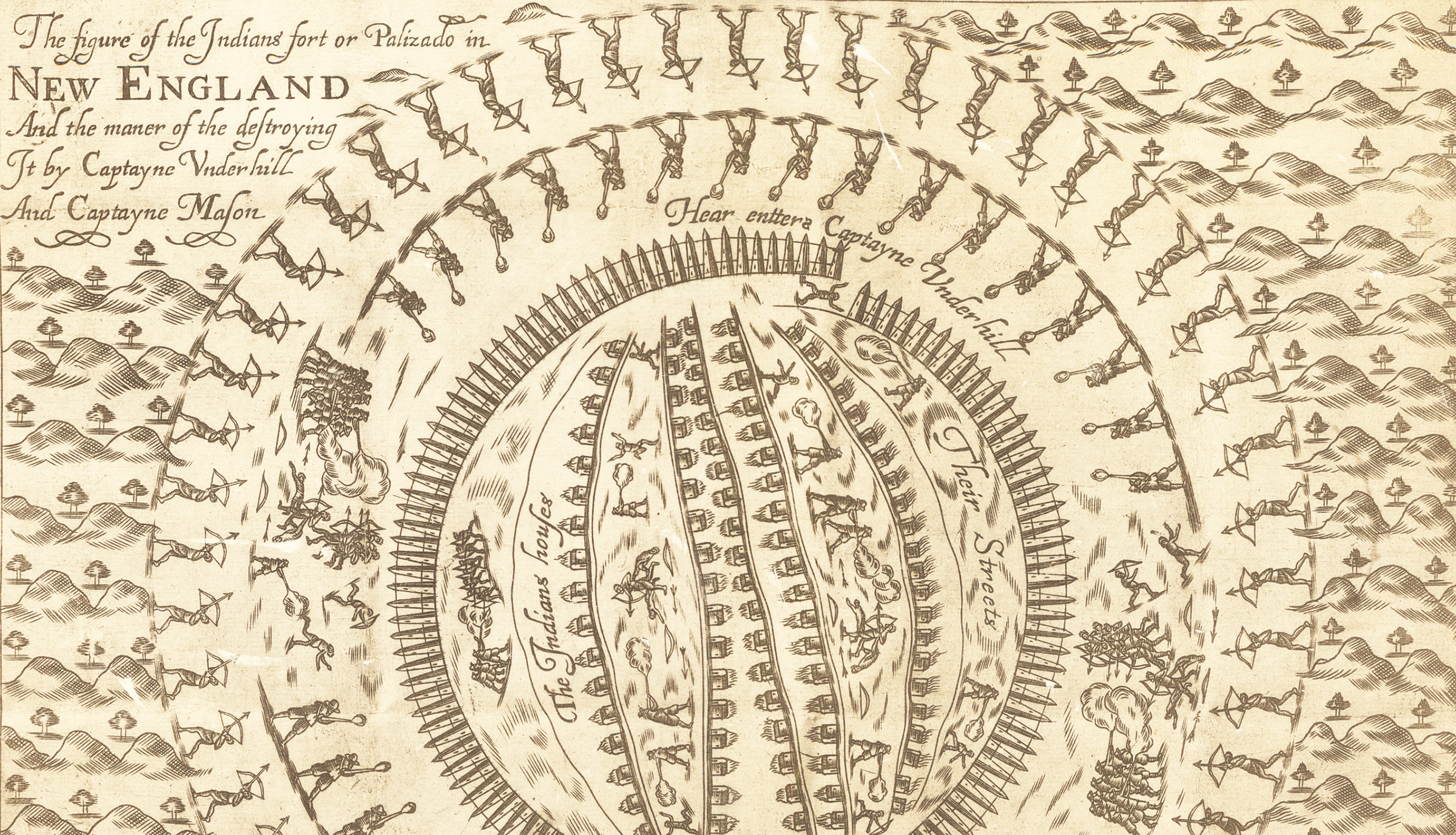
One English chronicler justified the slaughter of women and children who cried out for mercy by arguing that the colonists could not provide it since “some of the soldiers think the Devil was in” the Pequots. The raid’s military commander, John Underhill, knew that his tactics would elicit criticism. “Why should you be so furious (as some have said),” he asked, “should not Christians have more mercy and compassion?” He told them to consider David’s war, likely a reference to 1 Samuel 30, when an enemy’s arrogance and errant ways demanded “the most terriblest death that may be.” This death of innocents was unfortunate, but “sometimes the Scripture declareth women and children must perish with their parents.” The time had passed to challenge what had happened. “We had,” he concluded, “sufficient light from the word of God for our proceedings.” Underhill included a diagram depicting the assault on the Pequots living at Mystic. “The figure of the Indians fort or palisado in New England,” the caption read, “And the manner of the destroying it by Captain Underhill and Captain Mason.” The image depicted an orderly slaughter.
Underhill claimed that the colonists killed 1,500 Pequots in two months “so as their country is fully subdued and fallen into the hands of the English.” On June 15, Winthrop reported that the colonists had a “day of thanksgiving” in their churches to honor their victory over the Pequots. But the war was not yet over. Roger Williams heard a rumor that surviving Pequots would have attacked Narragansetts if they had the chance—a mist prevented them—and used the incident to warn Winthrop that colonial officials should treat any remaining Pequots “kindly” so they would not “turn wild Irish,” a reference to the longstanding resistance English invaders had encountered in Ireland. Rumors swirled from summer into autumn about alleged Pequot threats. Such fears motivated the murder in late June of twenty-two Pequot men by the colonist Israel Staughton and his men, though the soldiers spared two of the men and the eighty-one women and children with them.
In southern New England, colonial officials authorized the sale of Pequot captives into slavery—some to Providence Island in the Caribbean, where one local record referred to them as “the cannibal negroes brought from New England.” Two decades earlier some of the founders of New England had rebuked Thomas Hunt for his slave-trading activities, and stories of his heinous actions resonated within the Algonquian-speaking community and were passed down generation after generation. By the summer of 1637 colonial officials thought that the Pequots had surrendered any right to be free.
In his account, Bradford collapsed much of the violence of the war into the assault on the fort, which he described in brief but searing detail. “It was a fearful sight, to see them thus frying in the fire, and the streams of blood quenching the same,” he wrote, “and horrible was the stink and scent thereof, but the victory seemed a sweet sacrifice”—a line he borrowed from Leviticus—“and they gave the praise thereof to God, who had wrought so wonderfully for them; thus to enclose their enemies in their hands; and give them so speedy a victory over so proud and insulting an enemy.” Other dissenters and English observers joined the chorus, blaming prideful Pequots for bringing on their own destruction.
On the banks of the Mystic River, the dissenters enacted a ritual bloodletting echoing the unconventional tactics that colonial soldiers had unleashed against the Powhatans from 1622 to 1624. These colonists organized the assault on the Pequots because they perceived it was these natives, not the immigrants themselves, who were the trespassers, the people who threatened to undermine the colonists’ society, the violators of the sacred bonds that kept English communities together. Though migrants were still crossing the ocean, the dissenters did not see their colony as new or themselves as invaders. From this vantage point, the Pequots were the aggressors, and the puritans the noble warriors in defense of their godly republic.
The English present at the signing of the Treaty of Hartford, which brought a formal end to the Anglo–Pequot War on September 21, 1638, sought to broker a peace between the Narragansetts and the Mohegans within territory that the colonists believed was theirs. The treaty authorized these other natives to capture or decapitate Pequots known to have fought in the war, with the remainder to be absorbed by the two Indigenous nations. After the “Pequots shall be divided,” the treaty declared, they “shall no more be called Pequots but Narragansetts and Mohegans,” nor would the English allow them “to live in the country that was formerly theirs but is now the English’s by conquest,” which meant that the other native communities also could not “possess any part of the Pequot country without leave from the English.”
Such a statement of colonial authority had little meaning. Apart from those killed and sold into slavery, perhaps 2,000 Pequots survived. Some dispersed into Narragansett and Mohegan communities. Others remained in place, and at times became victims of aggressive colonial soldiers. Colonists in New Haven captured Nepaupuck and decapitated him, attaching his head to a pole on their town common. Many Pequots fled westward, perhaps seeking refuge among the Mohawks, though that proved disastrous when members of this easternmost of the Haudenosaunee (or Iroquois) confederacy attacked and killed refugees, at times sending their heads and hands to the English as a sign of their commitment to a possible alliance.
Narragansett sachem Miantonomi understood the threats that faced Indigenous communities. He had been a primary architect of the alliance between his people and colonists in the battle against the Pequots, and a beneficiary of the distribution of his foes’ land and bodies.
He knew that natives still outnumbered colonists—probably by a factor of ten around the shores of Narragansett Bay. Even still, within five years of the fatal assault along the Mystic River, he foresaw an existential crisis—and he went in search of allies for the next conflict.
In 1642, Miantonomi, likely trailed by colonial spies, traveled from one Indigenous town to another on Long Island, gathering commitments for a war he believed natives needed to launch. While there, he offered a radical vision of the circumstances that had led to this charged moment. To do so, he put aside tribal differences. “For so we are all Indians as the English are, and say brother to one another,” he declared to a group of Montauks that summer, expressing a new kind of ethnic consciousness, “so must we be one, as they are.” Circumstances had changed, he warned, and if natives did not join together “we shall all be gone shortly.” He based this assessment on the changes that he had seen in his own lifetime.
“Our fathers had plenty of deer and skins,” he continued, “our plains were full of deer, as also our woods, and of turkeys, and our coves full of fish and fowl. But these English having gotten our land, they with scythes cut down the grass, and with axes fell the trees; their cows and horses eat the grass, and their hogs spoil our clam banks.” The result of this trend was obvious: “We shall all be starved.” While the times were dire, he had not abandoned hope. The way forward was a new war. That idea motivated Miantonomi to tell the Montauks that they should “do as we, for we are all sachems from east to west, both Moquakes and Mohawks joining with us, and we are all resolved to fall upon them all, at one appointed day.”
From Contested Continent: The Struggle for North America, c. 1000–1680. Copyright © 2026 by Peter C. Mancall. Published by Oxford University Press, 2026. Reprinted by permission of the author and Oxford University Press.