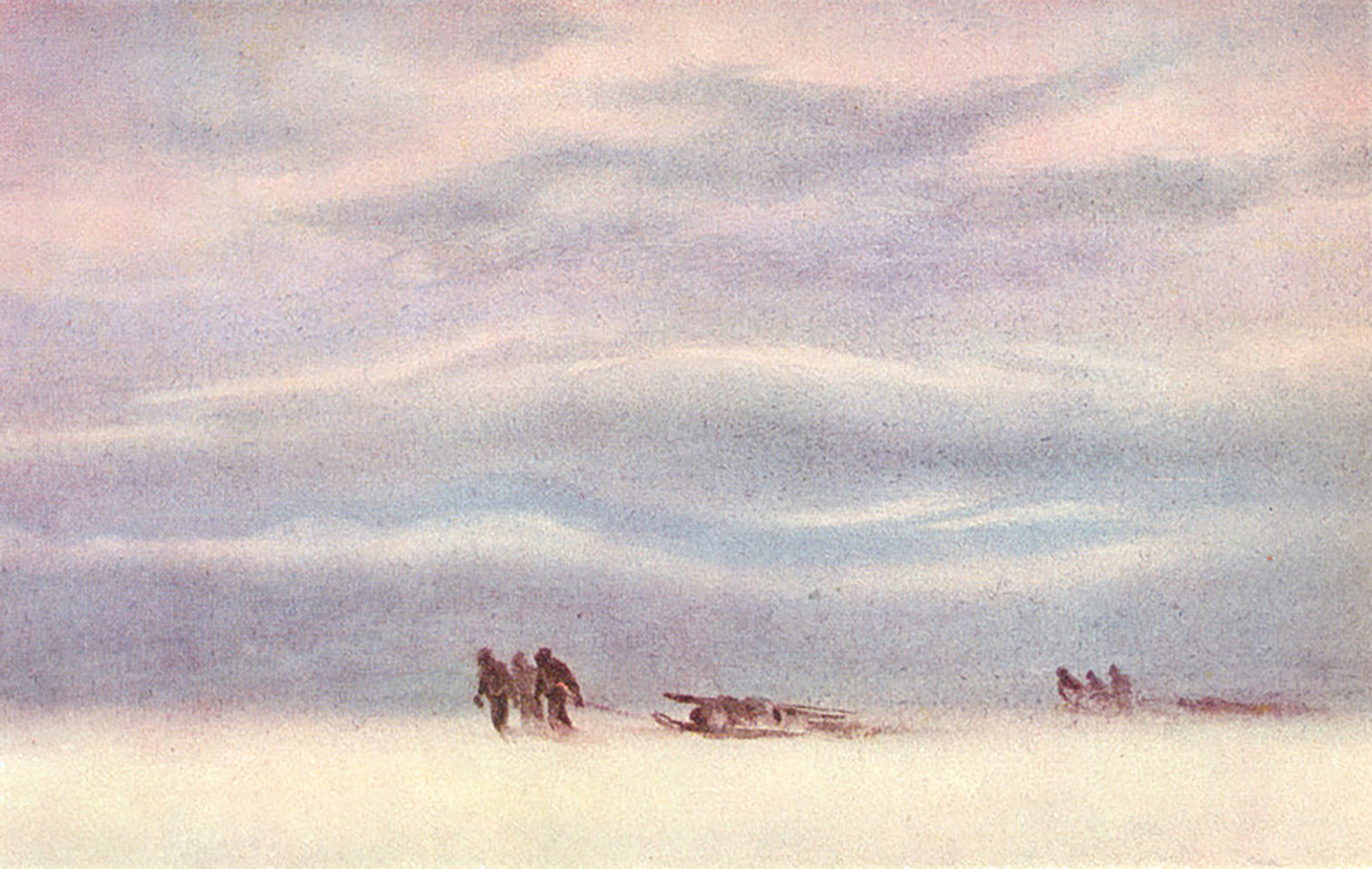
Sledging, by Dr. Edward A. Wilson, 1911, from The Voyages of Captain Scott, by Charles Turley, 1915. Project Gutenberg.
On February 8, 1902, the steam-powered barque Discovery anchored in McMurdo Sound, carrying Robert Falcon Scott’s first Antarctic expedition. Its cargo included guns, axes, saws, sledges, skis, compasses, chronometers, barometers, thermometers, microscopes, telescopes, magnetographs, theodolites, fireworks for signaling, explosives for blasting through ice, a windmill to generate electricity, a balloon for aerial surveys, a set of magic tricks, a collection of theatrical costumes, a piano, a harmonium, 36 cases of sherry, 5,000 pounds of marmalade, and more than 1,500 books, 48 of them by Sir Walter Scott. The Discovery also carried a single typewriter, a Remington No. 7, on which Ernest Shackleton, the third lieutenant in charge of holds, stores, provisions, and deep-sea water analysis, would perform an additional and perhaps even more vital duty, as the founding editor of Antarctica’s only magazine, The South Polar Times.
The South Polar Times is proof of something all editors know and all publishers deny: that the value of a periodical cannot be judged by the size of its circulation. There was only one copy of each of its twelve issues, to be shared (depending on the year) by between thirteen and forty-seven readers. It would come out monthly, but only in winter. The Antarctic sun set in April and did not rise again till August. Previous expeditions had learned that four months of darkness could make men despondent and mutinous. “I can think of nothing more disheartening, more destructive to human ambition, than this dense, unbroken blackness of the long polar night,” wrote the ship’s surgeon on the Belgian Antarctic Expedition of 1897–99, during which one man had died, two had gone insane, one had attempted to walk home to Belgium, and many had watched their hair turn gray. In the winter of 1899, a member of the British Southern Cross expedition to Antarctica wrote that “a gloom would envelop the mind in as thick a canopy as a London fog.”
Scott had no intention of permitting any such fog to envelop his own expedition, during which the Discovery spent two winters in Antarctica, frozen into the ice while awaiting the sledging seasons, when much of the scientific work would be undertaken and an attempt made on the South Pole. His antidotes were books, music, games, debates, and amateur theatricals (with some of the men in drag and others in false mustaches), along with strict social boundaries between the seamen, who dined on the mess deck, and the officers and scientists, who dined in a wood-paneled wardroom, on a table set with linen napery and china, after saying grace and before toasting the king: a scene that might have been even more impeccably Edwardian had their socks and underwear not dangled over their heads, drying on the stovepipes.
It was in that wardroom, on March 21, 1902, after cherry brandy and cigarettes, that the plans for Scott’s most ambitious diversion—an illustrated periodical—were unveiled. Albert Armitage, the Discovery’s navigator, recalled the discussion:
It was to be published on the 1st of each month; and every member of the ship’s company was invited to contribute towards making it the most amusing, instructive, up-to-date journal, with the largest circulation of any periodical within the Antarctic Circle. It was to combine all the best qualities of the penny and halfpenny London dailies, together with those of the superior comic papers, as well as of the fourpenny-halfpenny and half-crown monthly magazines. Notwithstanding this super-excellence, The South Polar Times was to be issued free to all the population of our small colony, the cost of production being more than covered by the grateful feeling of the recipients.
Shackleton, whose editorial credentials included co-authorship of a fifty-nine-page volume on a Boer War troopship and the frequently expressed conviction that Browning was a better poet than Tennyson, soon hung up a mahogany letter box, carved with a bas-relief of the sun disappearing beneath the horizon and the words
south polar times
discovery
1902
Potential contributors were instructed to drop their submissions—poems, humorous essays, and scientific articles, all on Antarctic themes—into the box, their identities concealed by noms de plume. “We agreed that the cloak of anonymity should encourage the indulgence of any shy vein of sentiment or humour that might exist among us,” wrote Scott, a demanding and sometimes moody leader whose own humor—more evident on paper than in person—was indulged by four pseudonyms: “Experto Crede” (Trust the Skilled), “Ignotus” (Unknown), “Glossopteris Flora” (an Antarctic fossil plant), and, when he composed the Monthly Acrostic, “Cross Stick.”
Unlike the wardroom, The South Polar Times was open to both officers and, as Scott referred to them, “the humbler members of our community who dwelt before the mast.” Armitage wrote:
On most days during the first month of the winter the clicking of the typewriter could be heard in Shackleton’s cabin as he busily “set up” the paper; and frequently a shy and conscious-looking blue-jacket [seaman] would enter the editor’s sanctum to ask that worthy man’s advice.
Shackleton was so beleaguered by would-be men of letters that he relocated the editorial office from his cabin to a storeroom in one of the holds, installed his typewriter on a packing case, and attached a rope to the door so that if he wished to work undisturbed, he could yank it shut from his seat (another packing case).
Shackleton’s magazine represented the convergence of several lines of journalistic influence. Winter periodicals had been a staple of British Arctic expeditions since 1819, when William Parry, on his search for the Northwest Passage, established the North Georgia Gazette and Winter Chronicle, a shipboard newspaper that published the work of “The Sportsman and the Essayist, the Philosopher and the Wit, the Poet and the Plain Matter-of-fact Man.” (Non-Brits tended to scoff at expedition periodicals. The Icelandic-American explorer Vilhjalmur Stefansson called them “busywork newspapers” and said they made men soft.) The SPT, as the expedition members called it, also owed a conspicuous debt to popular satirical magazines such as Punch, of which the Discovery library had thirty-five volumes. But what the SPT most resembled, the Antarctic historian Roland Huntford has pointed out, was a school magazine. The travel accounts, science articles, nature odes, verse parodies, and self-deprecatingly humorous essays of the Alleynian—the magazine of Dulwich College, which Shackleton attended until he left for the mercantile marine at sixteen—are deeply SPT-ish, except that the Dulwich boys tried to sound like men, whereas the Discovery men often tried to sound like boys.
April 23, 1902, was “a notable day,” according to Armitage, “for it marked the disappearance of the sun, a total eclipse of the moon, and the début of The South Polar Times.” (In his introductory note, Shackleton wrote that “as we can expect no light from without, we look for light from within.”) The first issue was presented to Scott at dinner in the wardroom, and a bottle of brandy uncorked so the officers could drink to the magazine’s success. Shackleton, a man infrequently given to exclamation points, recorded in his diary that the fruits of his labors were “greatly praised!”
In fact, The South Polar Times was the object of such keen interest that what Scott called “a rather delicate situation” arose: the mahogany box overflowed with more manuscripts than the magazine could accommodate, thus leading to the “danger of wounding the feelings of those literary aspirants whose contributions were rejected.” Shackleton’s politic solution was a supplementary journal called The Blizzard. Unlike the first-string South Polar Times, which appeared with hand-painted illustrations in a meticulously typed edition of one, The Blizzard was printed, in an extravagant run of fifty, on an Edison mimeograph. But the competition was too stiff. The Blizzard, universally recognized as the inferior publication, folded after a single issue.
Shackleton edited four more issues of The South Polar Times, which were passed hand to hand both in the wardroom and on the mess deck. Scott recalled:
I can see again a row of heads bent over a fresh monthly number to scan the latest efforts of our artists, and I can hear the hearty laughter at the sallies of our humorists and the general chaff when some sly allusion found its way home. Memory recalls also the proud author expectant of the turn of the page that should reveal his work and the shy author desirous that his pages should be turned quickly.
In late 1902, while The South Polar Times was on its summer hiatus, Scott, Shackleton, and Edward Wilson, the assistant ship’s surgeon as well as the magazine’s chief illustrator, left on a 960-mile sledging journey that took them within 410 miles of the South Pole—the farthest south any man had yet traveled.
They all developed scurvy. Shackleton’s case was the most serious, and, after he returned to the Discovery coughing blood, he was invalided home, against his wishes, on a relief ship. (He recovered sufficiently to lead three Antarctic parties himself, including the Endurance expedition, a series of heroically averted disasters that culminated in an 800-mile voyage across the South Atlantic in a lifeboat.)
The winter after Shackleton’s departure, the members of the Discovery expedition elected Louis Bernacchi, a Tasmanian physicist, the second editor of The South Polar Times. During his three-issue tenure, Bernacchi’s most valuable contributions to the magazine were recognizing that Shackleton had found a winning formula and having the good sense not to mess with it.
Scott returned to Antarctica on the Terra Nova in 1911 to attempt the South Pole one more time. The South Polar Times was revived for four issues during the winters of 1911 and 1912, under the editorship of Apsley Cherry-Garrard, the assistant zoologist, a nearsighted twenty-four-year-old aristocrat whose chief qualifications for the job were five years of translating Greek and Latin at Winchester and a cousin who edited Cornhill Magazine. As soon as Scott accepted Cherry-Garrard on the expedition, he gave the new editor his first assignment: learn to type.
I first heard about The South Polar Times when I was in college, half a century ago. I had been interested in polar exploration—first Arctic, then Antarctic—since my early teens, and Scott, Shackleton, and Cherry-Garrard were already familiar names, indeed objects of near-fangirl devotion. My junior year, I read a few paragraphs in an Antarctic biography about a periodical published on Scott’s expeditions. My ears pricked up so energetically—Twilight of an empire! Journalistic history! Polar heroes as editors!—that I briefly considered it as a topic for my senior thesis.
I didn’t write the thesis, but I started collecting books on the Arctic and Antarctic. They eventually filled several shelves. Now and then I thought about The South Polar Times. I’d never seen it; hardly anyone had. The originals are divided among three institutions in London and Cambridge. Two hundred and fifty copies of the Shackleton and Bernacchi issues were published in 1907, and 300 copies of the Cherry-Garrard issues (aside from his last one) in 1914. A combined set of 350 copies trickled out in 2002, followed by 500 copies of the SPT’s final issue in 2011.
In 2012, to celebrate the centenary of Scott’s death, all twelve issues were reprinted by London’s Folio Society in a facsimile edition of one thousand: a veritable Niagara. The Folio Society publishes things like Brave New World bound in aluminum foil and Lost Illusions bound in crushed silk. When the edition of The South Polar Times was announced, a member of an online forum wrote, “Oooooooh fudge. I bet this is going to be hideously expensive.” It was: £495 in England, $945 in the United States. Apparently, there were lots of people—or, at least, a thousand of them—who were interested in the same things I was interested in. They were, however, richer.
It occurred to me that this was one of the few times in my life when being a writer could be a means to an unaffordable end. (The first time was when I won a pair of Norwegian cross-country skis in an Eastern Mountain Sports contest by writing a paragraph about skiing down Park Avenue to a cocktail party in the Blizzard of 1978.) I’d write a review!
When the review copy arrived, I washed my hands before I opened the parcel, having never had a book in my house that cost as much as a used Volkswagen. Past editions of the SPT had lumped an entire year’s output into a single beefy volume. This was the first time that each of the twelve issues had been printed separately, so that when you turned the acid-free pages (perhaps, for verisimilitude, after crawling into your freezer with a paraffin lamp), you could approximate the experience of reading it hot off the typewriter.
I read the twelve issues over the course of a sweltering Massachusetts summer, trying to make them last as long as possible. At one point, I had a minor bloody nose and narrowly missed desecrating the pages. I usually fill my books with underlinings and marginalia, but if even a millidrop of blood—or ink—had fallen on the editorial work of Ernest Shackleton and Apsley Cherry-Garrard, I would have felt I’d spilled a Big Gulp in the nave of Notre-Dame.
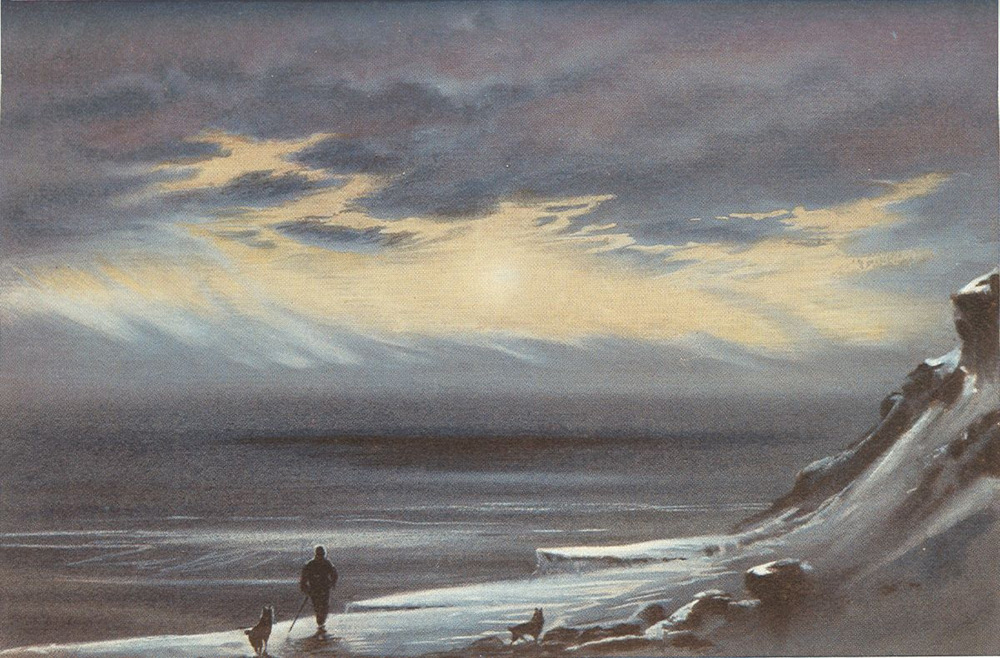
I’d known that The South Polar Times was illustrated, but I had no idea how irresistibly. The title page of the very first issue depicted a mock coat of arms whose escutcheon was flanked by two emperor penguins; backed by a sledge and skis; and surmounted by a tasseled balaclava on which a MacCormick’s skua perched, its wings outspread as if it were about to fly off the page: a little watercolor masterpiece of Edwardian humor that was both ornithologically unimpeachable and sublimely silly. Like most of the illustrations in the SPT, it was the work of Edward Wilson, the Discovery’s assistant surgeon, vertebrate zoologist, and expedition artist. (Before photography, artists routinely accompanied British expeditions in order to bring back visual records of landscapes, plants, and animals from faraway places and satisfy the thirst for geographic novelty that, along with the tentacles of Empire, made a small island nation feel far bigger than it was.)
It did not take long to dawn on me that although the SPT’s celebrated editors may have been the periodical’s brain, Wilson was its soul. His years in Antarctica on Scott’s expeditions represented the convergence of everything he most valued: art, birds, and God. He started drawing before he was three and decided to become a naturalist when he was nine. He collected shells, fossils, and birds’ eggs, never taking more than a single egg from a clutch of four. (He later wrote, “I can’t explain to anyone how one can so get to love a bird as to kiss every egg in its nest and to pray for them.”) He was a stringently ascetic Christian who confessed to his wife, a vicar’s daughter named Oriana, that he preferred bathing in hot water, “and something must be done to stop it.” Heading to Antarctica was an effective if labor-intensive way to guarantee plenty of cold water. From the Discovery, he wrote Oriana, “God means us to find out all we can of his works...and if it is right to search out his works in one corner of his Creation, it is right for some of us to go to the ends of the earth to search out others.” (In his view, God’s works included evolution, and once, in a tent on a sledging trip, he read aloud to Scott from The Origin of Species.) As a physician, he checked expedition members for signs of scurvy, treated frostbite and hypothermia, and bathed the injured. Uncle Bill, as he came to be called, was the man everyone leaned on. He frequently offered to finish the night watches of the other officers and scientists; he served as confidant and mediator; he soothed Scott’s dark moods. Cherry-Garrard wrote, “If you knew him you could not like him; you simply had to love him.”
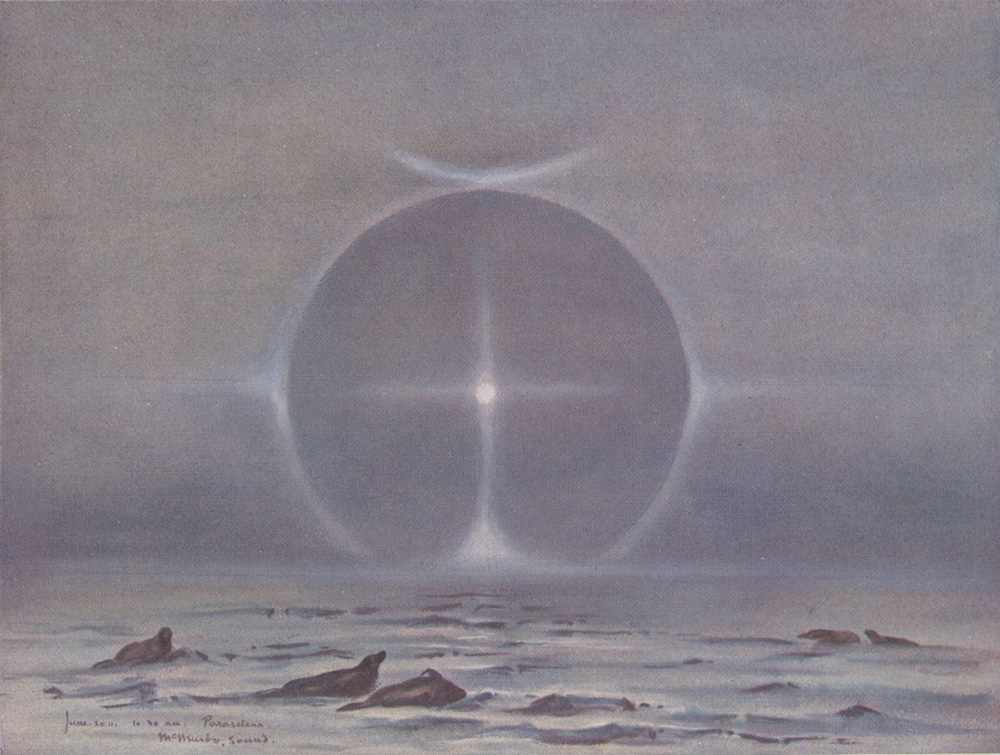
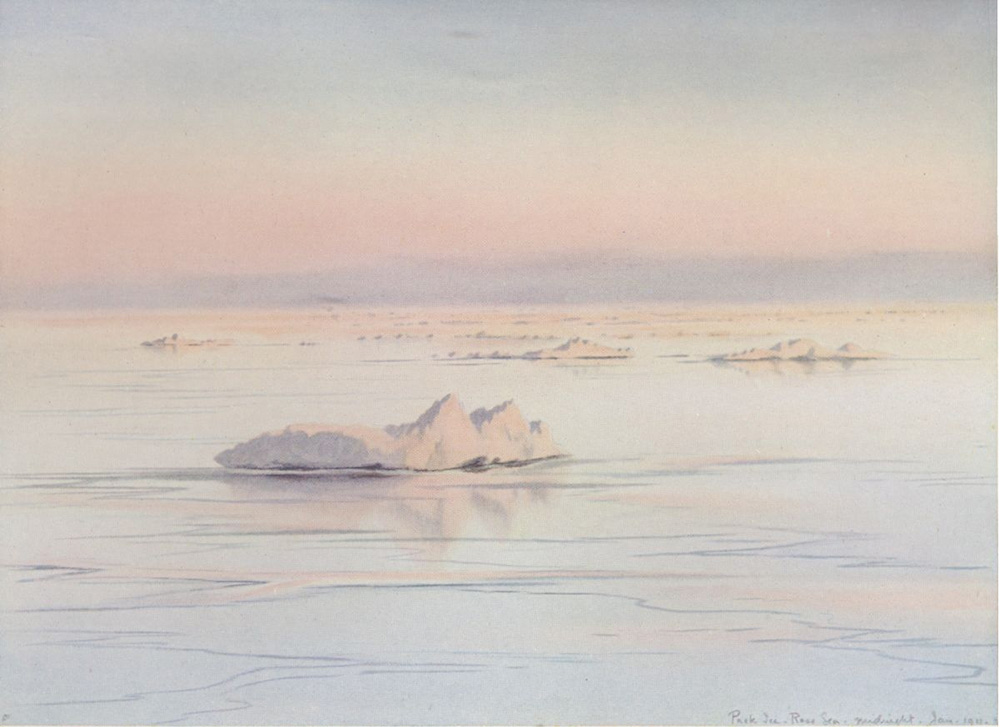
The polar heroes of my youth had thrilled me; Edward Wilson moved me, not least because of how seriously he took his scientific duties. “He is called to see and sketch the sunrise,” Scott wrote to the president of the Royal Geographical Society. “He is on the spot when a new bird is seen. The next moment he is at a microscope sketching.” On the Terra Nova’s outward voyage, he completed his contributions, both literary and artistic, to a two-volume report on British grouse disease (after nearly two thousand dissections, he discovered that the culprit was a parasitic threadworm) and was keenly looking forward to seeing the finished book on his return. In Antarctica, he drew auroras and ice crystals, algae cells and chitons, jellyfish and seal intestines. Some of Wilson’s scientific drawings appeared in the SPT. He also contributed maps; Turneresque landscapes; comic vignettes of expedition life in the form of faux Egyptian tablets; and paintings of the officers’ sledging flags, swallowtail pennants with heraldic insignia and mottos in English, French, Latin, Maori, and Hindustani. The motto on his own sledging flag—sewn by Oriana—was Res non verba (Deeds, not words).
Wilson’s finest illustrations were his portraits of birds, which he called “attempts to praise God.” He painted his share of petrels, skuas, and albatrosses, but he was especially fond of penguins. (So were the members of most British expeditions. The Scottish National Antarctic Expedition serenaded them with bagpipes, the Nimrod expedition with a gramophone. Scott’s men sang them “God Save the King.” Antarctica had no natives to civilize, but at least one could attempt to convert the penguins into loyal colonial subjects.) He attempted to raise an emperor penguin chick in his Discovery cabin, rising at 1:00 and 5:00 am to feed it prechewed seal meat. Wilson’s penguins frolic through the pages of The South Polar Times, waddling, preening, swimming, incubating eggs, brooding chicks, and, in one case—decades before it became a cliché—wearing evening dress, complete with black tailcoat, white waistcoat, poke collar, and white bow tie. He sketched them en plein air because, although he was a trained taxidermist, he preferred live models. (“Dreadful stuffed birds!” he once wrote Oriana. “No one would think of painting preserved flowers—why on earth do they paint preserved birds?”) In temperatures below –30 degrees Fahrenheit, his eyes inflamed by snow-blindness, he ungloved his hands for a few minutes at a stretch to draw with a soft pencil, making shorthand notes on the colors he planned to add when he came in from the cold. (“Pr. b.” was Prussian blue.)
Although the pictures were my favorite part, The South Polar Times had plenty of words, too, many of them in verse, contributed by men from both the higher and lower ends of the expedition hierarchy. The serious poetry was god-awful (“Her crew are Britons to a man, her name Discovery, / That England still shall set the pace as Mistress of the Sea”). But the light verse—“The Ballad of the Seal & the Whale,” “To a Reversible Thermometer,” “The Lay of the Blubber Lamp”—displayed a close acquaintance with the work of Lewis Carroll and Edward Lear, not to mention a sound background in metrical forms and a dandy sense of humor. A parody of Longfellow’s “Song of Hiawatha” presented two schools of thought on the proper use of a reindeer-hide sleeping bag:
on the outside grows the furside, on the inside grows the skinside;
So the furside is the outside, and the skinside is the inside…
One side likes the skinside inside, and the furside on the outside.
Others like the skinside outside, and the furside on the inside;
As the skinside is the hard side, and the furside is the soft side.
More than one SPT contributor even tried his hand at playwriting. In “When One Goes Forth a Voyaging, He Has a Tale to Tell,” two former members of the Discovery expedition, Hero No. I and Hero No. II, arrive for tea at the swanky London home of the de Pip family. Hearing from their mother that the heroes have returned from “nearly three years of most terrible sufferings and privations,” the daughters exclaim, “Oh, how interesting! How dreadful! How very brave of them!” Excitement turns to disappointment when the de Pips learn that the expedition was directed not toward the North Pole but toward the South Pole, which they assume is “quite a warm spot,” and that the Heroes encountered neither unfriendly natives nor ferocious polar bears. Another guest, Mr. Nincompoop Poodlefaker, writes off Antarctica entirely: “Haw! No golf links and no Opera there, Eh? No place for me! Not much! Don’t you know!”
The SPT also featured Scott’s acrostics, none of which I could solve; knowledgeable disquisitions on Antarctic geology, ornithology, and marine biology; Meteorological Notes; Events of the Month (“April 23. First number of ‘South Polar Times’ issued.” “May 2nd. Heavy gale.” “May 5th. Dr Koettlitz discovers bacteria in a seal’s intestines”); and Editor’s Notes, which covered such topics as conversation in the Discovery wardroom:
The following subjects have been thoroughly sifted during the past month at the dinner table of the British National Antarctic Expedition:
The capability of Peacocks to stand an English winter.
The cultivation of Tea and Indiarubber.
The advisability of saying “Good morning” at breakfast.
Glacier action in Antarctic Regions.
Crinolines, and the chance of their revival.
The word “fact” as a synonym for “probability.”
Schopenhauer’s views on Womanhood.
Terra-cotta Tablets and Lime-juice nodules.
The bottom of a tumbler.
The treatment of absurd statements by “smuggindifference.”
The influence of Poetry on certain people,
and
The braying of an ass.
Above my desk hang two xeroxed tokens of Antarctica. One is Edward Wilson’s painting of The South Polar Times letter box. The other is a photograph of Apsley Cherry-Garrard in the Terra Nova expedition’s hut at Cape Evans. Cherry-Garrard sits at a table in a woolen sweater, typing out an issue of the SPT on an Underwood No. 5. A photograph! One of the differences between Scott’s two Antarctic expeditions is that on the second, he brought a photographer, Herbert Ponting, who set up a darkroom with a lead-lined sink for developing glass plates. Cherry-Garrard’s four issues of the SPT were illustrated not only with watercolors by Wilson, who was now chief scientist (as well as expedition artist), but with photographs of emperor penguins, a Weddell seal, an iceberg, and a sled dog. No photos of human subjects made it into the magazine, though in a song called “Pont, Ponco, Pont,” the SPT introduced the verb to pont: expedition slang for “to be forced to pose in an uncomfortable position.”
Cherry-Garrard was an assiduous editor who both solicited anonymous contributions and commissioned pieces, on which he sometimes requested revisions. His first issue debuted on June 22, 1911: Midwinter Day, the deepest point of the polar night, a traditional holiday on polar expeditions. After tea, he presented the magazine—fifty pages of typescript, bound between sealskin-edged plywood covers—to Scott, who read most of it aloud to the assembled men, whereupon they tried to guess who had written what. “I fear no one thought I had done ‘Valhalla,’” recalled Thomas Griffith Taylor, the expedition’s senior geologist, “which is a mixed pleasure—for all seem to enjoy it; while Nelson put down the ‘Protoplasmic Cycle’ to Debenham, though he actually read the verse in the Pack in my diary!”
The celebration continued with a festive dinner served beneath a polychrome array of Union Jacks and sledging flags. The menu, illustrated by Wilson with a watercolor of the hut—smoke rising cozily from the chimney, Mount Erebus in the background—was published in the next issue of The South Polar Times:
consomme • seal
roast beef & yorkshire pudding
horse radish sauce
potatoes a la mode & brussels sprouts
plum pudding • mince pies
caviare antarctic
crystallised fruits • chocolate bonbons
butter bonbons • walnut toffee
almonds & raisins
wines
sherry • champagne • brandy punch • liquer
cigars • cigarettes & tobacco
snapdragon
pine-apple custard • raspberry jellies
buszard’s cake
•
god save the king
•
After dinner, a ski-pole-and-skua-feather Christmas tree was carried in. There were toasts; there was singing; there was dancing. After midnight, several of the revelers pulled on their warmest clothes and went outside to watch the Aurora Australis—first green, then yellow—streaming in curtains and billows above the Barne Glacier.
It is easy to mock the Englishmen who ate those mince pies and plum pudding. When you read The South Polar Times, Scott’s twenty-five-by-fifty-foot hut at Cape Evans—with its series of “Universitas Antarctica” evening lectures (on geology, parasitology, Mendelian genetics); its good-natured razzing (girls’ nicknames, Latin jokes, gibes about snoring and bunk decor); and its well-defined strata (officers and scientists at one end, “men” at the other, bulkhead of crates in the middle) sometimes sounds like a cross between Toad Hall and a British public school dormitory. But the social machinery worked. Along with the music and the games and the books, the SPT dispelled the winter gloom, just as Scott had planned. As the wardroom/mess-deck distinctions on the Discovery had promoted what Bernacchi called “an atmosphere of civilized tolerance,” so the hut’s code of gentility and wit permitted its tenants to behave as if they were having a ripping time on their hols instead of waiting for sledging journeys that might kill them.
Five days after their first issue appeared, Apsley Cherry-Garrard and Edward Wilson, along with Lieutenant Henry “Birdie” Bowers, left on one of those journeys, marching through the darkness in temperatures as low as –77 degrees Fahrenheit on an expedition to collect the eggs of emperor penguins—a special interest of Wilson’s—whose embryos were (erroneously) thought to represent a crucial evolutionary link between birds and reptiles. The men’s clothing froze into armor; their teeth cracked and shattered; the fluid inside their frostbite blisters turned to ice. In The Worst Journey in the World, Cherry-Garrard’s 1922 account, their ordeal sounds like hell. But in the SPT, Bowers leavened the worst part of that worst journey—the hurricane that blew away both their tent and the canvas roof of their stone igloo, leaving Cherry-Garrard certain they would all die—into a four-page pastiche of “This Is the House That Jack Built” that included these lines:
this is the Debris of Stones and Sledge,
(and Tent half a mile down the Ridge’s edge),
With parts of the cooker, and gloves and socks,
A muddle of sleeping bags, men and rocks,
Primuses, oil-cans, penguin skins,
Eggs and pemmican, biscuit tins,
The box scientific (Bill’s treasure trove),
And all that remained of the Blubber Stove
Which collapsed like the Tent and the Igloo lone,
And ended for ever “The Age of Stone.”
“The House That Cherry Built” was accompanied by a Wilson watercolor of three men in sleeping bags, as snug as swaddled babies tucked into a single crib.
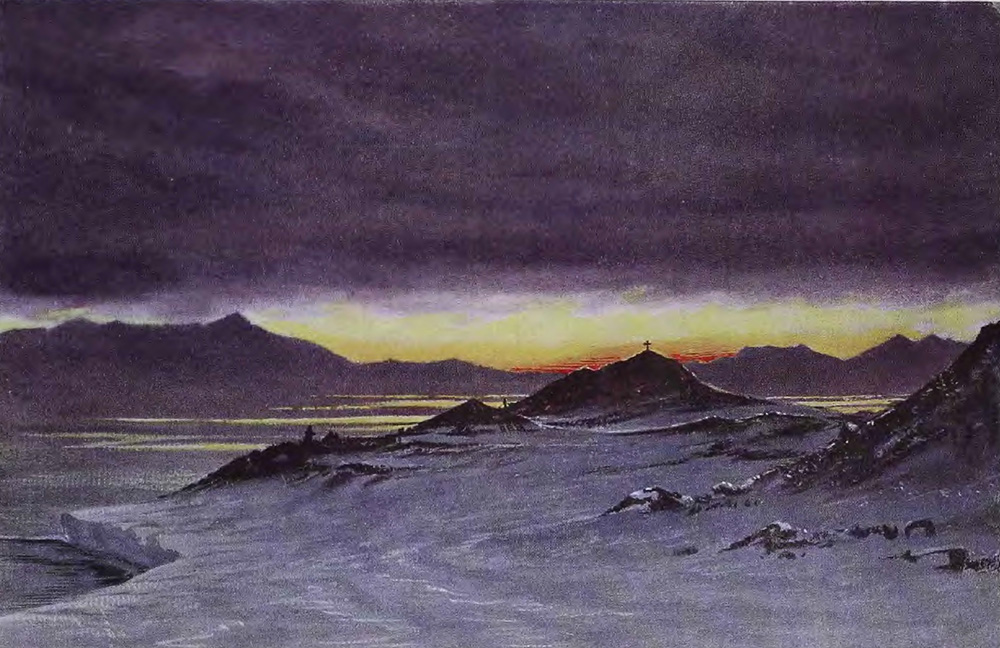
Four months later, Scott, Wilson, and Bowers, along with Lawrence Oates and Edgar Evans, sledged 898 miles to the South Pole, only to find that the Norwegian explorer Roald Amundsen—whose party had better clothing, better equipment, better food, and better weather—had beaten them there by thirty-four days. Amundsen’s men had spent the winter in a hut, too, 420 miles east of Cape Evans, but they were too busy making their dog whips and remaking their boots and planing their sledge runners to do much talking or publish a magazine. Amundsen’s party of taciturn pragmatists survived. Res non verba.
On the way back from the South Pole, Evans died after a fall on the Beardmore Glacier. Oates, whose frostbitten feet were delaying the march, died after stumbling out of the tent in a blizzard and, famously, telling his companions, “I am just going outside and may be some time.” Scott, Wilson, and Bowers died of starvation, scurvy, and hypothermia when they were less than thirteen miles from the supply depot—2,181 pounds of food, fuel, and equipment cached the previous year—that would have saved them.
Cherry-Garrard and a skeleton crew of twelve were waiting at the Cape Evans hut. When Scott’s party failed to return, they knew all five men must be dead. The only way to make it through the winter of 1912 was to pretend they didn’t know. As Frank Debenham, one of the expedition’s geologists, later explained, “It has been tacitly accepted that the tragedy of the autumn must not intrude itself upon us, and consequently we are able to throw it off at times and behave as if it were not intruding.” Cherry-Garrard put out one last issue of The South Polar Times. It made not a single mention of the elephant in the room. There were no illustrations by Wilson, of course, but Debenham, whistling in the dark, contributed a series of pen-and-ink sketches of penguins playing rugby.
The following spring, a search party was able to set out from Cape Evans. At latitude 79°40’S, they found Scott’s cambric tent buried in snow. Cherry-Garrard called what he saw inside “too bad for words.” On the left lay the frozen body of Wilson; on the right, Bowers: his two companions on the Worst Journey in the World, the illustrator and author of “The House That Cherry Built,” the men he would later describe as “gold, pure, shining, unalloyed.” In the middle lay Scott, his left arm stretched over Wilson. Cherry-Garrard also found the copy of Tennyson’s In Memoriam, bound in green leather, that he had lent to Wilson. Wilson had read and reread it on the way to the South Pole and written in his diary that if he died, he hoped “Ory’s faith and hope and trust will be to her what Tennyson’s was to him.”
Each of the men had left farewell letters—Bowers one, Wilson several, Scott many. Bowers told his mother, “I should so like to come through for your dear sake. It is splendid to pass however with such companions as I have...” Scott asked his wife to send the king a piece of the Union Jack he’d planted at the South Pole and urged her to “take the whole thing very sensibly as I’m sure you will.” Wilson told Oriana that “all is for the best to those who love God—and oh my Ory we have both loved Him with our whole lives—all is well.” And he told his friend and publisher Reginald Smith that he would have liked to see the grouse book.
Cherry-Garrard returned to England in the spring of 1913. He allowed his other South Polar Times issues to be published, but he kept the last one to himself. It was not made public for nearly a century. The official word is that it was withheld because its quality was inferior, and that is certainly true. But I can’t help wondering if Cherry-Garrard was embarrassed that while his friends were suffering and dying on the Great Ice Barrier, he was sitting at his Underwood No. 5, typing up a quatrain about blizzards in the style of Walt Whitman. Of course, that is exactly what Scott would have wanted him to do.
Adapted from Frog and Other Essays. Copyright © 2026 by Anne Fadiman. Published with permission of the author and Farrar, Straus and Giroux. This essay originally appeared, in a somewhat different form, in Harvard Review, No. 43, 2012.