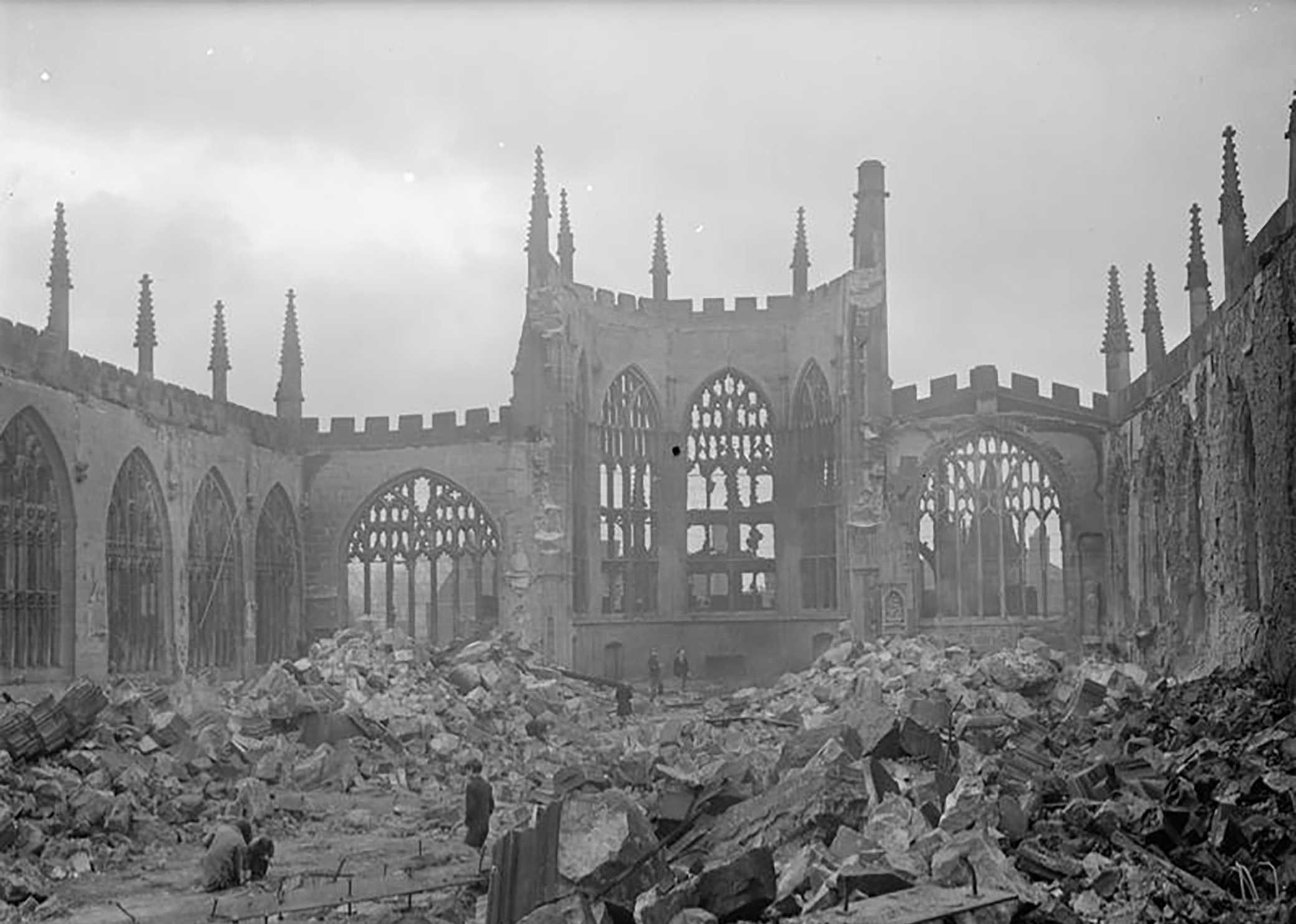
“Air Raid Damage in Coventry,” 1940. Photograph by Ernest Taylor. Imperial War Museums.
Adapted from Time’s Echo: Music, Memory, and the Second World War, from Knopf Doubleday, August 2023.
Tensions were already running high in the wood-paneled rooms of Bletchley Park estate, the elite British code-breaking operation, when technicians intercepted a curious transmission from the German Luftwaffe. The encrypted communiqué, sent from occupied France at 2:00 p.m. on November 9, 1940, appeared to speak of a “Moonlight Sonata,” yet it was clear the senders were not sharing opinions on Beethoven. There was in fact talk of an “operation” involving “Target Areas” and “Air fleets.” The cryptanalysts grasped that an air raid was under discussion, but the question of precisely when and where eluded them.
The name of the operation itself held a critical clue, at least to the timing of the raid. On Thursday, November 14, the moon was indeed full over the city of Coventry. This West Midlands industrial hub was home to many munitions factories densely crowded around the medieval city center, and residents had already become grimly accustomed to the rituals of wartime life, with nightly blackout restrictions and sirens routinely sending them scrambling for air raid shelters. From the outset, the vulnerability of the city’s crown jewel, its medieval cathedral dedicated to Saint Michael, had been a grave concern. Built in a perpendicular style, the cathedral’s tower and spire stood some ninety meters high above a vast flat wooden roof coated with lead. After occasional bombing raids of a smaller scale had started up that summer, concerned parties had considered painting the German word for church—KIRCHE—on the roof in enormous letters, but the idea was ultimately abandoned as unlikely to deter attacks.
The frost on that roof was sparkling in the moonlight on November 14, when at 6:30 p.m. air raid sirens pierced the quiet. Within minutes, 509 German bombers had converged above Coventry and commenced an attack of a concentrated ferocity unlike anything that had been seen in the war. In the hours that followed, the Luftwaffe planes rained down 30,000 to 40,000 incendiaries and 16,000 bombs carrying more than 500 tons of explosives.. Then came parachute-borne mines, which looked to one civilian observer like floating dustbins. The raid continued through the night, lasting an excruciating twelve hours.
By its end, 568 people had been killed and 863 injured. With more than half of Coventry’s medieval city destroyed, the cathedral had not stood a chance. At around 8:00 p.m., it had been struck by multiple incendiaries. One penetrated straight to the interior floor, landing between the pews. Another penetrated the lead-lined exterior roof and lodged itself above the vast interior oak ceiling, directly above the organ. Then a second wave of incendiaries hit the church. Then a third. The cathedral’s provost, R.T. Howard, was one of four men on fire watch that night, and he left behind a chilling record of the affair. By 11:00 p.m., having rescued many valuable artifacts, books, and pieces of furniture, he was forced to abandon the site and watched from nearby as “the whole interior [became] a seething mass of flames and piled-up blazing beams and timbers, interpenetrated and surmounted with dense, bronze-colored smoke.” Through the wreckage, he noted a particular area burning with a heightened intensity: feeding the flames was the cathedral’s historic organ. By the next morning only the exterior walls remained, now open to the sky. They framed a sea of smoldering masonry, mangled girders, blackened beams. At one end, however, the church’s medieval tower, capped by its spire, still stood defiantly intact. In fact, Howard later recalled, throughout the night its bells had tolled on the hour, ringing out into the flames.
On November 15, 1940, the morning after the bombing raid that destroyed Coventry Cathedral, Provost Howard stood by the church’s still-smoldering shell, pointed to a pile of rubble, and declared to a reporter from the Coventry Standard, “We shall build it again.” The church’s symbolic importance to Britain was reinforced the following day when King George visited the ruins, and on Christmas Day the next month, when Provost Howard delivered the traditional broadcast to the entire British Empire as a “Message from the Ruins,” assuring his listeners across the globe, “Even now the ruined cathedral keeps much of its former majesty and beauty unconquered by destruction.”
Mustering the resolve to rebuild, however, proved to be the easy part. The process quickly became bogged down in all manner of bureaucratic and planning disagreements, and after several false starts, it was not until a decade later, in 1950, that the final call for new cathedral designs went out to architects. In the intervening years, and in fact before the war had even ended, the question of what to do with the country’s bombed-out churches had been discussed on a national level. Among the most eloquent pleas for preservation came in August 1944 from a group of distinguished citizens, including John Maynard Keynes, T.S. Eliot, and Kenneth Clark, who wrote a collective letter to the Times voicing their support for saving some of the ruined churches as freestanding war memorials. To do so, they argued, would ensure that the memory of the Second World War would remain firmly represented within the heart of the urban landscape. Without such bold reminders of recent terrors, they cautioned, cultural amnesia would quickly fill the void.
It is doubtful that the Scottish architect Basil Spence saw this letter when it was first published, because he was still enlisted as a soldier, but he nevertheless arrived at a similar conclusion. By June 1950, the Coventry design competition had been announced, and it included a dramatic letter from the bishop and Provost Howard assuring the future chosen architect that “prayer will be with you from the Cathedral Crypt and from the Diocese of Coventry.” Spence was intrigued enough that on a gray autumn afternoon a few months later, he drove from Edinburgh to Coventry, a distance of three hundred miles, to see the site with his own eyes. What he found there shocked him:
This first visit to the ruined Cathedral was one of the most deeply stirring and moving days I have ever spent…. As soon as I set foot on the ruined nave I felt the impact of delicate enclosure. It was still a cathedral. Instead of the beautiful wooden roof it had the skies as a vault. This was a Holy Place, and although the Conditions specified that we need keep only the tower spire, and the two crypt chapels, I felt I could not destroy this beautiful place, and that whatever else I did, I would preserve as much of the Cathedral as I could.
One year later, in 1951, Spence submitted a design for a new edifice in a modernist style, to be built perpendicular to the ruins of the old cathedral. The two buildings were to be linked structurally by an elevated porch over the adjacent St. Michael’s Avenue. The new building’s exterior would be clean and unadorned, while its interior would showcase religious art by some of the country’s most established craftsmen. In August of that year, Spence’s vision was selected from among two hundred competitors, and work began on what would become one of the most iconic modern cathedrals in the world.
Seven years later, when it came time to plan the Festival of Arts that would celebrate the opening of Spence’s bold new edifice, the organizers sought to make a statement by commissioning a major new musical work. Benjamin Britten was in many ways the natural choice. Over the previous decade, his own international and domestic fame had grown. His body of work had emerged as one of the twentieth century’s great examples of public-facing modernism, a musical language that could still be broadly understood even if its syntax was new. It also embraced a certain ethical outlook in a way that remains inseparable from its sounding surfaces, its lean harmonies and jagged edges, as if only a cracked mirror could accurately reflect a broken world. As a lifelong pacifist and gay man across an era when homosexuality was criminalized, Britten in his art remained particularly attuned to human suffering, to the plight of the outsider, to the violence lurking beneath the veneer of civilized modern life. Now hailed as “the greatest synthesist since Mozart,” he had revived a seemingly long-extinct tradition of English opera and risen to the very top of the British musical establishment.
The composer had long been awaiting an opportunity to compose a requiem, a setting of the Latin Mass for the dead, and once approached in 1958, he agreed immediately. It was not until 1961, however, that he was able to focus on composing the work, and by then he had already made the crucial decision to deploy Wilfred Owen’s poetry within the Latin Mass. This contemporary approach would instantly distinguish his requiem from older models on which he also leaned, including, with particular transparency, Verdi’s Requiem.
By the 1960s, Owen’s reputation in the UK was in sharp ascendance. Like Britten, he had been a staunch pacifist (and also gay) but, unlike Britten, he had honed his beliefs in the crucible of combat. He accepted war in defense of freedom but opposed any violence spurred by empty nationalist vanity. Born in 1893, Owen had enlisted in 1915 and worked his way up the ranks. By January 1917, he was commanding a platoon fighting on the Somme. A grueling nine days in April of that year nearly undid him, as a shell exploded close to his head, lifting his entire body off the ground. He recovered from his shell shock over several claustrophobic days, as he put it, “in a hole just big enough to lie in, and covered with corrugated iron.” He was not alone in the hole: the mutilated remains of a dismembered fellow soldier “lay not only nearby, but in various places around and about.” Some two weeks later, Owen was sent back from the front to recover at a war hospital, where he had the good fortune of meeting the poet Siegfried Sassoon, who in turn deeply influenced his views on war, pacifism, and poetry. After recovering, he returned to active combat in September 1918, writing to his mother (with whom he used a secret code to convey his battalion’s location) a touching description of why he had gone back to the front: “I came out in order to help these boys—directly by leading them as well as an officer can; indirectly, by watching their sufferings that I may speak of them as well as a pleader can. I have done the first.”
One month later, Owen was dead, shot by machine guns while his men were attempting to cross the Sambre Canal close to Ors in northern France. The telegram with news of his death is said to have arrived at his home in Shrewsbury as the bells were ringing on Armistice Day.
Owen’s desire to plead on behalf of his boys was fulfilled many times over by his poetry, most of it published posthumously. Sensual in its physical attention to the minute details of soldiers’ bodies, both pristine and maimed, it was also deeply compassionate about the life essence wasted, “the undone years.” Spurred on by the scenes of tragedy he witnessed daily on the battlefield, Owen grew determined to challenge the profound ignorance he saw on the home front, to shake awake decision-makers and expose the patriotic lunacy that was leading to men’s bodies being “melted down to pay for political statues.”
In the War Requiem, Britten was able to deploy Owen’s verse like small detonations placed perfectly at key fulcrum points in the requiem text, thereby creating a work that simultaneously honors the dead in solemn tradition-minded tones and refuses to naturalize their deaths, to airbrush the brutality of war, or falsely separate institutional religion from the patriarchal power structures that made war possible in the first place. As a result, the War Requiem never lets the listener escape into a facile “rest in peace” sense of consolation. Britten seems to believe, as with Schoenberg’s Survivor from Warsaw, that to say a peaceful farewell to the dead is to forget them. Or conversely, as Nietzsche wrote, “only something which never stops hurting remains in memory.”
The work itself is immensely scaled, lasting ninety minutes and requiring a vast composite ensemble. The traditional Mass setting is mostly sung by a mixed chorus, its forces amplified at key moments by a solo soprano, and accompanied by a full orchestra. The interlaid settings of Owen’s poetry are in turn sung by tenor and baritone soloists, accompanied by a separate chamber orchestra. Finally, there is a boys’ choir, typically positioned offstage, which sings portions of the Latin Mass set in an older style, at once archaic and celestial, as if representing a more ancient and uncorrupted relationship to faith. Britten once described the boys’ choir as “the impersonal voices of innocence.”
The work begins with a somber, outwardly calm yet inwardly tense setting of the traditional Requiem aeternam prayer, the plea for eternal rest. Britten’s forces and his writing style here stand on the shoulders of the great requiem tradition, but the composer, once dubbed a “revolutionary conservative,” has filtered this tradition through a modern scrim. The bells that toll from deep within the orchestra form a dissonant tritone, an effect that is picked up in the chorus and instantly destabilizes the atmosphere. Irregular meters catch the ear off guard. The string lines have a lurching quality. Britten layers in the archaic-celestial voices of the boys, whose initial entrance has meter changes in every bar, and the chorus quietly intones the prayer, “Eternal rest grant unto them, O Lord.” But scant rest follows, as some six minutes into the movement the tempo suddenly quickens, textures thin out, intensity builds, and the tenor bursts in with words that shatter the music’s already taut surfaces: “What passing-bells for these who die as cattle?” The line, from Owen’s “Anthem for Doomed Youth,” brilliantly positions the soloist as if he were a fellow listener alongside the audience, now rising up bitterly to interrogate the music we have just heard. Those bells of piety, faith, and tradition, the sonnet suggests, only mock the gruesome slaying of men sent to their pointless deaths on the battlefield:
Only the monstrous anger of the guns.
Only the stuttering rifles’ rapid rattle
Can patter out their hasty orisons
No mockeries for them from prayers or bells,
Nor any voice of mourning save the choirs,—
The shrill, demented choirs of wailing shells;
And bugles calling for them from sad shires.
The tenor’s commentary also marks this music and all the other Owen interpolations not only with their own sound world but also with their own temporal reality, as the poetry disrupts, estranges, and stands outside the flow of the Mass. Its Latin words are ancient and timeless; Owen’s poetry is time-bound and linked to a moment of cultural rupture after which the Mass itself cannot—or should not—sound the same. Thus, from the work’s outset, the Owen texts in combination with the Missa pro defunctis prompt a kind of double awareness from the listener. Before the first movement has even concluded, we realize this will be a requiem unlike any others, laying claim to the older tradition while at the same time forever altering its meaning.
Perhaps the work’s most celebrated passage appears in its final movement, the “Libera Me,” in which the choir and soprano soloist have pleaded for deliverance when the tenor soloist enters, “slow and quiet” in Britten’s marking, his voice rising and falling in melancholy half steps. From Owen’s poem “Strange Meeting,” he tells of a journey down a curious tunnel beneath the battlefield. The dead were there unstirring, until one soldier rose “with piteous recognition in fixed eyes” to reveal himself:
I am the enemy you killed, my friend
I knew you in this dark; for so you frowned
Yesterday through me as you jabbed and killed.
I parried; but my hands were loath and cold.
The soldiers acknowledge their parallel fates and share a moment of profound regret for “the undone years / The hopelessness… the truth untold, / the pity of war, the pity war distilled.”
Owen’s text, so piercingly set by Britten, lays bare the bankruptcy of a system that created hatreds between men who shared the same hopes and dreams in life. And while many have noted the homoerotic undertones beneath the watchful compassion of Owen’s verse, this poem also captures something of the improbably intimate connections of a different sort that occurred across enemy lines. During his experience in combat, Owen once devoured an untouched meal abandoned by fleeing German troops. He had held in his hand letters scrawled by enemy fingers and halted mid-word. These experiences brought home the sense of common humanity that in turn stoked the poet’s pacifism. As the journalist Philip Gibbs later put it, the British soldiers lucky enough to survive realized they had been unwitting pawns in a massacre of human beings “who prayed to the same God, loved the same joys of life, and had no hatred of one another except as it had been lighted and inflamed by their governors, their philosophers, and their newspapers.”
But it is too late for the pair who have found each other in the tunnel of Owen’s poetry. The text of “Strange Meeting” includes four lines that make clear they are in fact already in hell—though, interestingly, Britten chose to exclude these lines from his setting. Perhaps this was the restrained English gentleman in him, tactfully withholding this ultimate insult to his ecclesiastical patrons, or perhaps the composer wanted to deny listeners a kind of theological escape hatch from the poem’s indictment of how the innocent have paid the ultimate price. Whatever the case, the setting ends with the tenor and baritone singing, “Let us sleep now.” The boys’ chorus and the rest of the singers conclude:
In paridisum deducant te Angeli;
Into paradise may the Angels lead thee
. . .
Requiescant in Pace. Amen.
Let them rest in Peace. Amen.
In the score’s closing bars, the haunting tritone bells return. Despite the music’s sweeping journey, this dissonance has persisted. And likewise, while the score’s disparate instrumental groups have on occasion found common dramatic cause, there has ultimately been no reconciliation between the public register of the Mass and the private testimony of the poet. The music, by turns beautiful and deeply unsettling, serves its memorial function most palpably by preserving this tension. As long as nations continue perpetuating senseless wars, Britten’s score insists, the peace in which the dead rest will remain shallow, provisional, and dissonant.
Over the decades since its premiere, the War Requiem has become a staple of the repertoire for large orchestras around the world, and given its massive dimensions and expressive heft, every performance becomes a civic occasion. Despite its enduring success, however, one particular criticism of the War Requiem has also lingered. While the Owen texts confer on the work a First World War orientation, at least Britten formally acknowledged the Second World War through the work’s dedication to friends who had died fighting in it and through his comments and letters prior to the premiere. But there is no similar acknowledgment, even nominally, of the Holocaust. The absence is striking, and from today’s perspective, it narrows the work’s ethical scope, for it says precisely nothing about a twentieth-century barbarism that makes Owen’s tales of “bugles calling for them from sad shires” sound of a different world. Nor in fact do the Owen texts seem particularly pertinent, ironically, to the types of aerial bombing campaigns that killed thousands of civilians, destroyed Coventry Cathedral, and terrorized London, to say nothing of the bombings of Tokyo, Hiroshima, and Nagasaki. In Owen’s “Strange Meeting,” there is a rough equivalence between these two foot soldiers from opposing nations in that both are tragically (and equally) captive to bankrupt systems of politics and belief. But the Second World War had no such parallels. Would the poem’s ethical vision extend to a sequel meeting twenty-five years later between an air force pilot and a victim of indiscriminate aerial bombing? Does it matter if one side is fighting on behalf of fascism? And in a more basic sense, how should a pacifist philosophy approach the phenomenon of state-sponsored genocide?
It is difficult to imagine Britten seriously considering these questions without straining the purity of his pacifism. He did feel compelled to witness the suffering brought about by the Nazi regime —by visiting Belsen, for instance. But when it came to creating his War Requiem, he clearly sought to make what he regarded as a universal statement; in so doing, he left the darkness of more recent history unrecounted and unreconciled, and left these broader questions not so much unanswered as unasked.
In a way, however, these absences may also be called to speak, or, as Henry James observed, “there is a presence in what is missing.” Just as musical memorials may carry forward the memory of events their composers sought to memorialize, they also open windows onto the eras of their own creation. In Britten’s case, the story of the War Requiem in fact brings into focus not only a larger British impulse to nest the public memory of the Second World War within the memory of the First. It may also be seen as carrying forward the broader history of the delayed recognition of the Holocaust in British society.
One might imagine the wartime British government taking an interest in publicizing the truth about Nazi atrocities in order to strengthen British resolve and support for the war at home. But as the historian Tony Kushner has clarified, the government was aware of having lost the public’s trust in its atrocity-reporting during the First World War. This time around, the argument went, it had to be especially judicious with such reports, or as one Ministry of Information memorandum from July 1941 stated, news of atrocities or “horror stuff” was to be used “sparingly and must deal with indisputably innocent people. Not with violent political opponents [that is, socialists and Communists]. And not with Jews.”
After the British liberation of Belsen, this government policy came face-to-face with the shocking realities discovered within camp walls. As the British media began disseminating the horrifying news, there was concern in many quarters that it would not be believed. Simple narratives were required. The ethnic identities of the victims were de-emphasized and often effectively airbrushed.
Collectively, these wartime and early postwar efforts had the effect of deracinating the victims and misrepresenting the nature of Nazi evil, both of which may have further delayed the British understanding of the Holocaust as such. Against this backdrop, the War Requiem begins to emerge as both art and artifact, in other words, a creation very much of its time. The UK was hardly unique in its grappling with these challenges, and popular myth has further muddied the waters in many countries by suggesting it was in fact Holocaust survivors themselves who did not wish to speak about what they had endured. This notion may have been useful in assuaging whatever collective guilt had accrued for not providing survivors enough opportunities to be heard, but recent scholarship has roundly debunked the myth of silence. The cellist Anita Lasker-Wallfisch, for one, possibly the only survivor whom Britten knew personally and certainly the one he knew best, recalled her own disbelief at this lack of interest in the stories of survivors during the early postwar years. “I thought we would change the world with our experiences,” she told me. “But nobody asked.”
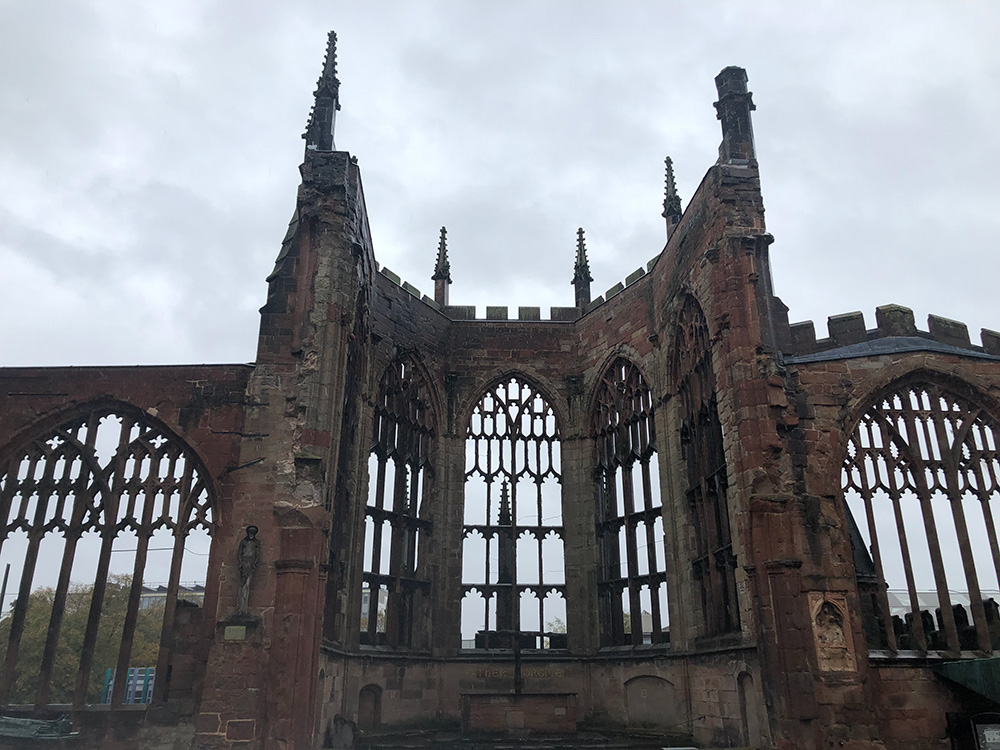
“There is the empty chapel, only the wind’s home.” Eliot’s bleak verse from The Waste Land felt almost made to order for the moment on a dismal October day when, after navigating the dense maze of downtown streets in the cold rain, I finally caught sight of the majestic ruin at Coventry. I had seen countless images of the old cathedral’s hollowed shell, but nothing quite prepares you for encountering it in person: its scale, its starkness, its aura. The exterior walls enclose what is now a large courtyard-like space dotted by a few benches and memorial sculptures, with the cathedral’s original tower and spire looming high above. In the former apse, vast openings once filled with stained glass framed a view of the dark gray clouds. The rain seemed to keep other visitors away, so I stood alone in the vast space, watching the raindrops making tiny splashes in the puddles on the stone floor.
To its parishioners over the centuries, the old cathedral, once the largest parish church in England, must have seemed like an impregnable fortress of God. Now it could not repel a raindrop. Perhaps the unsettling power of ruins has always flowed from this encounter with the radical finitude of history, the fragility of all that once seemed permanent. “Our glance lingers over the debris of a triumphal arch, a portico... a palace, and we retreat into ourselves,” wrote Diderot in 1767, responding to a painting of ruins. “We contemplate the ravages of time, and in our imagination we scatter the rubble of the very buildings in which we live over the ground; in that moment, solitude and silence prevail around us, we are the sole survivors of an entire nation that is no more.”
It was easy to imagine the architect Basil Spence on his first visit, standing on this same site and responding to the very pull of the ruins that Diderot describes, their way of revealing the deep vulnerability of the present often masked by its pretense to the eternal. Spence after all had lived through two world wars and fought in one of them. He had the wisdom to realize that the ruins at Coventry should be preserved, but how could he not have also feared on some level that his grand successor edifice—conceived barely a decade after Hiroshima and Nagasaki, and at the height of the Cold War—would end up in a similar state of ruin? Indeed, the cement fortresses and bunkered styles of modernist brutalism so popular after the war, it has been observed, were in part a response, conscious or unconscious, to the anxiety of bombing, the fear of death and ruination from above.

Traces of this anxiety may be detected in the cathedral Spence designed for Coventry, in its mass and solidity, its unornamented exterior (he likened it to “a plain jewel-casket with many jewels inside”), its series of angled stained-glass windows protected by external walls as if to guard its flank in the manner of a medieval castle. These features date Spence’s building and, in so doing, call the bluff of modernism’s own imagined break with history. The new cathedral today in fact stands like a monument to modernist architecture of the 1950s, and to that moment’s own fantasies of the future and its hauntings by the past. Tellingly, this mid-century modern style of design has now aged enough to become fodder for its own wave of nostalgia. “Modernism is our antiquity,” the art historian T.J. Clark has written, “the only one we have.”
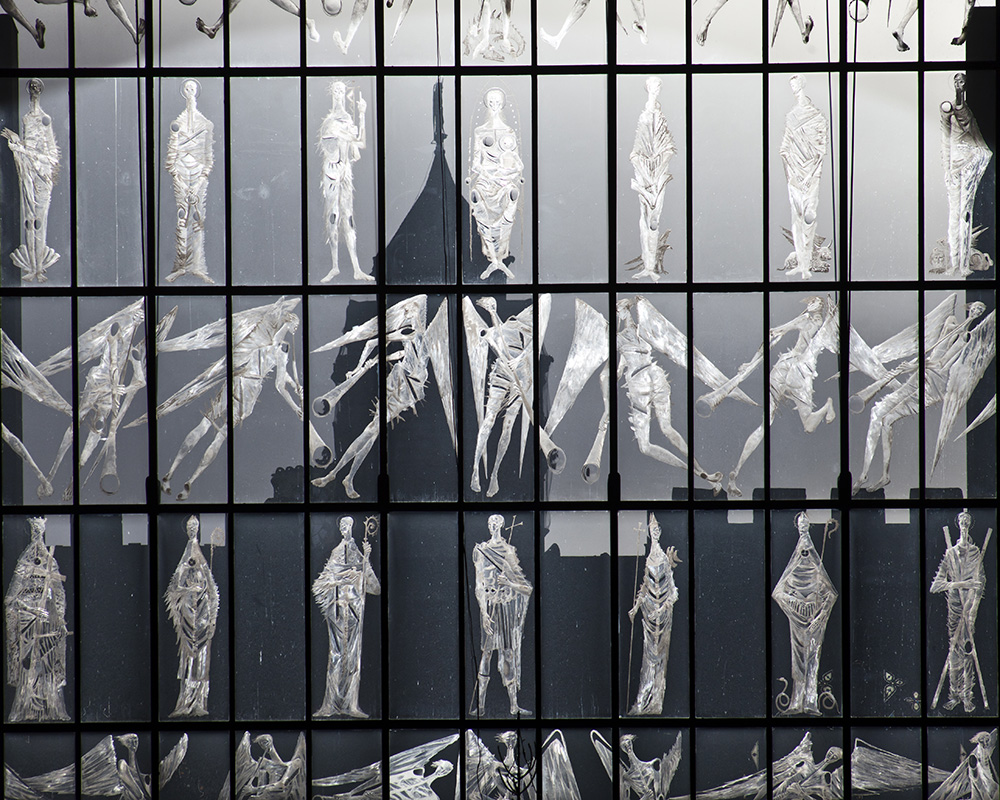
If the exterior of Spence’s cathedral presents itself as a jewel casket, the jewels inside are indeed vibrant. Upon entering the space, one is immediately struck by Graham Sutherland’s enormous tapestry (seventy-two feet tall), which hangs behind the altar and depicts a resurrected Christ on a throne. And John Piper’s abstract grid of stained glass in the bowed baptistery window creates a beautiful blend of primary colors even on a cloudy day. But perhaps Spence’s most remarkable stroke is the enormous Great West Screen at the rear of the nave, a glass wall stretching floor to ceiling across a span of forty-five feet, mediating the view from inside the new cathedral onto the ruins of the old. On this screen, the artist John Hutton engraved sixty-six images of saints, angels, and Old Testament figures.
On the day I visited, these wispy figures had taken on a translucent, ghostly air as they hovered against the light gray sky, the bottom rows offset by the dark silhouette of the old cathedral. Interestingly, in Hutton’s design, the saints appear as stiffly posed icon-like figures, each confined within a single glass rectangle, but the angels, by contrast, are a whirl of motion, wings and limbs askew, cutting across the screen’s precise grid-like geometry. Many of them are blowing horns with a fervor that seems to possess their entire bodies.
The angels’ songs are clearly directed into the church, forward toward the altar with the image of the enthroned Christ. Spence, as if fearing the contrary pull of the ruins, was especially concerned that his site retain this forward orientation. When the Great West Screen was first installed, the architect was dismayed to discover that when one stood outside the cathedral and looked in through the glass, the engraved saints and angels were in fact blocking the view of the altar with its triumphant Christ. Spence then insisted that Hutton ascend his scaffolding once more and painstakingly modify the etchings to make them more transparent. For Provost Howard, who worked closely with Spence throughout most of the planning, the relationship between ruin and rebirth was more theological yet equally forward-oriented. “As I watched the Cathedral burning,” he had written, “it seemed to me as though I were watching the crucifixion of Jesus upon His Cross.” The new cathedral, then, risen from the ashes, represented nothing less than Christ’s resurrection.
Yet when it came to creating the one work of music now forever associated with the new Coventry Cathedral, Benjamin Britten found the courage to turn the music around, to take the retrospective view, to angle his art toward the wreckage. In the War Requiem, Owen’s poetry haunts the Mass for the dead just as the ruins of the old cathedral haunt Spence’s modern edifice. Both serve as constant reminders of the thinness of civilization’s veneer and of the human capacity for self-destruction. For the composer in 1962, after two world wars and all they had revealed, the traditional Mass for the dead could no longer be authentically rendered in its original form, which is to say, as theology divorced from history. By disrupting and puncturing the Mass, Owen’s poems render it as a series of fragments. The blood-soaked history of the twentieth century, this music tells us, has left established religion itself as a kind of ruin.
At the same time, Britten was too spiritual a man to simply walk away from the ruins of theology. In the War Requiem—just as Spence did at Coventry—he chose to preserve them. His commission had given him the freedom to choose any text, “sacred or secular,” yet he chose the Mass for the dead, and his music carries forward its fragments without ironic distance; his settings speak with compassion and sympathy, and in the “Dies irae” with genuine terror. Traditional rituals of communal mourning still have a place, this music suggests, but they are no longer remotely sufficient. In short, there are angels in Britten’s musical memorial, but unlike those wispy specimens on Hutton’s screen, we might call them “angels of history.”
The term comes from Walter Benjamin, who in 1921 purchased a monograph by Paul Klee featuring a rather curious and awkward angel. Its wings appear clipped, tangled, and unequal to the task of flight; its hair is made of scrolls; its body hovers in a state of suspension. Benjamin hung this image near his desk and drew from it philosophical and mystical inspiration. Klee, who had himself fought in the First World War, had titled his work Angelus Novus. For Benjamin, this was the angel of history.
In the ninth of his “Theses on the Philosophy of History,” written only months before his suicide after being turned back while attempting to escape Vichy France, Benjamin famously describes this angel as facing toward the past. His eyes are open and his mouth is agape. Where we may see history as a chain of discrete events, Benjamin writes, the angel sees only “one single catastrophe” whose ruins are piling upon ruins. Benjamin suggests that the angel would like to redeem this broken world, to “awaken the dead, and make whole what has been smashed.” But he cannot do so, because “a storm is blowing from Paradise and [it] has got caught in his wings; it is so strong that the angel can no longer close them. This storm drives him irresistibly into the future, to which his back is turned, while the pile of debris before him grows toward the sky.” Humans have a name for this storm, Benjamin adds as a coup de grâce of his devastating allegory. We call it progress.
If Hutton’s angels are inscribed in glass, playing for Christ on his throne, Britten’s angels are inscribed in sound, playing for the ruins. His angels of history would see the two world wars not as a chain of related events but as “one single catastrophe.” They too would have a dream of making whole what has been smashed. Or in Britten’s own words, the entire War Requiem was meant as nothing less than “an attempt to modify or to adjust the wrongs of the world or the pains of the world with some dream.” It is an enduring dream still present whenever the work is performed with sincerity and received in the same way, and also a portable dream. One has to travel to Coventry to see Hutton’s angels in person, but Britten’s angels come to you, along with his Requiem. They pass by, like the music, in a single extended moment, blown forward by progress while facing the past, seeking to awaken the memory of the dead, asking us (in Owen’s phrase) to “love the greater love.” Our task is only to listen, and to hear.

The rain had stopped by the time I finished exploring Coventry Cathedral, and the soft gray light had begun draining from the sky. Before I could set off for the train station, however, I discovered the site had one last surprise in store. The surviving medieval tower still has its own set of bells, and just as I was stepping out of the church onto St. Michael’s Avenue, they began ringing out, joyfully clangorous.
I stood transfixed as the sound echoed off the stone and fanned out: over the broken ruins, over the fortresslike cathedral, over the streets of Coventry. The sound of these bells seemed to carry within itself the resonance of all those older bells. I thought of the dissonant orchestral bells in the War Requiem that had once rung out on this very spot, and of the bells that had rung out as the old cathedral stood intact across the centuries. I imagined the night of the bombing, and the bells that still rang even as the cathedral burned. I saw the audience on the night of the premiere, shuffling out in reverent silence. Music’s memory had cast its spell. And for a few fleeting moments, the sound was everywhere, the years melted away, and the past drifted free from the sovereignty of time.
Adapted from Time’s Echo: Music, Memory, and The Second World War by Jeremy Eichler. Copyright © 2023 by Jeremy Eichler. Published by arrangement with Vintage, an imprint of The Knopf Doubleday Group, a division of Penguin Random House LLC.