Adapted from Every Valley: The Desperate Lives and Troubled Times that Made Handel’s Messiah, from Doubleday, 2024.
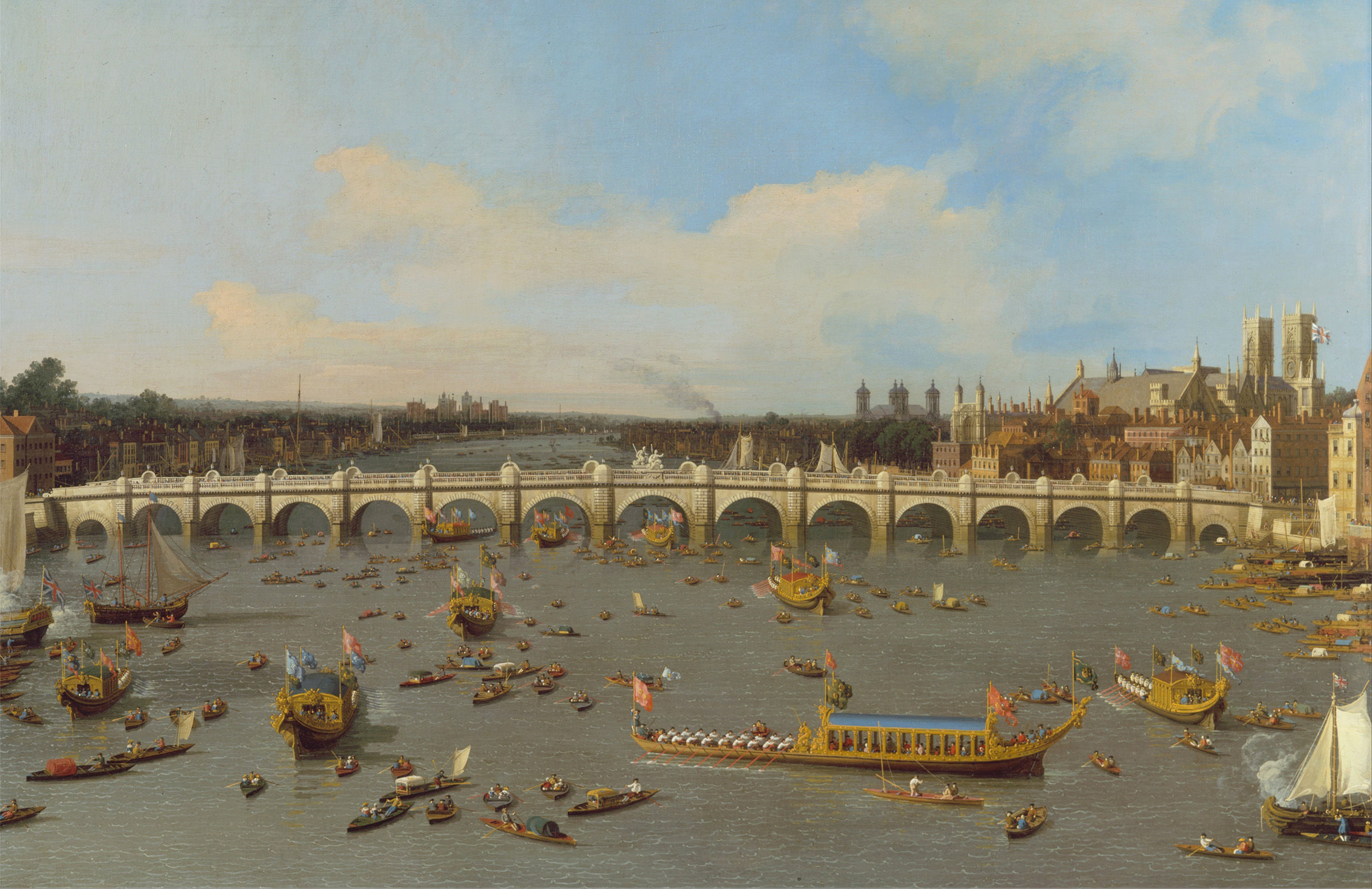
The Thames was tiled with boats late on a midsummer Wednesday, the kind of liquid English evening where twilight seems to last forever. His Most Sacred Majesty George I, three years into his reign, had set out in a gilded barge around eight o’clock. River craft brimming with duchesses, earls, and other “Persons of Quality,” as one witness put it, now jostled for position near him on the water. On another ceremonial barge, fifty violinists, trumpeters, and other musicians cycled through minuets, airs, and hornpipes.
Surrounding the courtiers in silk gowns and powdered wigs, commoners paddled along in their own rowboats and skiffs, laughing and hurling creative insults at one another across the water. “You pimps to your own mothers, stallions to your sisters…christened out of a chamber pot, how dare you show your ugly faces upon the river of Thames, and fright the king’s swans?,” rowers and wherrymen were known to cry. “You offspring of a dunghill, and brothers to a pumpkin…hold your tongues…or I’ll whet my needle upon mine arse and sew your lips together,” might come the reply.
As the raucous procession passed by, onlookers gawked and chittered on dry land. The people, reported a Swiss observer, were “sans nombre.” Every now and then, a cheer might ripple through the ranks, starting beyond earshot and rolling closer, like a rainstorm combing through a clump of willows.
To any newcomer in the crowd, nature itself seemed to bend to the king’s will. From Whitehall to Westminster, past Lambeth and the pleasure gardens at Vauxhall, the slow-moving current was drawing the boats, astonishingly, upriver. A child on the embankment could have challenged the sovereign to a race and won—by running in what would have been, on any ordinary day, the wrong direction.
The entire affair, it turned out, had been planned on a waterman’s secret.
Travelers coming to London by sea were sometimes surprised when their sailing ships anchored at the mouth of the Thames and then simply waited—not for a shift in the wind but for a change in the water. Depending on the hour, the river flowed either forward or backward, pushed along by the estuarial tide, carrying lost boots, schools of pike and carp, occasionally corpses, and just now royals and nobility headed toward supper and an evening’s entertainment at a garden villa upstream in Chelsea. Early the next morning, with the water returned to its normal state, George floated back home and allowed everyone finally to retire to bed.
Two days later, when a newspaper gave an account of the outing, the most remarkable thing was reckoned to be not the king and his mobile court, swept along by a reversible river, but rather “the finest Symphonies, compos’d express for this Occasion,” and the German who had written them. He was thirty-two years old, graced with a royal pension, and comfortable in four languages. He was said to have survived a sword thrust when an opponent’s blade landed on a button. He had attached himself to dukes who became princes and princes who became kings. It would take the better part of a century for other people to rearrange his latest work, composed in bright major keys built for the outdoors, and drag it into a concert hall. Its title, Water Music, would forever carry a whiff of cow parsley and river mud. But chroniclers were already calling him “the famous Mr. Hendel,” and on this splendid July evening, a few months into his thirty-third year, he had every reason to believe one obvious thing: the right river, taken at the flood, could work miracles.
George Frideric Handel—one of the ways he would eventually spell his name—was a native of Halle in Saxony, part of the mosaic of central European kingdoms, principalities, duchies, and free cities that formed the Holy Roman Empire. As a traveling musician, Handel had visited some of the greatest cities on the Continent, but nothing would have prepared him for London—a metropolis of more than 600,000 people, on its way to becoming the largest city in Europe as well as its commercial center. The only built passage across the Thames was the narrow London Bridge, whose roadway was hemmed in by shop fronts. But on the water below, the writer and pamphleteer Daniel Defoe counted two thousand seagoing ships moored or under sail, plus barges, pleasure boats, and other river craft. The Italian painter Canaletto would later render the busy waterscape as a kind of northern Venice, with crowded quays and outdoor staircases descending to the water from palatial riverside homes. “I shall not give you my Opinion of every distinct thing in this City, or an Encomium of [its] Beauty and Ornaments,” reported a German visitor, Christian Heinrich Erndl, a physician like Handel’s father, “lest the Splendor of so August a City shou’d be diminish’d by my weak Description.”
Few places so fully showcased the ability of humans to destroy their surroundings as well as to resurrect them. The Great Fire of 1666 had swept through the oldest quarters of the city, but since then, medieval houses and streets had surrendered to new squares and public works that radiated confidence—“a Prodigy of Buildings, that nothing in the World does, or ever did, surpass, except old Rome in Trajan’s Time,” as Defoe described it. Others were harsher in their assessments. An aspiring writer named Jonathan Swift made a checklist of the things London gutters carried toward the river in a rainstorm: “Sweepings from butchers’ stalls, dung, guts, and blood / Drowned puppies, stinking sprats, all drenched in mud, / Dead cats, and turnip tops, come tumbling down the flood.” Still, anyone who walked along the Thames could have captured the city’s transformation in a single glance along the north bank. In the foreground was the Tower of London, ancient and fearsome, while farther upriver, St. Paul’s Cathedral, Christopher Wren’s masterpiece of lightness and grandeur, presided over new courts and guildhalls.
Few societies placed suffering and cruelty so fully on public display. Mobs, riots, and looting were common. Public chastisements, such as being whipped or pilloried, were occasions for entertainment. One German visitor to London in 1710, the same year Handel arrived, was taken by his hosts to see cockfighting near Gray’s Inn, dogs attacking a bull on Clerkenwell Green, a sword fight in Southwark, inmates parading at the Bedlam asylum in Moorfields, and a woman on a Thames barge who balanced knives on her eyelids, all of which “vastly delights this nation but to me seemed nothing special.”
As many as 186,000 men had been mobilized for the War of the Spanish Succession, and, as with previous conflicts, Londoners tended to dread the survivors’ return. Peace had its victims, too. Burials typically increased in the years immediately after a peace treaty was signed. Whenever demobilized soldiers and sailors came to town, murders and deaths from fevers always followed, and women tended to be the disproportionate victims. New, more virulent strains of communicable diseases also arrived with London’s emergence as a global trading center. Even people who weathered common infections were left with the marks of their good fortune, from faces divoted by smallpox to suppurating wounds that would not heal.
Private misery had its equivalents in public life. The major institutions of state—the monarchy, the Parliament, and the Church of England—were riven and unstable. What circumstances permitted violence for political ends, what counted as legitimate authority, when divine will sanctioned secular killing, the entire social and political order seemed built on shifting sand. Catholics were subject to legal and civil restrictions, and among Protestants, a panoply of terms identified the excluded, suspect, or merely troublesome: Nonconformists, Deists, latitudinarians, and a host of other categories for Christian minorities, constituting some eight percent of England’s population and more in other parts of the kingdom. The last execution for blasphemy had taken place in 1697. The last alleged witch in England was tried in 1717 and surprisingly acquitted, despite solemn testimony that bees had swarmed from her victims’ mouths. A decade later, the last person to be convicted of witchcraft in Britain as a whole, a woman known as Janet Horne, was drizzled with tar in a Scottish village and then set aflame.
In politics, people had come to speak as though Britain were naturally sorted into two rival camps. So-called Whigs could trace their lineage back to parliamentary forces in the civil war of the 1640s. They rallied in support of William and Mary in 1688 and, later, the Act of Settlement. When the Hanoverians assumed power, Whigs came up with a version of history tailor-made to justify the new regime: the story that the Glorious Revolution had rescued parliamentary democracy and preserved an island nation safe from the tyranny of Catholic Europe. The Tories, by contrast, had their roots in the civil war’s royalist armies. They were among those most incensed by the unprincipled interruption of Stuart rule and what they saw as the self-interested, corrupt politicking of the Whigs.
In the House of Commons, the lower, elected house of Parliament, Whigs and Tories would later evolve into modern political parties. Future voters would come to see the competing sides as representing different visions of government and contrasting slates of policies. But at the time, Parliament rested on the votes of fewer than 200,000 male property-holders out of a British population of around 10 million. Political rancor was expressed in ways that extended far beyond an election campaign or a debate in the Commons. Factionalism was a repertoire of aspersion, a quick-think rule for knowing whom to blame when things went wrong.
Coffeehouses—more than five hundred in London by the late 1730s, more than the number of inns or taverns—became places where men reinforced whatever profession and outlook on the world they carried in with them. Scholars met at the Grecian in Devereux Court. Barristers huddled at Nando’s in Fleet Street. Marine insurers gathered at Lloyd’s in Lombard Street, while life insurers preferred Tom’s in Exchange Alley. Among the wider public, abstract words—liberty, corruption, constitution, luxury, pride—had the practical power to identify comrades or flush out enemies. Pamphleteers, playwrights, and preachers wielded them like cudgels. “Patriotism, in Days of Yore...denoted a Generous Disposition in a Man towards Serving the Publick,” wrote one observer. “Now, these Times of Reversing are come; it...is indiscriminately made use of by each Party when out of Power...in order to consecrate their Opposition to that which is in.” Even the labels Whig and Tory had originated as terms of abuse for people whose opinions one happened to dislike. The former came from a Scottish word for a mare-wrangler, the latter from an Irish term for an outlaw. In the middle of the century, Samuel Johnson compiled seven examples of the proper use of the word politician, running from Shakespeare to his own day, for his Dictionary of the English Language. All of them were negative.
Anyone with a point of view and access to a print shop seemed to have a plan for fixing everyone else’s insanity. Government licensing of periodicals had ended in 1695, and weekly and monthly newspapers filled a market now free from official oversight. “England is a Country abounding in printed Papers,” a foreign traveler reported. By one count, as many as six thousand polemics, tracts, and commentaries were published in the two decades before the Hanoverians arrived, with little sign of a slowdown once George I was installed as king. Innovations in printing technology and the rapid growth of an urban literate class—by the 1710s, perhaps 45 percent of men and 25 percent of women could read—contributed to the flurry of paper. Information was available in ways that seemed new, fast, and out of control.
“We had no such thing as printed newspapers in those days to spread rumors and reports of things,” remembered the narrator of A Journal of the Plague Year, Daniel Defoe’s semi-fictional account of a London epidemic half a century earlier, “so that things did not spread instantly over the whole nation, as they do now.”
For the first time, it became possible to earn a living just from having something to say. A new term—hacks—came into use for London’s swelling cohort of piecework authors. (The same word also referred to hired carriages and people who sold sex.) The narrow alleyways and courtyards northeast of St. Paul’s Cathedral were choked with the lodgings of would-be novelists, originally meaning someone who reported novel facts and gossip—that is, a journalist—along with the print shops and booksellers that brought their strivings into public view. A young man from the colonies named Benjamin Franklin found work with a printer in Bartholomew Close, where the rowdy apprentices started calling him “Water-American” since he declined their custom of downing pints of ale throughout the workday. Instead of drinking, he tried his hand at hack writing. He used company paper and ink to produce a pamphlet that promised “my present Thoughts of the general State of Things in the Universe.” Franklin’s angry employer judged it “abominable.”
Not far from the print shop where Franklin worked, another artery of publishers, coffeehouses, and tenements—Grub Street—became a byword for the urge to share one’s views and, even more, the ache to have someone take notice. “It fell dead-born from the press,” complained the Scottish philosopher David Hume about his first attempt at a book, A Treatise of Human Nature. “It came unnoticed and unobserved into the world,” he said of another. People of varying social classes found themselves swept up in the first great age of stressing over likes and followers and then, when all else failed, turning to the obscene. The world was flush with creative commentaries on the vulgarity of public life—doggerel that alluded to a public figure’s sexual appetites, pornographic allegories, ribald puns, filthy ditties, lewd parodies—which of course also stoked it.
In the summer of 1717, as Handel ran through the movements of his Water Music, floating alongside George I’s royal barge on the Thames, he could only have marveled at his own meteoric rise. Yet he would also have been aware of the precariousness of the regime that now sustained him. An outsider dependent on staying on the right side of the powerful, Handel understood the many divisions that snaked through his adopted society. His income, as well as his art, rested on the favor of people who could also easily withdraw it. A generous supporter or advance ticket sales might cover some of the cost of a production, but opening night then hung on the goodwill of a patron or a public violently sensitive to prices. A change in ticket price could spark a riot, with theatergoers storming the stage and tearing apart sets and chandeliers. When shows ran at a loss, the typical course was for a producer simply “to banish himself from the kingdom” and outrun the creditors, an early historian reported, as one of the King’s Theater managers had chosen to do.
Amid the continuing craze for Italian music, in early 1719, a circle of opera enthusiasts proposed a different model. Their concept was to create a new production outfit structured as a joint-stock company. Supporters would be investors rather than donors, expecting a return on their outlay but also bearing the risk should things fail. A who’s who of Handel’s landlords and acquaintances signed on, among them Richard Boyle, Earl of Burlington, who owned the Piccadilly home where Handel had lived for a time, and James Brydges, later Duke of Chandos, under whose patronage Handel had begun his first serious attempt at setting English texts. Their hope was to gain a royal charter—the official imprimatur of the king, which could then be used to pull in further partners and paying audiences. By that summer, they had persuaded King George to grant the charter for what would become the Royal Academy of Music and provide a thousand pounds annually as capital. Other investors added perhaps nineteen thousand pounds in all. The Royal Academy’s board of directors named Handel as “Master of the Orchester with a Sallary” and empowered him to steal away Italian singers and musicians from their European engagements.
Over the previous century, Venetians, Florentines, Neapolitans, and others had together set in motion a revolution in sonic common sense: a profound change in the conventions of musical form, perceptions of beauty, and expectations about what counted as obvious or wrongheaded art.
Living in the artistic realm that Italians had created meant accepting the existing order of the world while also undermining it. You started by imagining a normalcy different from the one outside your window. A woman might sing a man’s part as a travesty—en travesti, meaning literally a change of clothes—a term that would only later come to mean abnormal or an affront. A man could sing from the edges of his vocal cords and leap into a high falsetto, his false voice. He could do so with even greater range as a castrato, someone whose testes had been removed before his voice had hardened in puberty, a procedure practiced in Italy, the Ottoman Empire, and elsewhere for centuries. Onstage he might play a steel-clad knight, soaring above the battlefield with the voice of an angel. Castrati superstars—Nicolini, Pasqualini, Paoluccio, Momo, Farinelli, Senesino, Guadagni—were paid gargantuan fees for a season's performances. In public they could be swarmed by adoring admirers, both male and female. “Some of them had got it into their Heads, that truly the Ladies were in Love with them,” a lengthy French treatise on Italian castrati reported in 1718, “and fondly flattered themselves with mighty Conquests.”
In a theater, the powerful could sound like women. Ancient gods could walk among men. Wars could end not in gore and death but in communal song. Doing all of this well required intellect and discernment, knowledge of musical form and its effects, and, most important, a sense of sociability. Players and singers were guided by instructions written on a staff, but the notes were suggestions rather than edicts. In a soundscape that allowed uncertainty and impromptu change, musicians had to be both self-aware and neighborly, a skill also necessitated by the technology of the time. A quiet harpsichord could speak comfortably alongside a human voice or a few violins, but not more. A lute-like theorbo, with its gentle strings and absurdly long neck, could manage a coiled horn as a partner, but only if its bell were turned discreetly away from the listener. Even a trumpet could cooperate peaceably with other instruments when played in its upper register, where the physics of its metal tubing gave the player more notes to choose from, its timbre more like a warbling bird than a blaring call to arms.
No one had yet given music of this type a label. When they did, the one they chose was also a slur, like punk or grunge. It was the French baroque, used in English for the first time in 1765 and perhaps derived from a Portuguese term for a rough pearl or a mouthful of irregular teeth. To its enthusiasts, that was precisely the point. An orchestra of the period was also an intentional community, often assembled for a specific occasion, smaller than in later centuries, and with no need for a conductor—a role covered by the keyboard player or lead violinist and preserved in the modern term concertmaster. The music they made was solicitous and scrappy, risky and intimate. It soared and swerved, thrilling and dangerous, at odds with everything that had come before, and, to the artists who came after, the perfect example of wildness and excess. But to those who lived it, at the core of their work lay the belief that human creativity could best be used to make an intense, weird, and complicated conversation, sloughing off old conventions while manufacturing bold new ones. “We have freed ourselves from the narrow limits of ancient music,” Handel once said.
The Royal Academy of Music was launched in 1720 with a season that featured a new Handel opera, Radamisto. Handel seemed to have hit on a formula that worked. He offered an imaginary story set in a real place, the ancient Near East, with a tyrannical king, happy and unhappy marriages, a father’s love for his son, and—echoing the expectations of the moment—harmonious government at last restored.
Just as Handel’s backers had hoped, the opera opened to raves. Scalpers offered tickets at outrageous prices. Women nearly fainted in the stifling crowds. For the productions that followed, Handel was able to secure the talents of some of the leading performers from the Continent. Francesca Cuzzoni, a celebrated soprano, was paid handsomely to give up other commitments and move to London. A playbill that featured the renowned castrato Senesino was enough to guarantee a sellout.
In short order, the Royal Academy had shown that Britain had a place for what came to be called opera seria, a sung story on serious, if formulaic, themes. But corralling the cast that sustained it all—a company of large talents and even larger needs—proved to be a challenge. Handel was “addicted to the use of profane expressions,” as one account put it, and he often had reason to use them. In rehearsals, he was developing a reputation as a demanding taskmaster, fiery when needed, as he had been in Italy. “You may be a real devil,” Handel is supposed to have told the temperamental Cuzzoni during one session, grabbing her by the waist and threatening to throw her from a window, “but I will have you know that I am Beelzebub, the chief of the devils!” Rivalries among performers and their backers paralleled the vicious partisanship between Whigs and Tories. During performances, people in the audience typically talked and shouted, moving about in their boxes and interacting with what was happening onstage. When singers made an entrance, devotees might break into “Hissing on one Side, and Clapping on the other” before descending to “Catcalls, and other great Indecencies,” with the battle continuing afterward in published reviews and private letters.
Grub Street writers intensified the theatrical warfare. “But who would have thought the Infection should reach the Haymarket and inspire Two Singing Ladies”— Cuzzoni and Faustina Bordoni, a Venetian mezzo-soprano—“to pull each other’s Coiffs,” wrote an anonymous author, inventing a scene that others reported as fact. “It is certainly an apparent Shame that two such well bred Ladies should call Bitch and Whore.” Other composers, such as the popular Italian cellist Giovanni Bononcini, competed with Handel for adherents, who divided themselves into factions with a ferocity that could end friendships.
Some listeners found it all ridiculous. “Strange all this Difference should be,” went a popular epigram then circulating around London, “Twixt Tweedle-dum and Tweedle-dee!”—one of the original sources for the names that Lewis Carroll would later make famous in Alice’s journeys through the looking-glass. Upon hearing of Handel’s Radamisto, Isaac Newton reported that going once to an opera was enough for him. The first act he sat through with pleasure, the second stretched his patience, and the third prompted him to run away.
Still, with ticket sales brisk and the financial support provided by a royal subsidy and a joint-stock company, the Royal Academy seemed exactly the steady foundation that Handel had wished for. Within a few years, the academy’s success placed Handel in a position to make his life in Britain permanent. In early 1727, King George signed the assent decree that confirmed Handel’s naturalization as a British subject. It was one of the last acts George would ever endorse. That June, en route as usual to Hanover, the king collapsed from a stroke and died. Plans were soon made for the coronation of the Prince of Wales as George II. Handel was commissioned to provide the musical grandeur to accompany the royal ceremony in Westminster Abbey.
George was determined that his coronation be larger and more ornate than his father’s. A raised walkway was constructed across the grounds in front of the abbey so that crowds could watch the parade of dignitaries without obstructed views. Coffee sellers were on hand to provide refreshment. Tickets were offered for sale to people beyond the usual passel of nobility and upper gentry. The entire procession took two hours to pass, so long that the aging Sarah Churchill was seen to demand that a military bandsman surrender his drum for her to use as a stool.
Not everything on the day went according to plan. Inside the abbey, choristers located in different parts of the vast building couldn’t see or hear one another and mistakenly launched into different pieces at the same time. “The Anthems in confusion: All irregular in the Music,” the archbishop of Canterbury wrote exasperatedly on his printed order of service. But for one of the coronation anthems in particular, Handel had summoned all of his theatrical sensibility, and the result was astounding.
The text of “Zadok the Priest” came from the biblical story of the prophet Nathan and the Jewish high priest Zadok, who blessed Solomon as king of a united Israel. The music swelled through an undulating prelude, with the tension building across strings and winds. Figures surged upward and forward, then stepped back, then began to rise again, stretching the feeling of anticipation almost to exhaustion. Just at the point of boredom, an explosion of blaring brass and voices echoed through the abbey’s soaring space. “Zadok the Priest and Nathan the prophet, anointed Solomon King,” the choir sang in full voice, the initial z firing like an artillery rocket. “And all the people rejoiced and said: ‘God save the king, long live the king!’” No piece of music had ever so powerfully connected biblical Israel and modern Britain, or so explicitly laid claim to the idea that these kings, too—German by birth and British by parliamentary design—were chosen of God. It was a work of cosmic confidence for a family that now fully counted as a dynasty. Every British sovereign to follow (including Charles III nearly three centuries later, in 2023) would choose to have “Zadok the Priest” played at their coronations, as if rubbing a talisman for the security of their own reigns.
Handel seemed more settled than ever. He had multiple sources of income, royal favor, and new seasons to plan at the King’s Theatre. He was at the center of a metropolitan society consumed with debates about music and the relative virtues of one composer or performer over another. “People have now forgot Homer, and Virgil, and Caesar, or at least they have lost their ranks,” joked poet John Gay, who would later write the libretto for The Beggar’s Opera. “There is nobody allowed to say, ‘I sing,’ but an eunuch, or an Italian woman.”
This is an edited excerpt from Every Valley: The Desperate Lives and Troubled Times That Made Handel’s Messiah by Charles King. Reprinted by permission of Vintage, an imprint of the Knopf Doubleday Publishing Group, a division of Penguin Random House LLC. Copyright © 2024 by Charles King.