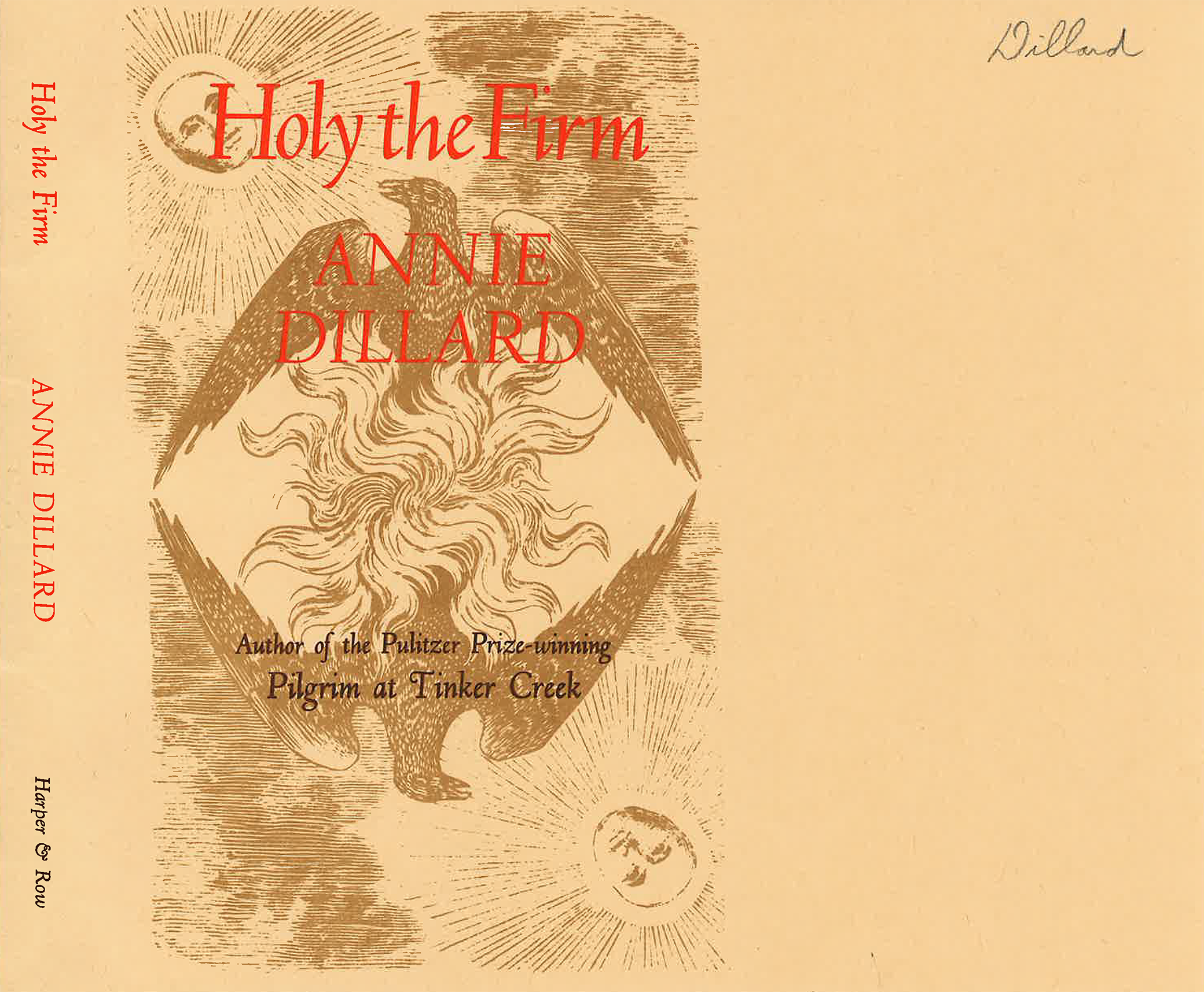
Dust jacket for the first edition of Annie Dillard’s third book, Holy the Firm, 1977. From the Lewis Lapham papers, Columbia University Archival Collections.
Adapted from a retrospective review—first published on March 21, 2016, in the New York Times—of Dillard’s last book, The Abundance: Narrative Essays Old and New. Until her death on September 15, 2026, Dillard was a cherished member of the Quarterly's editorial board as well as a frequent contributor to its pages. Her voice has now joined the voices of the past. You can hear it, that voice, in her poems, essays, and novels but also in a letter she sent Lewis Lapham on August 19, 1974, upon returning from the Galápagos.
“What would you do differently, you up on your beanstalk looking at scenes of all peoples at all times in all places? When you climb down, would you dance any less to the music you love, knowing that music to be as provisional as a bug? Somebody has to make jugs and shoes, to turn the soil, fish. If you descend the long rope ladders back to your people and time in the fabric, if you tell them what you have seen, and even if someone cares to listen, then what?”—Annie Dillard
Annie Dillard’s long career as a daredevil nonfiction aerialist began in October 1972, on a camping trip to the coast of Maine. She tells the story in the afterword to the 25th-anniversary edition of Pilgrim at Tinker Creek. Twenty-seven years old, somewhere between her home in the suburban foothills of Virginia’s Blue Ridge Mountains and Maine’s Acadia National Park, she’d picked up a “nature book” by a writer whose previous book she’d admired. His latest effort was a torpid disappointment. Wondering how fireflies make their light, the author hadn’t troubled himself to find out. Dillard, who had been troubling herself and finding things out since childhood, knew the answer to this entomological mystery: Fireflies possess a pair of substances with excellent names, luciferin and luciferase, that are crucial to their conversion of chemical energy to light. Far less explicable to her than the light of fireflies was the dimming of an author’s once-bright mind. “What on earth,” Dillard asked herself, “had happened to this man?” Here, too, she was prepared to hazard an answer: “Decades had happened, that was all.” She resolved to write about the world before she wearied of it, or lost her nerve.
Now that decades have happened to her, I wish I could travel back in time to deliver to that 27-year-old camper on the coast of Maine some reassuring news: On the page at least, nerve is something she would never run short of. As evidence, I’d present her with my review copy of The Abundance: Narrative Essays Old and New. In what feels like a valedictory collection, Dillard has selected, rearranged, and in some cases retitled and revised 22 of the best essays she’s written over the last 40 years, curating what amounts to a retrospective exhibit of her own career. The time for a Dillard retrospective seems right. As Geoff Dyer notes in his foreword, the sort of “genre-resistant nonfiction” whose possibilities Dillard began scouting out in the early 1970s is now a recognized genre enjoying a vogue. Many readers and writers, Dyer among them, have followed her into those borderlands.
Dillard was a pioneer in another sense, daring at age 27 to nominate herself for membership in the explorers’ club of American letters whose most famous exemplars—Thoreau, Muir, Abbey—were men. Profiling her in The Atlantic, Diana Saverin shared a savory quotation from the journals Dillard kept while struggling to write the book that would become Pilgrim at Tinker Creek: “It’s impossible to imagine another situation where you can’t write a book ’cause you weren’t born with a penis. Except maybe Life With My Penis.” (If you can almost hear a rim shot following that punch line, there are good reasons, divulged in one of the essays included in The Abundance, “Jokes.”)
Having resolved on the coast of Maine to write about the world, Dillard took Walden for her model, a debt she acknowledges in “Heaven and Earth in Jest,” the opening chapter of Pilgrim at Tinker Creek, to which in The Abundance she’s given a more down-to-earth title, “On Foot in Virginia’s Roanoke Valley.” (Many of the alterations Dillard made to her early work show an inclination to temper her youthful exuberances, tone things down, simplify. “Living Like Weasels,” a favorite with anthologists, is now “The Weasel.”) Like Thoreau, she exhibits in those early essays a knack for aphorism and parable. Like him, she makes her suburban surroundings seem wilder than they were, her adventures more solitary than they were, her pilgrim’s persona more self-reliantly masculine than she was—or he was.
Emerson exhorted poets to “magnify the small” and “micrify the great,” and Dillard knows as well as anyone, Thoreau included, how to put that bit of Emersonian theory into practice. Consider, for instance, the frog. If you’ve read Pilgrim at Tinker Creek, you know the frog I’m talking about, the one that makes a memorable appearance in the essay formerly known as “Heaven and Earth in Jest”—an appearance and disappearance both. Once you’ve read the relevant passage, watched the frog deflate and crumple before your eyes as a giant water bug turns it into an amphibian smoothie and sucks it dry, you can’t unread the passage, the side effects of which—as is often the case with Dillard—can be long-lasting. It’s a reviewer’s commonplace to praise a writer’s prose as hallucinogenic, but in Dillard’s case, the adjective fits: Her essays have been known to induce in their users visions of dreamlike intensity.
Even then, in the early 1970s, when she was writing under the influence of Thoreau, she was beginning to emerge from under it. The century that separates her from her Transcendentalist precursors matters. She knows her Thoreau, her Dickinson, her Merton, her Ecclesiastes, her Book of Job; she also knows her Darwin, her Einstein, her Oppenheimer, her luciferin and her luciferase. With others of her postwar, post-Hiroshima, post-Holocaust generation—Joan Didion comes to mind—she shares an apocalyptic streak. Walden is auroral, as if written by dawn’s light. The Abundance is crepuscular. Darkness keeps falling across the page. Readers seeking pretty glimpses of heaven on earth will find little comfort here. Humor, yes. And a fair portion of the beautiful and the sublime. A great deal of the sublime. But little comfort. Dillard has said she prefers what Neoplatonic Christians called the via negativa, the doubtful path to God. She may believe in a “created universe,” not an accidental one, but she does so while making herself stare—and making her readers stare—into the “unthinkable void” of space and time.
In arranging her retrospective exhibit, Dillard abjured chronological order. The essays she wrote first arrive late. She chooses to begin instead with “Total Eclipse” and to end with “An Expedition to the Pole,” a pair of essays from her 1982 book Teaching a Stone to Talk. Together, framing the collection, these two essays lend it the shape of a Divine Comedy. “Total Eclipse” at first appears to be an account of the astronomical event named in the title, and for another writer—John McPhee, say—the astronomical event alone would have more than sufficed, but Dillard is a metaphysician, not an empiricist. Her preferred method is to transform, through the alchemy of metaphor, natural phenomena into spiritual ones. In her hands, the total eclipse, observed from a hillside in Washington’s Yakima Valley, becomes a descent into an underworld, a “region of dread.” Images of deep-sea diving recur. Blotting out the sun, the moon, like “a mushroom cloud,” obliterates “meaning itself.” The essay is her Inferno.
In “An Expedition to the Pole,” she counterpoints the history of polar exploration with a visit to a New Age Catholic church where the Mass is performed to the accompaniment of a folksy singalong. “I would rather, I think, undergo the famous dark night of the soul,” she writes, “than encounter in church the dread hootenanny.” Who wouldn’t? And yet, as she braids these two threads, the hootenanny and the expedition to the pole, they begin to combine and mingle in astonishing ways—like firefly enzymes, perhaps. An extended metaphor emerges, a kinship between worship and polar exploration that grows increasingly hallucinatory, until by the essay’s end, literalizing her metaphor, Dillard delivers us into a comical fantasia: The congregants of the Catholic church are now sharing an ice floe with survivors of doomed expeditions, and Dillard’s pilgrim of a narrator is banging a tambourine, joining in on the jamboree as she goes drifting toward the Pole of Relative Inaccessibility for which she has been “searching in the mountains and along the seacoasts for years.” This is nonfiction? Yes. It’s also Dillard’s Paradiso, as close to heaven on earth as she ever gets.
As The Abundance helps make clear, although Pilgrim remains her most famous book, it turns out to have also been her most conventional one. She showed more nerve later on, not less. Dillard once extended a metaphor that compared writing to the acrobatics of a stunt pilot. In her early work, she tends to soar and sink on lyrical thermals and downdrafts, composing arias of figurative language, piling simile upon simile, image on image, and when I was myself in my 20s, I thrilled to the aerial show of her prose. I still do, though somewhat to my surprise the essay I found most powerful on this reading was “For the Time Being,” a selection from the book of that name, published in 1999, the latest of the eight books from which The Abundance draws. In it, the figurative language and the lyricism and the flights of rhetoric and fancy have been boiled off, leaving a distillate of prose that is both crystalline and austere. Weaving together a natural history of sand and a fragmented biography of the French paleontologist and Jesuit priest Teilhard de Chardin, fellow traveler on the via negativa, the essay represents a culmination, an ultima Thule, of Dillard’s late style, and possibly of her four-decade career.
I’d be remiss if I neglected to report that the book’s subtitle—Narrative Essays Old and New—is a touch misleading. The newest of these 22 essays—one of two that can’t be found in a previous book—dates from 2005. Is it greedy to wish that there were more new offerings among the old? Is it indiscreet to wonder what Dillard has been up to since she published her second novel, The Maytrees, in 2007? Is it grim to worry that there won’t be more to come? That, as Dillard has suggested in interviews, the pilgrimage might be over? That this might be it? If this is it, if this is what the decades have done to her, to us, it will have been enough, more than. The title of The Abundance is not misleading in the slightest. What I mostly felt, reading it, was gratitude for the bounty.