In the early 1970s, when he was the managing editor of Harper’s Magazine, Lewis H. Lapham began working with, and corresponding with, a young poet and essayist named Annie Dillard. For the rest of his career and hers, Lapham continued to publish Dillard at Harper’s and then at Lapham’s Quarterly. A member of the Quarterly’s editorial board, Dillard contributed to ten issues. It is no surprise to hear her voice on the topic of Nature or Water, but her tremendous curiosity encompassed the cosmos and the human wreck of time, not just weasels and creeks. She possessed that poetic gift celebrated by Emerson: “to magnify the small, micrify the great.” We find her in the Sports & Games issue, remembering her childhood love of baseball—how the red stitches on the good leather “seemed to call forth a skill both easy and precise.” We find her in the Flesh issue, remembering the hair on her father’s arms and the skin on her mother’s face, which “took impressions readily.”
“On the opening of a book or the looking into a manuscript I listen for the sound of a voice in the first-person singular,” Lapham once wrote. “From authors I have read more than once I learn to value the weight of words and to delight in their meter and cadence—in Gibbon’s polyphonic counterpoint and Guedalla’s command of the subjunctive, in Mailer’s hyperbole and Dillard’s similes.” When Lapham died in 2024, Dillard commemorated him with one such simile, writing of her longtime friend and editor, “He spoke with his cigarette in his mouth, so he said everything behind a cloud of smoke like Moses at Sinai.”
On the occasion of Dillard’s death on September 15, 2026, Lapham was no longer present at his desk to pen a tribute in reply, so we are sharing instead, verbatim, a letter he sent Dillard on August 30, 1974, answering one she’d written to him upon her return from an assignment he’d sent her on, to the Galápagos. The “Mr. Shnayerson” in Dillard’s letter is Robert Shnayerson, editor-in-chief of Harper’s from 1971 to 1976. “Richard” is Dillard’s first husband, whose surname she kept. By “on Linblad,” she meant the Lindblad expeditions for tourists that, beginning in 1966, explorer Lars-Eric Lindblad regularly led to Antarctica and the Galápagos. The assignment these letters discuss would result in an essay, “Innocence in the Galápagos: A Voyage to a Time Machine in the Pacific,” published in the May 1975 issue of Harper’s and later collected under a new title, “Life on the Rocks,” in Dillard’s third book, Teaching a Stone to Talk, published in 1982.
“What shall we sing, while the fire burns down?” Dillard asks near the end of the finished essay. Her answer: “We can sing only specifics, time’s rambling tune, the places we have seen, the faces we have known.” And then, bardically, she adds: “I will sing you the Galápagos Islands, the sea lions soft on the rocks. It’s all still happening there, in real light, the cool currents upwelling, the finches falling on the wind, the shearwaters looping the waves.”
Hollins, Va. 24020
August 19, 1974
Dear Lewis:
After I talked to you on Tuesday, I woke up, fled to the mountains with a tent, and stayed through Sunday. “Little Miss Blurt,” Richard calls me; I can’t seem to outgrow it.
The thing to do, therefore, is to write an excellent Galapagos piece, and that right early. I’ve filled three notebooks with notes on a dozen various, specialized books—but I know I shouldn’t use them. The chosen words of Mr. Shnayerson resound in my skull: “We are not sending you to the Galapagos…to quote William James.”
So. I know too much. What shall I do with all this material? What length are we talking about—twenty pages? What about two articles? If, God help me, it should come to that. I don’t want to do two; I’m just not certain I can control myself. Gidget never saw the like.
I think at the moment what I’ve got is a piece about language. Not what immediately comes to mind—hence the delay. About isolation and individuation—and with these abstractions suitably cloaked in sealskin, leaping about. I hope you like it enough to send me to Antarctica on Linblad.
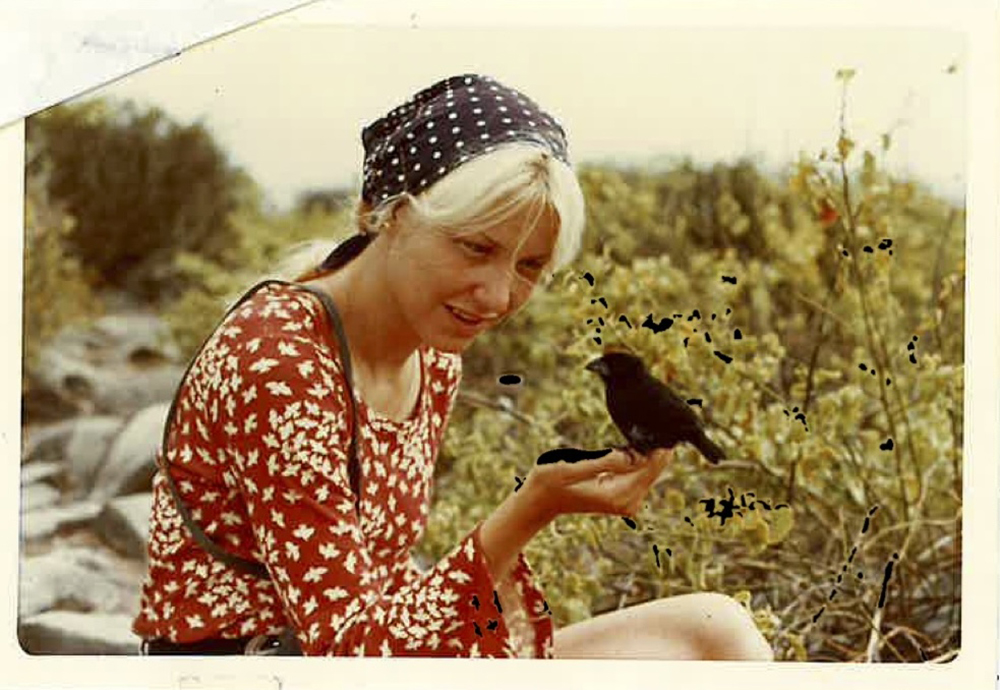
Enclosed find adult male large-billed cactus ground finch. It’s a Darwin’s finch. That’s a canteen strap over my shoulder; I was baiting them in, the finches and the mockingbirds, with a palm of fresh water. They can smell it thirty yards away.
Yours,
Annie
August 30, 1974
Dear Annie:
We can be talking about 20 or 40 pages, depending upon what happens to the abstractions cloaked in sealskin. I like the idea of an essay about language, and I don’t object to re-reading passages of Melville or Henry James. The finch interested me, as did your determined appraisal of it. Let me know when your questions become more specific.
Yours,
Lewis H. Lapham