“A poet only to myself, to men Useless.”
—William Wordsworth, The Prelude
(1) Our politics are a binary melodrama: humanist against evangelical, Democrat against Republican, socialist against fascist, woke against racist, Kimmel against Trump, comedians against reality-show celebrities. By dominating the stage, these dramas exclude other ways of understanding who we are and what we want, in other words, what we lack.
(2) These melodramatic struggles distract us from the real question—what values shall we live by? Our true values are not to be found in what we think, or in what we say we believe, but in how we live.
(3) This contradicts the idea, common among us, that we are a free country rich in belief. “I believe X,” we are told, with the expectation that others will respect that belief, even if it makes no sense. It is as if belief has been reserved only for the unbelievable.
(4) The value we live through in the present moment is no different from the foundational value of ancient Greece and Rome: the “right of conquest.” This may sound hyperbolic, but the people of Gaza, Venezuela, and even Greenland understand it well. This value instructs friend and foe alike, “You can do whatever you want on the condition that you make your desires fit my ends, or else.” As Trump aide Stephen Miller acknowledged in a CNN interview in January 2026, “We live in a world … that is governed by strength, that is governed by force, that is governed by power.” Vae victis, woe to the victims.
(5) The worst psychopathology of everyday life is to be treated unjustly and not to know it. This injustice inevitably concerns money, its inequities, and its specious allure. Buddhist philosopher David Loy writes, “Money is the flight from emptiness that makes life empty.” This is the truth, but it is also something that we don’t know.
(6) Rather than seeing emptiness as a mark of failure, can we see it as something to reclaim? Emptiness is a fundamental human joy if we feel free to respond to it. Freedom to play, to create, to live in our own strength. As Tibetan Buddhist Tarthang Tulku thought, “Life is the play of energy in the void.” Children are primed for life through play, but their play only prepares them for a world that doesn’t exist.
(7) Jesus was a heretic because he hated hypocrites, those whose “throats were open graves.” In Nietzsche’s estimation, this made him “the noblest of men.” Jesus made himself useless to the ways of the Temple and useless to the ways of Empire. He encouraged us to take back our emptiness from the ethical absolutes of the Mosaic Law and from the false gods of Rome. He began the very human remaking of his Father’s earthly kingdom without any ethical guidance beyond the primordial aspirations of love. As Saint Augustine taught, simply, “Love and do what you will.”
Make yourself useless! Take back your emptiness! Make something beautiful!
As universities rid themselves of the arts, humanities, and social sciences, they become glorified vocational schools for those seeking jobs in tech or business. One might object that there is no human interest in the skills developed in such schools, but at least the people are employed, we’re told, and they’re getting the “good jobs.”
But even that logic is in doubt when so many students find that entry-level employment has been monopolized by AI, and, amid the West’s never-ending Industrial Revolution, by automation. This reality is leaving tens of thousands of people, heads filled with expensive skills that nobody wants or needs, living in their childhood bedrooms or their parents’ basement, gloomily doom-scrolling through the day, wondering how in the world their student loans will ever be repaid, and feeling just generally unneeded and unwanted. Not surprisingly, the consequences for mental health have been bad. According to a 2023 Gallup poll, 47 percent of Gen Z adults are anxious or depressed “often or always” because of social media, financial stress, and isolation.
But the numbers are, indeed, brow-raising: in late 2025, the unemployment rate among college graduates stood at nearly 6 percent, while the general unemployment rate was just over 4 percent. So, why go to college at all? Sure, apprentice to one of the trades. Go for construction, as if there were no downside to manual labor.
Techno-capitalism’s circle in hell is the hole (or parental basement) of the Empty Self. Imagine Dante walking in this hell, wondering about the devilish devices that the damned are staring into, fingers flying, and Virgil commenting, “They’re looking for themselves.”
Dante asks, “What are they seeing, master?”
Virgil replies, “Ghosts.”
“And what sin did they commit for this punishment?”
“Their sin was their lifelessness.”
Virgil has Bob Dylan’s “Desolation Row” on heavy rotation.
Gen Z youth imagine that their future is dependent on studying subjects for which they have no living interest. They have only the failing assumption that writing code, analyzing data, programming, or engineering software will eventually lead to prosperous material lives—or just survival, no matter how dull the reality is.
This is made even more hellish by the fact that the people in it are alone. My generation had to disengage from television, but a life lived online is another level of insidious alienation and, worse yet, it is all on the inside, eroding inner life, leaving nothing for the soul, nothing for soul-work, everything for addictive pleasure and profit. As David Foster Wallace commented in a 1996 interview with David Lipsky for Rolling Stone, sounding out a now familiar doom:
At a certain point we’re going to have to build up some machinery inside our guts to help us deal with this. The technology is just going to get better and better. And it’s going to get easier and easier and more and more convenient, and more and more pleasurable, to be alone with images on a screen, given to us by people who do not love us but want our money. If we don’t do that, then (a) as individuals, we’re going to die, and (b) the culture’s going to grind to a halt.
But Wallace didn’t mean to blame the young. The difference between Gen Z and earlier generations is that our young have to suffer the effects of techno-alienation much more intensely because the technology has indeed gotten “better and better.” They will be caught within it for a much longer time, and without the helpful memory of any sort of “time before tech.” Perhaps this is why Gen Z is currently experiencing a paradoxical nostalgia for the analogue world of the 1990s.
Well, then, what are we to do? How about, “Workers of the world, relax! Make yourselves useless, you have nothing to lose but your virtual chains!”
In On Tyranny, Timothy Snyder asks us to say no to rising fascism by preserving liberal democratic institutions. But he never imagines that there might be reasons to say no to those institutions, to our “managers of despair,” as well. He offers little understanding of the importance of a resistant culture, innately anarchic, opposing all that is anti-human. Resistant cultures seek to provide a place where we can become who we really are, a place where we are not mere functions of the world we happened to be born into, not diminished creatures whose being has been reduced to a marketable “skill set.”
Resistant cultures work through honesty, intelligence, and beauty. They ask of us what Buddha asked of his followers: listen, consider, and cultivate. Listen to what we have discovered; consider what you have heard; and if you like what you have heard and considered, if it speaks to you, then join with others in the sangha, the Buddhist community, where you can cultivate a path that others in their turn may follow. This is the ideal way to join any human group: not by thoughtlessly inhabiting its damaged forms and conditions, but by freely engaging, considering, choosing, and, with this freedom in place, making something beautiful. As Thich Nhat Hanh taught, “The next Buddha will be a sangha.”
“Value haunts my being.”
—Jean-Paul Sartre
I have written this manifesto in what Vladimir Nabokov called “a state of aesthetic bliss,” which he defined as: a sense of being somehow, somewhere, connected with other states of being where art (curiosity, tenderness, kindness, ecstasy) is the norm.
That’s the hill I intend to die on, for all the good intending will do me. Because that hill may already be gone. I have reclined in its grasses for so long—gazing down on moving water, assuming that all I had to do was turn and I’d be looking up toward the crest—that I may have missed the moment when the earthmovers came in, noisy though they are, and the mountaintop removal began. And then a guy in an orange vest and a hard hat comes up and explains to me that, “Son, you’re living in the world of yesterday.”
Stefan Zweig’s complaint in The World of Yesterday was exactly this: A form of moral beauty had disappeared beneath him and he was left suspended in air. As Goth Rock legend Robert Smith of the Cure sings in “Endsong,” the last song on their album Songs of a Lost World (2024): it’s gone, gone, “Nothing left of all I loved.”
And yet, I hope that this manifesto, in its playfulness, its nonlinear anarchy, expresses not a longing for the work of the past but energy for the future. Not illustrations for an ideology, but the pure energy of worldmaking. In a sense, we need to “forget the Beatles” and the countercultures they inspired. Presently, that culture lives only a gray half-life through Spotify playlists, Hollywood biopics about Dylan and the Doors (et tu, Led Zep?), and the blasphemous productions of corporate giants like Universal Music Group, selling us our own past. That music has been, in tech parlance, the victim of “enshittification,” the apotheosis of which will be that quickly approaching time when music’s “zone” is flooded with AI slop. As one AI music generator named “imoliver” commented, “I have no musical talent at all. I can’t sing, I can’t play instruments, and I have no musical background.” All this under the cover of “democratizing songmaking,” never mind that the mark of the best music has heretofore been its soulful heresies. What was once alive and full of the warmth of sharing is now only about creating a brand and making a buck in a world where anyone, anywhere, could make the next big hit.
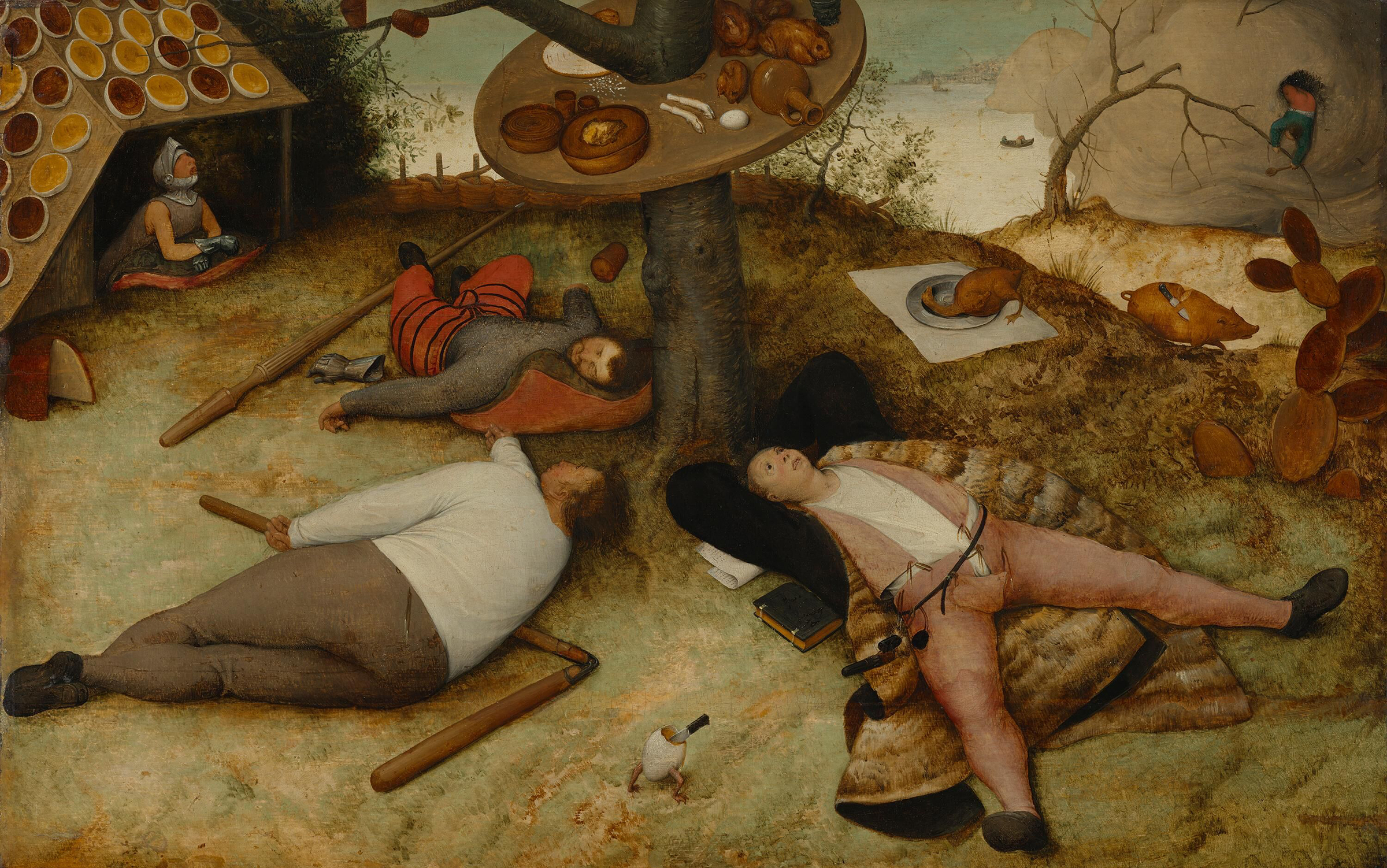
You’ve heard of the Land of Cockaigne, that fanciful place where abundance reigns. Well, welcome to the Land of Cliché, where AI rummages through all that has been said and sung and then throws it against the wall to see what sticks. Someone should be ashamed, but we’re all too excited about this brave new world to know it.
The arts need to de-shittify and return to peasant energies, ready to be changed, changed utterly, into something a new generation can live in and live through. In the Imagination, a new comedy will rise, because its loving playfulness, its caring embrace of others, is always with us, regardless of every inhuman distortion of the world as it stands. Hegel called this comedy the “World in Love.” Ultimately, that is what Nietzsche’s “transvaluation of all values” seeks, too: love not as an ethical command but as an artful metaphysic.
“Suddenly it is at an end. THE WORLD IS NEW!”—William Carlos Williams, Spring and All
From On Resistance: A Manifesto. Used with permission of the publisher, Melville House Publishing. Copyright © 2026 by Curtis White.