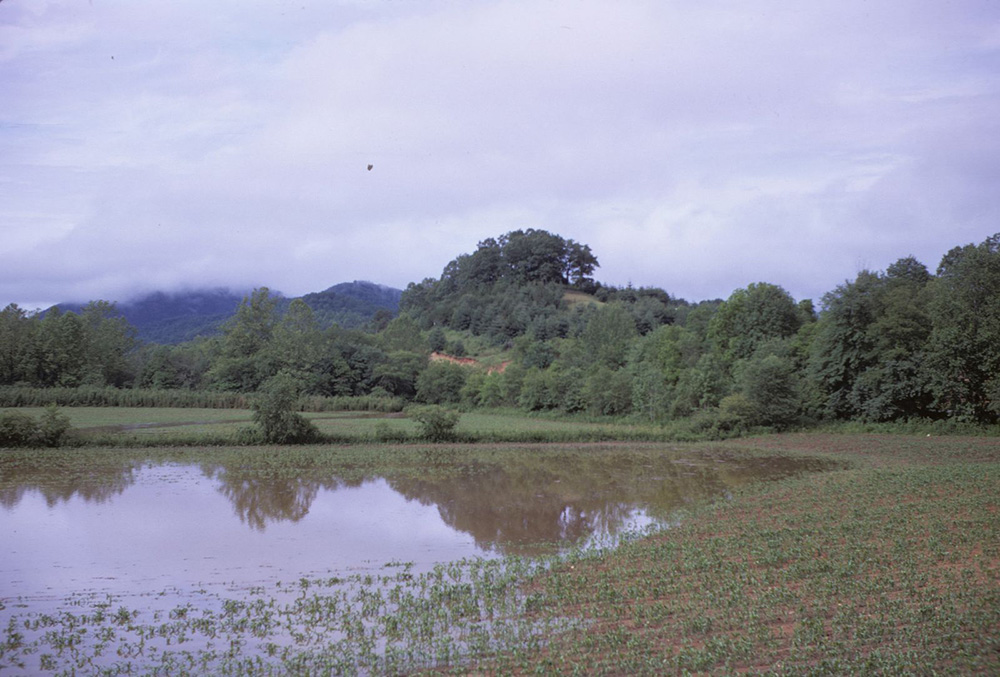
The Little Tennessee is not a big river. It flows a mere 135 miles from its source in northeastern Georgia—some 3,240 feet above sea level—to its point of discharge at Lenoir City, Tennessee, where it joins the Tennessee River. Still, each time I paddle along this river I remind myself of how this waterway has played an outsized role in North American history. Here, I can glimpse evidence of how Cherokees lived in dozens of towns—many with earthen mounds at their centers—connected by free-flowing rivers and an intricate network of overland paths. In the shallows, large boulders still bear the markings of Cherokees using nutting stones to prepare food. Look hard enough and you’ll see evidence of fishing weirs built by Cherokee fishers hundreds of years ago. By the eighteenth century, towns like Noquisiyi dotted the Little T’s riverbanks and formed the heartland of the Cherokee people.
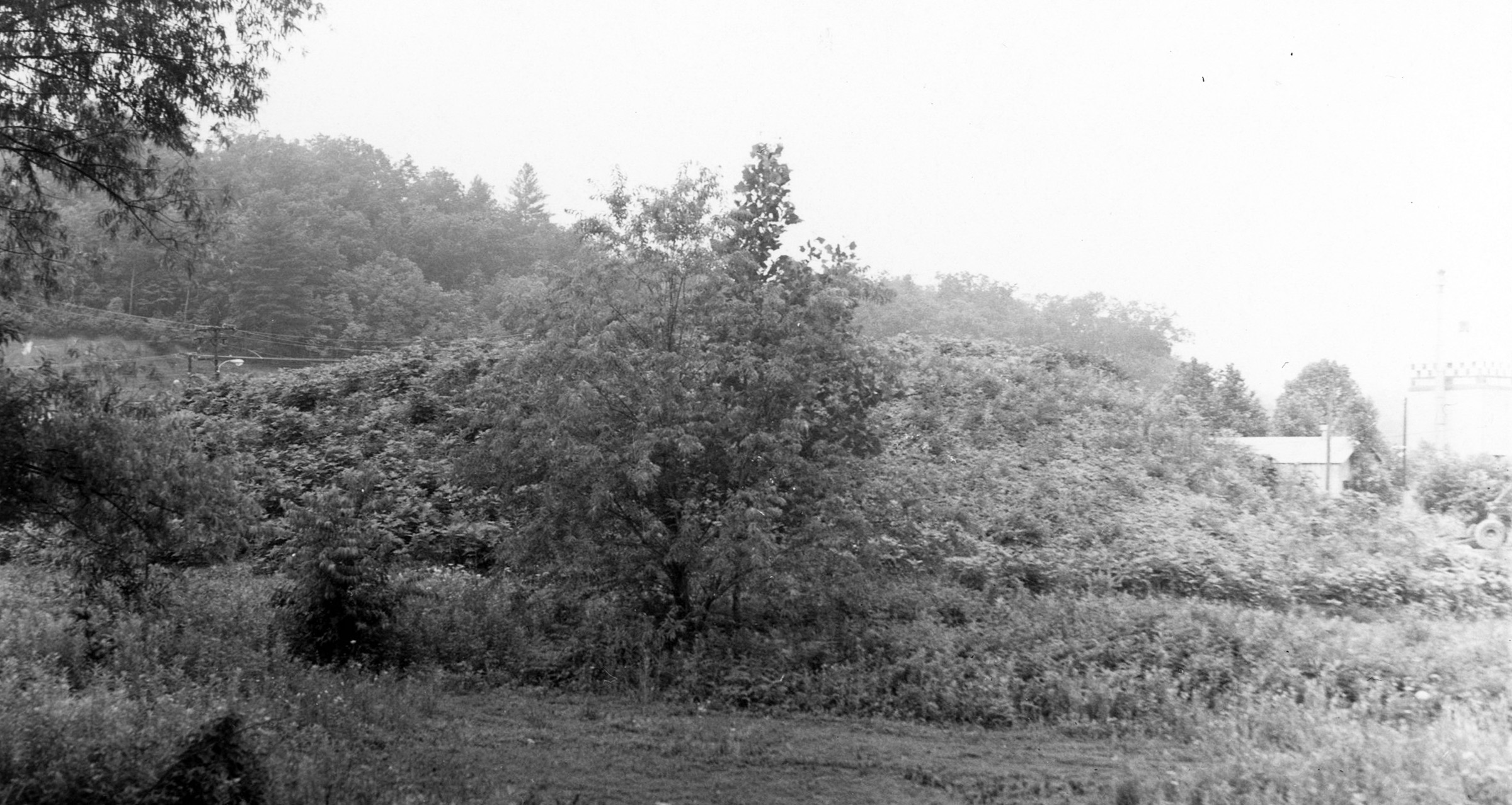
For around 12,000 years, Indigenous people have lived in and around Noquisiyi, now known as Franklin, North Carolina, a small community in the mountains of southern Appalachia. By about 1000, the ancestors of today’s Cherokee people built an earthen mound that, by the estimate of a 1937 archaeological study, rose 25 feet above the ground, measured 98 feet wide, and stretched 164 feet in length. On that elevated platform, Cherokees constructed a council house, thereby declaring their deep sense of connection to this section of the Little Tennessee River Valley. Noquisiyi, which translates as “Star Place,” was their home; they intended to stay forever.
Noquisiyi was flourishing in the spring of 1776. But in the months after Anglo–American colonists declared their independence from Great Britian, this thriving town lay in ruins. The Declaration of Independence incited anti-Cherokee violence across Southern Appalachia. The document presented a list of twenty-seven grievances; the last accused the king of exciting “domestic insurrections amongst us” and endeavoring to “bring on the inhabitants of our frontiers, the merciless Indian Savages, whose known rule of warfare, is an undistinguished destruction of all ages, sexes, and conditions.”
When Thomas Jefferson wrote these words, reports of Native American raids on settlers filled the pages of colonial newspapers, private correspondence, and militia reports. Thomas Paine read these reports. Writing in his influential Common Sense, published in early 1776, Paine accused King George III of using his “barbarous and hellish power, which hath stirred up the Indians and Negroes to destroy us.”
The charges seemed clear: Native warriors and their African American co-conspirators had aligned with the British and threatened the founders’ vision for a republic independent of Great Britain. Nowhere did this seem truer than in backcountry settlements with names like Watauga and Transylvania—places we know today as the states of Tennessee and Kentucky. In 1776, these regions were Cherokee hunting grounds in the trans-Appalachian West, diverse ecosystems that Cherokee warriors from towns along the Little T—such as Dragging Canoe, Sewanooko (also spelled Savanukah, and known as the Raven of Chota), and Abram of Chilhowie—were unwilling to cede to colonists.
In the 1770s Southern Appalachia became ground zero for genocidal violence and patriot cruelty that reshaped a region and stained the moral foundations upon which a young republic rested.
As the founders presented the Declaration of Independence to the world at Philadelphia’s Independence Hall, Cherokee attention remained closer to home. In recent years Cherokees had watched with growing unease as English, Scottish, and Scots-Irish colonists settled on hunting lands along the Watauga, Holston, Cumberland, and Tennessee rivers. Small but growing numbers of settlers had the potential to spark violence that could jeopardize the security of British colonies. The Crown knew this, which is why it enacted the Proclamation Line of 1763, an imaginary boundary that followed the north-south axis of the Appalachian Mountains. The Proclamation prohibited unauthorized settlements on lands possessed by “the several Nations of Tribes of Indians” in the trans-Appalachian West. The Crown had trade and diplomatic agreements with several of these tribes, including the Cherokees, and wanted to prevent Native communities from being “molested or disturbed” by unauthorized settlers.
But the Proclamation Line failed to halt the westward movement and machinations of illegal settlers. In March 1775, land speculator Richard Henderson had convinced Cherokee chiefs to sign a treaty at Sycamore Shoals. That agreement gave Henderson’s Transylvania Company control over large swaths of modern-day Kentucky and Tennessee.
Both British and American officials declared the Treaty of Sycamore Shoals illegal. Cherokee leaders agreed. Back in their towns along the Little T, Cherokee chiefs Attakullakulla (Little Carpenter), Oconostota, and Sewanooko, insisted that Henderson duped them. In correspondence dated May 2, 1776, Sewanooko dictated a letter sent to Henry Stuart, the brother of John Stuart, the Superintendent of Indian Affairs for the Southern District. Sewanooko asserted that Cherokees traveled to Sycamore Shoals believing that Henderson wanted to renew leases to Cherokee hunting grounds. They did not think they were selling lands watered by rivers that Cherokees referred to as ganvhida yvwi, or “Long Person.”
Henderson was only one of scores of land speculators that Cherokees rejected, increasingly in militaristic terms. Just over a year before the announcement of the Declaration of Independence, Cherokee warriors launched an armed resistance campaign, attacking illegal settlements in a bid to maintain sovereignty over their hunting lands. In response, the Overmountain Men, frontier militias formed to defend settlers against raids by Cherokee warriors, emerged. The resolve of these militias intensified as news of the Declaration of Independence filtered into the South. In Charleston, South Carolina, the public reading of the Declaration produced, according to one eyewitness, a “general satisfaction among the people.” Such sentiments extended into the “backcountry” where the Overmountain Men’s shouts for liberty meant calls for Cherokee blood.
The Overmountain Men were led by prominent public figures such as John Sevier, John Rhea, and John Crockett, father of frontiersman Davy Crockett. These men enjoyed economic prosperity, political success, and notoriety because they killed and dispossessed Cherokees of their land. John Sevier, who moved to the Tennessee River Valley in the 1770s and participated in the Watauga Purchase of Cherokee land in 1775, continued to lead destructive attacks on Cherokee towns into the early 1790s, and carried his prejudice into the next century. In her 1963 book The Cherokees, historian Grace Steele Woodward noted that Sevier once observed that Cherokee children are “nits that make lice.”
The actions of the Overmountain Men and their confederates suggests they wanted to kill “the nits” before they became “lice.” This racialized and dehumanizing logic gained support from frontier traders and settlers who characterized Cherokee violence as unprovoked. The Moravian Archives, for example, record that during the spring of 1776, Cherokee warriors killed and scalped seventeen Moravian settlers living along the Holston River. In July, South Carolina officials reported that Cherokee warriors killed settlers along the Catawba River. Fearful and angry, Southern men demanded action.
The growing disquiet in the mountains suited patriot leaders in the South. Men like Sevier and Richard Henderson dreamed of taking Cherokee homelands and using them as communications and trade thoroughfares that would connect trans-Appalachian settlements with colonies along the Atlantic seaboard. Far from the British “egging on” the Cherokees, as the writer Alan Pell Crawford contends, Cherokee warriors negotiated with British (and ultimately Spanish) officials for munitions and supplies to fight for their territorial sovereignty. Armed Cherokee warriors caused deep anxiety among white Southerners. One man, driven by years of resentments toward the Cherokees, was determined to destroy them.
The Irish-born Griffith Rutherford, a brigadier general endowed with an abiding hatred of Cherokees that he’d nurtured since the end of the bloody Anglo–Cherokee War in 1761, proved eager to bring war to the Cherokees. In 1774, he wrote to the North Carolina Council of Safety to insist that he and his militiamen receive “plenty of powder” so, in the words of the North Carolina delegates, they could execute a “war with all possible vigor against those savages,” thereby ensuring the future safety of the “back settlements.” By August, North Carolina’s delegates to the Continental Congress insisted that the goal of North Carolina’s militia must be “to extinguish the very race of them and scarce to leave enough of existence to be a vestige in proof that a Cherokee nation once was.” As they reminded North Carolina militiamen, “mercy to their Warriors is cruelty to ourselves.”
What followed were some of the most grotesque scenes of genocidal violence ever witnessed in North America. Overmountain Men joined militias from the Carolinas, Georgia, and Virginia in slaughtering Cherokees, destroying crops, and burning towns. Patriot archives in the South reveal how Rutherford successfully organized more than three thousand men into militia units. In letters to the delegates of the Continental Congress, Rutherford and fellow officers reported marching into “the heart of the Cherokee Country,” traversing seemingly impregnable mountains, and transforming fertile valleys into killing fields.
Griffith Rutherford’s private correspondence with contemporaries reveal scenes in which militias killed men, women, and children indiscriminately. Some of the militiamen paused amid the screams of the dying and the fire engulfing once verdant communities to collect souvenirs. With sharpened cutlasses at the ready, men scalped lifeless Cherokee bodies, eager to pocket the £75 reward being offered by South Carolina for each Cherokee scalp.
As the seasons turned and leaves fell to the ground, Rutherford’s men continued to destroy Cherokee communities into the late fall of 1776. One of those towns, Noquisiyi, was set ablaze by Rutherford’s men on September 10, 1776. Cherokees fled, surviving, some later claimed, thanks to protective spirit beings known in Cherokee folklore as the Nûñnë'hï. When the bloodshed stopped, some Cherokees returned to survey the damage to Noquisiyi. Nothing remained. Fearful, heartbroken, or both, Cherokees never rebuilt the Star Place.
Across the entirely of Cherokee Country, fifty-odd Cherokee towns, including the majority that dotted the Little Tennessee River Valley, were reduced to fewer than twenty by the end of 1777. Hearing progress reports of this destruction, Thomas Jefferson rejoiced. Echoing other founders, Jefferson wrote in November 1776 that having driven the Cherokees off, the “Southern colonies are happily rid of every other enemy and may exert their whole force in that quarter.”
Histories of the American Revolution tend to emphasize patriot victories over the British at Saratoga, Trenton, or Yorktown. Rarely is the mountainous South remembered in this story, save for occasional references to the Overmountain Men’s defeat of British Loyalists at the Battle of Kings Mountain in South Carolina in October 1780. Public commemorations of the Battle of Kings Mountain have tended to reframe the Overmountain Men as Patriots who fought for American freedom, erasing their role in the destruction of Cherokee towns and the exterminatory violence they inflicted on Cherokee communities.
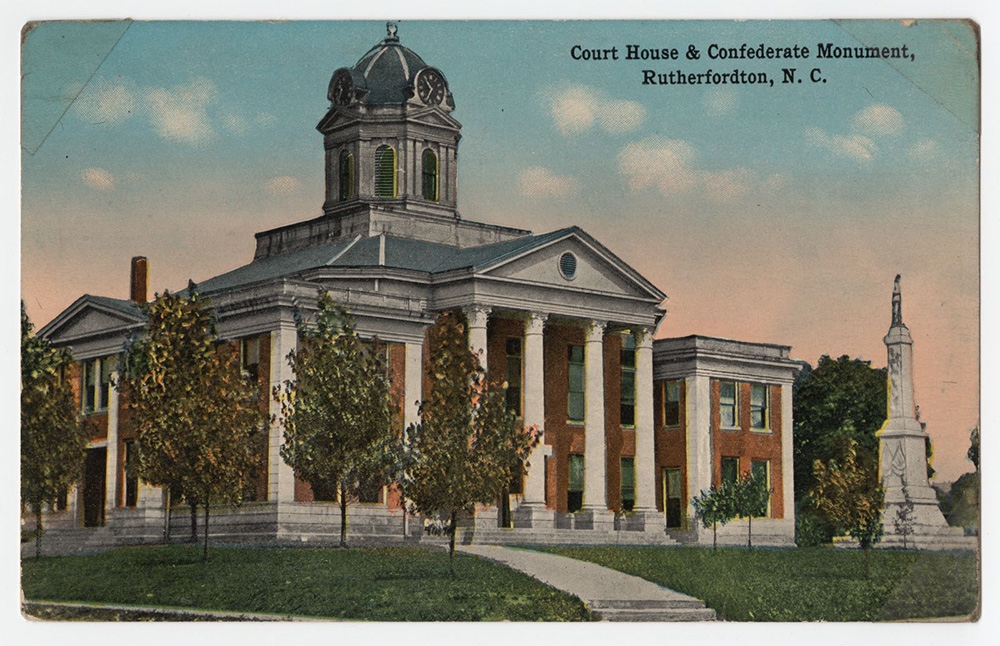
Statues honoring the Overmountain Men can be found in various public spaces throughout Virginia, Tennessee, and North Carolina. Cherokee warriors who fought in defense of their people’s sovereignty in 1776 and 1777, and—in the case of the Chickamauga Cherokees—into the early 1790s, receive hardly any comparable public acknowledgement.
On July 4, 2026, a new statue honoring the Overmountain Men was unveiled in Rutherfordton, a town founded on the slaughter of Cherokees in 1787 and situated just east of Asheville, North Carolina. Titled “Road to Victory,” local media carried stories celebrating the statue’s unveiling. The Asheville Citizen-Times quoted a local academic who claimed the Overmountain Men fought the Loyalists because the British knew that inland expansion “would make the colonists too independent.” WCAB News, a source for online news in Rutherford County, added to the celebratory coverage by quoting county officials who described the unveiling as “a special way to celebrate July 4th and the 250th anniversary of our country.”
Along the Little T, a monument of a different sort still stands. The Noquisiyi mound, which Nancy Taylor Largent, a Cherokee Nation citizen, told me “most people don’t even notice,” testifies to millennia of Indigenous history in the mountains. Largent, who’s also a board member of the Noquisi Initiative, a nonprofit dedicated to the mound’s preservation, was only half joking when she made this quip. In early 2026, Largent was present as the Noquisi Initiative returned the mound to Cherokee ownership. The transfer of ownership occurred without much public comment.
And yet, views on historical memory, like politics, are as divided in the mountains of western North Carolina as they are in the rest of the United States in the 2020s. Elaine Eisenbraun, executive director of the Noquisi Initiative, reminded me in a telephone interview that the Fourth of July is about a nation’s birth, and “birth doesn’t occur without pain”—something that the glorification of the Overmountain Men and other “extremely siloed” portrayals of the past neglect.
Bob McCollum agrees. A fellow Noquisi Initiative board member, he feels “people are more curious now” about the mound that watches over the Little T, but the bar is low. A decade ago, the general attitude toward the Noquisiyi mound was one of indifference. McCollum’s comments helped me contextualize Largent’s quip. Talking with her reminded me of the dedication that so many Cherokees display in keeping their history alive. Largent calls this “reclamation” work. As she described her dedication for this work to me, my mind again flashed back to the terrorism experienced by her Cherokee ancestors 250 years ago. Largent thinks about that violence, too; it brings her to tears. Still, she doesn’t look away from those difficult histories. People need “reminding of the reality.”
In late 2025, historian Ned Blackhawk urged a more honest accounting of the American Revolution. He concluded that twenty-first-century Americans have an opportunity to see the Declaration of Independence as a document promoting a national story of “interdependence.” Many historians would agree with Blackhawk. “Interdependence” doesn’t mean looking away from the complexities of the past, much less sanitizing difficult histories. It means the opposite. It means staring directly into these often-violent histories, sitting with them, and more fully understanding their enduring impact on the American republic.
Largent, Eisenbraun, and McCollum continue doing this type of interdependent history. Their work not only acknowledges, but grapples with, the meaning of the bloody histories upon which the republic was founded two and a half centuries ago.