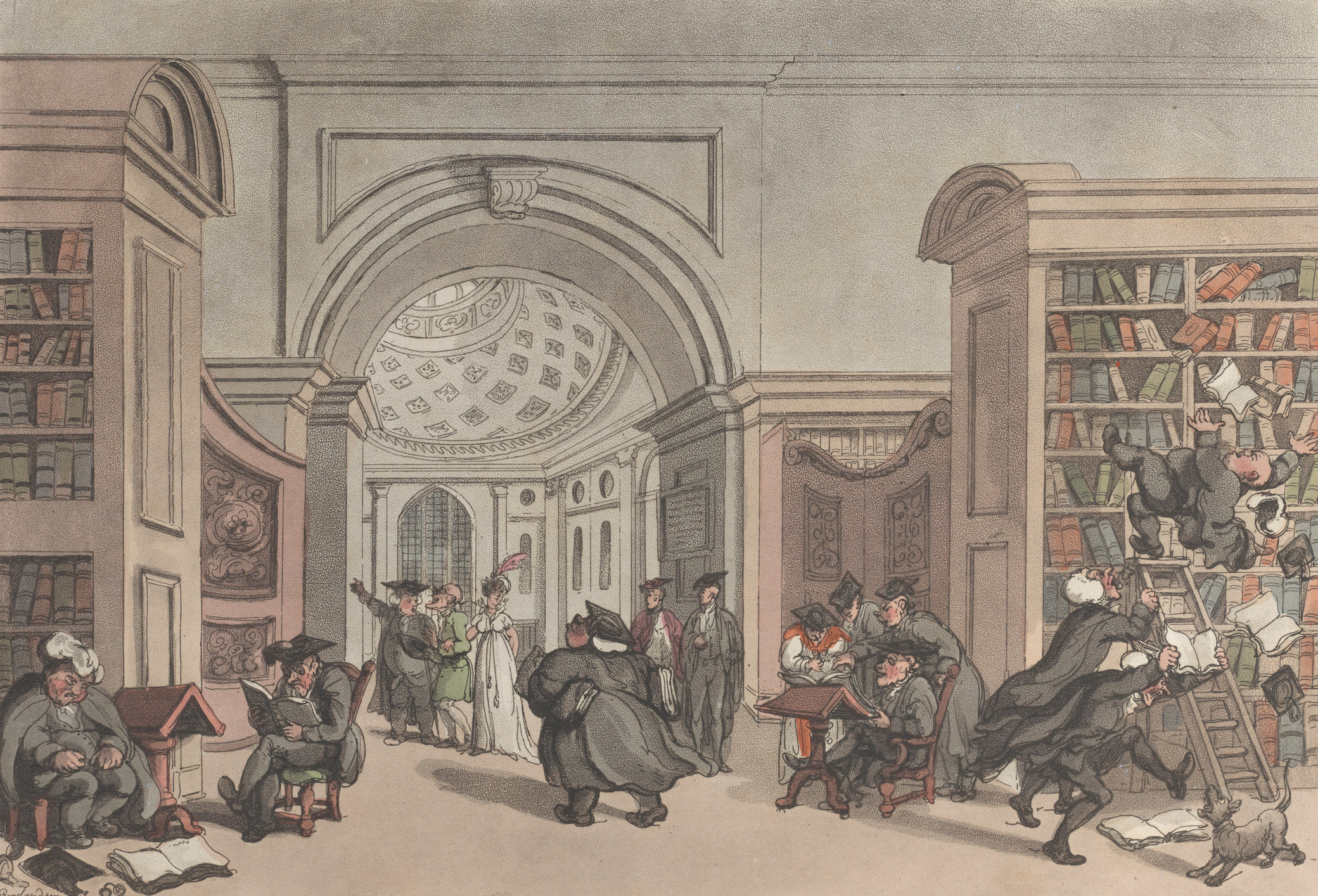
Inside View of the Public Library, Cambridge, by Thomas Rowlandson, 1809. Metropolitan Museum of Art, The Elisha Whittelsey Collection, The Elisha Whittelsey Fund, 1959.
• “The planet is indifferent to political discourses. It counts time in eons, not presidential tenures. Planetary-thinking forces awareness that the cognitive maps of modernity no longer make sense. Neither conservative nor liberal political positions are up to the task of the present.” (Verso)
• “A Homerist Reacts to Christopher Nolan’s The Odyssey.” (Hyperallergic)
• The life of library collections, from storage to display. (New York Historical Society)
• A legacy of protest at Delhi’s Jantar Mantar. (Economic Times)
• A new story of Vesuvius. (National Geographic)
• On The Secret History of the Rape Kit, at times more like “a mystery novel than a feminist polemic.” (Cleveland Review of Books)
• “Now that Miss Marple and Nancy Drew’s early novels are entering the public domain, what comes next for them?” (Los Angeles Review of Books)
• On the detective-heroines and lady criminals of Victorian detective novels. (CrimeReads)
• “The Harawayian cyborg was revolutionary because it reappropriated, to feminist purposes, a monster whose mingling of metal and flesh posed a truly horrific specter of body horror during the late Cold War. Four decades later, this icon has entirely lost its disruptive power.” (The Yale Review)
• This week in obituaries: Susumu Tonegawa, Luiz Carlos Barreto, Plas Johnson, Kaylee Hottle, David Johnson, Clint Reilly, Peter Lassally, R. James Woolsey, Garfield Sobers, Mary Kate Golding, Mike Preston, Denise Oliver-Vélez, Kozo Okamoto, and Sgt. Angel Rampersad, First Lt. Tyler James Feehan, and Army Pvt. Isabella Gonzales, the latest of at least 18 U.S. service members who have been killed in Israel’s war with Iran.