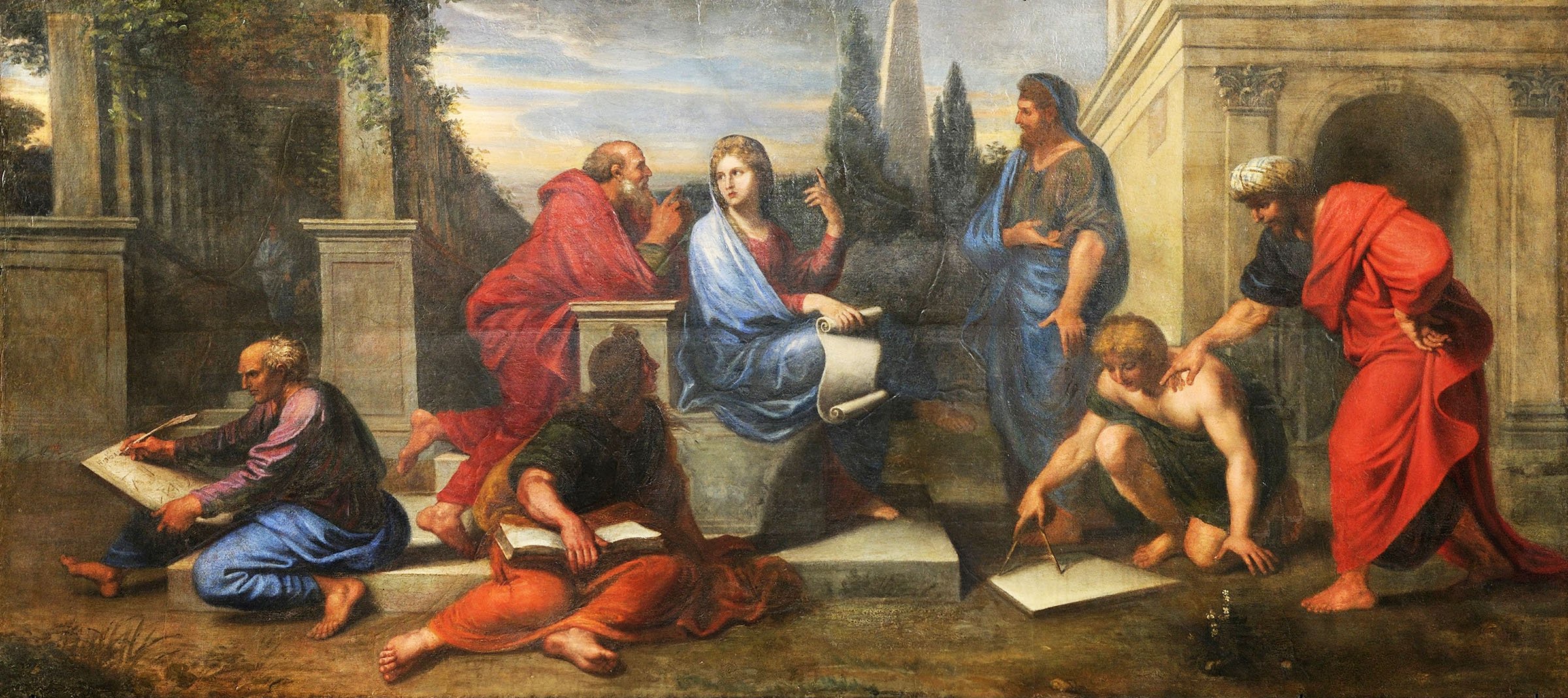
“What in God’s name are the humanities,” Lewis Lapham asked in a commencement address he delivered at St. John’s College in 2003, “and why are they of any use to us here in the bright blue, technological wonder of the twenty-first century?” His answer—the humanities are not luxuries akin to “the country club membership or the house in Palm Beach” but liberating necessities—harmonizes with the answers Zena Hitz seeks and finds in her 2020 book, Lost in Thought: The Hidden Pleasures of an Intellectual Life, from which this essay has been adapted. As she writes here, and as she noted on the June 12, 2026, episode of The World in Time, Hitz first discovered the hidden pleasures of an intellectual life as a student at St. John’s College, whose faculty she has since joined.
From my earliest memory I lived with books of all kinds. There were stacks on my bedroom floor, and they lined the dusty walls of my family’s Victorian house. My older brother taught me to read and infected me with an appetite for reading; both of my parents were lovers of books, words, and ideas without professional training or support, amateurs in the original and best sense. San Francisco in the 1970s was a strange place for many famous reasons, but its basic commitment to leisure is clear to me only now that we have passed into a far less leisurely age.
Reading and thinking for their own sake went along with outings to the stony beaches or dark mountain forests of northern California, without a clear object or specialized skills or expensive equipment. The standard for success of an activity was enjoying oneself in fellowship with others; such endeavors included the arts and crafts projects that no one would ever buy, and musical performances whose value would evaporate at too great a distance from the campfire.
My family was fond of fierce arguments over matters of fact, when no one present knew what they were talking about: world records and body counts, the proper classification of living things, and the nature of a lunar eclipse. The dictionary, the encyclopedia, and the almanac were the final reference points by which the arguments were settled. These resolutions were never entirely satisfactory. In the reference books we found ammunition for yet further discussion and argument. Not one piece of knowledge that we sought or acquired was useful for any purpose whatsoever.
My brother and I pursued obsessions with wild animals, especially sea creatures. We knew all eighteen species of penguin and the feeding habits of whales. Large, blubbery sea lions sometimes surfaced at the local seashore; otherwise, we relied on books or visits to the local science museum, studying our beloved objects through whale skeletons or at the thick-glassed dolphin tank that replayed recorded dolphin sounds when we pressed a button at the side. We amassed a vast collection of stuffed animals, who formed a political community and elected a small walrus as president. We established a constitution for them, wrote civic anthems, and, of course, told stories. We imagined our way into the lives of animals, fusing animal and human capacities as children have always done.
Larger questions lurked unexpressed behind our sea of facts and our playful imagining. What is a human being? Is it enough to see, feel, eat, swim, squeak? Are we a part of nature, or somehow outside of nature?
My father and I once discussed that question on a camping trip, sitting on a rock in a mountain stream in the shade of clustered redwoods. It seemed unimaginable that we were like the forest, running water, or rock around us. Somehow a human being stands outside of the natural, and yet even a child knows that the time will come when breath is gone and all is overcome by weight, resistance, decay, and fermentation, our flesh traveling through the gullets of animals to become dirt and dust.
My family did not undertake intellectual practices and concerns as a means to an end. They did not consider them to be preparation for life, but rather a way of spending one’s time that had worth in itself. Accordingly, they did not blink when I left home to study old books and fundamental human questions at a tiny liberal arts college on the East Coast, a secular school under the improbable religious name of St. John’s College. My parents did not ask me what use I would make of epic poems or ancient treatises on plants, whether it would help me to find my way in the world. Not that my choice was foreordained: my brother, for instance, pursued specialized training in biochemistry. But I needed neither prodding nor reassurance to study the liberal arts. The value of such an education, as one path among others, was simply obvious to us.
I blossomed in the simplicity and spontaneity of life at the college: the exclusive focus on reading and conversation, the insistence on asking basic human questions, the conviction that the value of intellectual activity lay in the search more than the achievement. I remember writing an essay on Oedipus Rex as a freshman and being overwhelmed with the delight of discovering new—to me—insights. I walked about in the pale green of spring trees in rapt distraction, thinking about things, and I knew that, somehow, I had found an essential piece of my future life.
What does it mean to pursue learning for its own sake? Is it even possible? Is the joy of learning itself selfish? If not, how could the strands of selfishness in it, the rush for achievement, the thrill of competition, be unwound from its heart? And yet, without visible results, why should intellectual life matter, especially in a world so suffused with suffering? What role could it or should it play in repairing the broken fragments of our communities or in pushing back the darkness at their margins?
What does learning look like, stripped of its trappings of fame, prestige, fortune, and social use? In other words, how is it good for its own sake, because of its effect on the learner rather than because of its outward results?
I say “its effect on the learner,” but that phrase of course raises further questions. What sort of effect are we looking for? If learning is simply a pleasure, like a foot massage or a walk on the beach, would that suffice to account for its value? I think not, because a human being must be more than a vehicle of pleasure.
Questions about what is valuable in itself for human beings have to do with what a human being is and what our ultimate value is.
These are huge questions, to the point of being indigestible. They have to be nibbled around rather than gulped all at once. We all know examples of learning loved for itself. We see the love of learning in children collecting and cataloging dead bugs, or in bookworms as they huddle in closets and corners, hiding from their public lives as shop owners, politicians, or housewives.
A bird watcher with his binoculars and guidebook lives a life of learning, as does a hobbyist modeling historically accurate toy soldiers, carefully researching period costumes and hairstyles.
We desire to learn for as many reasons as there are things to desire. A spy reads a work of literature to get inside the mindset of her target; a quant on Wall Street fiercely calculates risks to maximize profits; a political activist pores over scientific literature seeking evidence that supports his cause; a mafia boss studies the chemistry of decomposition to get rid of a body.
These are not exercises of the love of learning but are undertaken for different goals: military victory, wealth, political success, escaping the notice of the law. So we call such uses of the intellect instrumental; they are motivated by results and outcomes, whatever the intensity of their pursuit. By contrast, the hidden life of learning involves some savoring of its natural objects—people, numbers, God, nature—for their own sake.
A person can do mathematics without doing it thoughtfully and reflectively, caught instead in a fear- and shame-driven race for achievement. Such is the life of learning offered by much or most of our educational system. On the other hand, a person can start out on a project as a mere means to an end and find herself appreciating the activity for itself. Consider comedian Steve Martin’s description of how he became a philosophy major thanks to the influence of his girlfriend, Stormie:
If Stormie had said I would look good in a burgundy ball gown, I would have gone out and bought a burgundy ball gown. Instead, she suggested I read W. Somerset Maugham’s The Razor’s Edge. The Razor’s Edge is a book about a quest for knowledge. Universal, final, unquestionable knowledge. I was swept up in the book’s glorification of learning and the idea that, like a stage magician, I could have secrets possessed only by a few.
Martin starts out trying to please his girlfriend and ends up discovering a passion for learning that shapes his young life. But his interest in philosophy outlasts the relationship that inspired it; it would be a mistake to see it as inauthentic, as a mere attempt to please someone else, because of the way it was discovered.
Jack London tells a similar story in his semiautobiographical novel Martin Eden. The working-class protagonist is invited to a wealthy stranger’s house, where he examines a pile of alluring books and meets a beautiful young woman. He falls in love with both and undertakes a grueling self-directed course of reading for her sake. But as it turns out, the books unlock a highly critical and brilliant individual with whom the wealthy young woman is incompatible. Eden’s development exposes a rift between the carefully policed gentility of the educated middle classes and the wild and open possibilities of intellectual development. His progress into a suicidal disillusionment also points to a danger of a life of learning: an alienation that breeds arrogance and contempt for others.
Save the dangers for later: for now, it is enough to notice from these two stories that we form ourselves—our talents, our interests, and our characteristic activities—from humble, nakedly instrumental beginnings: from getting what we want, avoiding humiliation, and seeking love, approval, and social advancement.
They open doorways within us, desires, concerns, sources of wonder that we did not know were there. Activities catch on in this way because they meet a natural need in us. Our natural needs often lie buried; something from the outside attracts us, or shatters or breaks through the obstacles, so that those needs are brought to the surface.
Something in us wants to learn for its own sake, even if we embark on that learning for the sake of some smaller end.
How ought we describe this human need, the appetite for learning and understanding, in a way that illuminates its typical forms and deviations? I follow a tradition originating with Plato and Aristotle that distinguishes types of desire by their final ends. Plato and Aristotle and many after them sought something they called the highest good—the best human activity, pursued for its own sake—for which we have a natural affinity above all others.
Such a good would be something in which one’s whole life would culminate, a form of secure happiness built into who we are and what we want.
Our ultimate end can be displayed by our choices as the thing to which we are most fundamentally committed, something for which, when the chips are down, we will sacrifice anything else. It may only be at points of conflict or times of trial where we discover what in the soup of our conflicting desires and pursuits matters most to us. We promise “till death do us part” when our love is young and good-looking and when life is full of promise, but it is in failure or decrepitude or at the hospital bed that we learn what we meant and why.
What would happen if we tried to organize our lives around merely instrumental pursuits, such as earning money or promoting justice? Aristotle argued that our ultimate end had to be sought for its own sake, or our actions would turn out to be empty and vain. If I work for the sake of money, spend money on basic necessities for life, and organize my life around working, then my life is a pointless spiral of work for the sake of work.
Leisure is not merely recreation, which we might undertake for the sake of work—to relax or rest before beginning to labor anew. Leisure is an inward space whose use could count as the culmination of all our endeavors. For Aristotle, only contemplation—the activity of seeing and understanding and savoring the world as it is—could be the ultimately satisfying use of leisure.
Despite a long tradition of thinking that Aristotle helped to inspire, the kind of leisure that functions as an ultimate goal of living does not require vast estates and the life of a country gentleman. It can be taken in a moment, or in a long pause; it can fruitfully coexist with certain kinds of manual labor. The great books movement that for a time shaped American intellectual culture began among working people, in workmen’s institutes where people who toiled with their hands sought to develop themselves as human beings with rich inner lives.
That said, under certain circumstances leisure does not exist, and so its use is impossible. Pursuing the necessities of life can be utterly overwhelming. This is particularly true if one has to work at an exploitative job. In Martin Eden, Jack London describes his protagonist Martin studying fervently to educate himself, both for his own sake and to make him worthy of the woman he loves. Gradually he runs out of money. He takes a job in a laundry that requires fourteen hours of solid, concentrated work six days a week. Having previously lived on only five hours of sleep, he is confident upon taking the job that he can continue to read after work. After one day in the laundry, the powers of concentration necessary for him to read evaporate.
After one week, he no longer has the energy even to think: “There was no room in his brain for the universe and its mighty problems. All the broad and spacious corridors of his soul were closed and hermetically sealed.” After three weeks of this routine, Martin returns to drinking after a long abstinence, and he finds in drunkenness the imagination, warmth, wonder, and beauty that the laundry work has driven out of him.
London’s account is fictional or semifictional, but it closely matches the real-life experiences of others. George Orwell writes of his stint in the kitchen of a Paris hotel, where employees at his level work eighty to one hundred hours a week, leaving no time to think, and no money to save up for a family or for a change of career. Their lives are wasted in exhausting work from which drink and sleep are the only refuge. Barbara Ehrenreich describes her experience at the end of two shifts of waitressing: “I am not tired at all, I assure myself, though it may be that there is simply no more ‘I’ left to do the tiredness monitoring.”
Leisure can be destroyed in appalling working conditions designed by others. Leisure can also be destroyed by anxieties imposed, through no fault of our own, in the crush of life. It can be destroyed by compulsive behaviors that consume all of our thought and awareness. Leisure can also be destroyed by our own choices. Aristotle’s teacher Plato, through the mouth of Socrates, describes philosophical leisure by contrast to the experience of someone immersed in law courts and in various forms of social striving. To a philosopher, a leisured person, it does not matter
whether they talk for a day or for a year, if only they may hit on that which is. But the other—the man of the law courts—is always in a hurry when he is talking; he has to speak with one eye on the clock. Besides, he can’t make speeches on any subject he likes; he has his adversary standing over him, armed with compulsory powers and with the sworn statement, which is read out point by point as he proceeds, and must be kept to by the speaker.
The unleisurely life of the law courts, hurried and constrained by the demands of others, is evidently the product of education and choice, not of externally imposed economic circumstances.
We have contemporary parallels to the voluntary slavery of Plato’s law courts. Consider the world of urban tech workers described in Lauren Smiley’s 2015 essay “The Shut-In Economy.” Many such workers work from home and live by themselves. To save time, they use numerous apps for everyday tasks such as ordering meals, grocery shopping, and simple household organization. Today’s Martin Edens, the low-paid delivery workers, drivers, and cleaners, must stack job upon job just to meet the cost of necessities. But those they serve, the urban tech workers, do not save time for the purpose of leisured contemplation or wholesome hobbies, but rather in order to work even more. Smiley describes one tech worker who has determined that for every hour she saves by outsourcing her personal and household tasks, she can make $1000 for her company. So she works eleven-hour days and uses app services to run her errands, do her hair, and straighten her home.
By contrast, the office job that was more common in previous decades may be deadly boring in itself, but it leaves clear an inward space for other routes of development. John Baker worked for many years pushing paper at the Automobile Association in Essex, and in his spare time looked at birds with systematic personal and contemplative intensity. He followed peregrine falcons by bicycle, carrying maps, eyeglasses, and voluminous notebooks. The result was the extraordinary poetic reflection published in his 1967 book, The Peregrine.
The patron saint of overworked teachers, Alice Kober, taught five classes at a time at Brooklyn College in the 1940s. At any rate, she taught during the day. At night, she set about deciphering an ancient language, Linear B, that had been uncovered on clay tablets at the turn of the century and that stood as a Mount Everest for linguists, a seemingly impossible puzzle. A middle-aged spinster, the daughter of working-class immigrants, she collected the statistics for each sign of the dead language on 200,000 paper slips. Because of paper shortages during and after the war these slips had to be repurposed from any spare paper she could find. The slips in turn were collected into old cigarette cartons. Her work was cut off by an untimely illness, but she laid the foundation for the dramatic deciphering that took place only a few years after her death.
The robustness of the capacity of human beings to savor, contemplate, and enjoy indicates its natural depth in us. The leisure activities that count as a culminating end of life have a sort of timelessness. When we are at leisure, we stop counting the minutes toward the goal, because the goal is precisely what we are doing. Sometimes, leisure takes the form of an intense activity: staying up all night talking, cataloging weeds in the garden, John Baker’s bird-watching. The freedom of a leisurely activity is the freedom from results or outcomes beyond it, not the freedom of rest or recreation.
The praise of learning for its own sake as necessary for a flourishing life is often charged with displaying an aristocratic bias, as if aristocratic Aristotle’s endorsement was the kiss of moral death, as if a truth could not be tangled up with moral ugliness.
The idea that real and serious learning is something practiced only by a small elite is stubborn and hard to displace. But it is false. In the United States, perfectly ordinary people pack up their telescopes in summertime and head for star parties in dark rural areas, seeking out supernovas, double stars, and unusual planetary conjunctions. Travel to Gettysburg and you will find thousands upon thousands of ordinary citizens who suddenly want to know everything about a battle that took place 150 years ago: the human fighters and the human dead, their clothes, their weapons, their stratagems, victories, and failures.
Behind such pursuits lie fundamental questions: Where did the universe come from? Are the vast galaxies the product of chance or design? What makes war, the greatest of human evils, possible? What could make it seem morally necessary?
The love of learning is general among human beings and pursued in a variety of ways and degrees. We do not always recognize it. We miss it in its lowlier forms, and misidentify it in its higher ones.
Intellectual life is a way to recover one’s real value when it is denied recognition by the power plays and careless judgments of social life. That is why it is a source of dignity. In ordinary social life, knowledge is exchanged for money or for power, for approval or for a sense of belonging, to mark superiority in status or to achieve a feeling of importance. These are our common currencies, our ways of advancing ourselves or diminishing others. But since a human being is more than his or her social uses, more fundamental ways of relating are possible.
These forms of communion can consist in the joyful friendship of bookworms or the gritty pursuit of the truth about something together with people one would otherwise find unbearable.
If there were no such thing as a core of humanity that we all shared in common, we could not make sense of our experience of connecting with one another in the depths. So, too, if there were not something in us beyond our social value in wealth, social status, or political achievement, it would not be obvious why an inner life would be anything worth cultivating. In this way, intellectual life, learning for its own sake, suggests a mysterious subject—the thinking or reflecting person, who has a hidden worth or dignity.
Adapted from Lost in Thought: The Hidden Pleasures of an Intellectual Life. Copyright © 2020 by Zena Hitz. Published by Princeton University Press. Reprinted by permission.