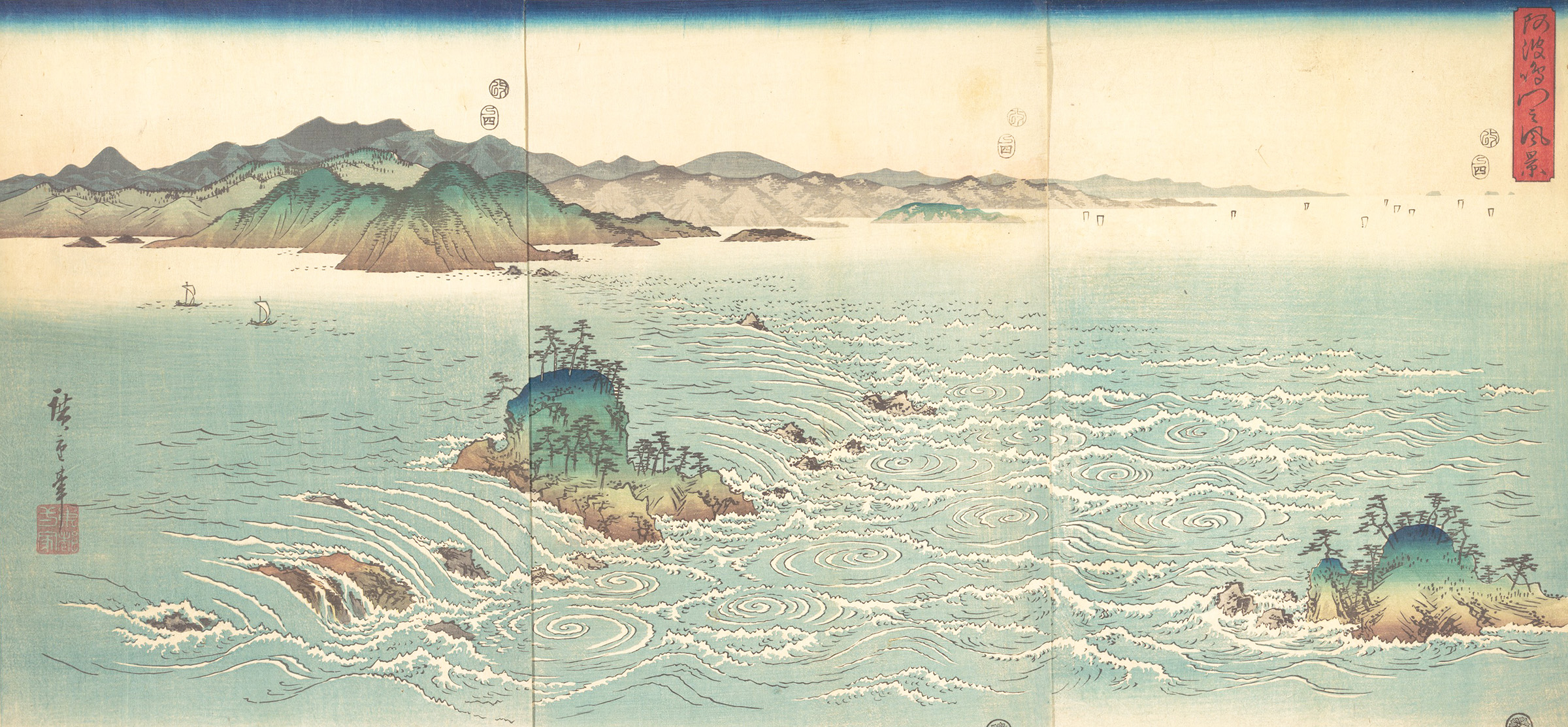
One of 53 alphabetically arranged essays about “geomyths” collected in Mythopedia: A Brief Compendium of Natural History Lore. As Mayor writes in the Preface, her brief compendium draws upon oral traditions from all over the world and upon “the most recent historical and scientific discoveries that shed light on the remarkable phenomena featured in the legendary stories”—phenomena such as tsunamis, meteor impacts, lethal lakes, perpetual fires, frogs and fish that rain from the sky, and sand dunes that sing. “Whirlpool” is her entry for the letter W.
In ancient Greek mythology, Scylla and Charybdis were terrible monsters facing each other in the Strait of Messina, between Italy and Sicily. Charybdis eternally gulped and belched great volumes of seawater, creating a perilous vortex. There was only one way to avoid being sucked into her deadly maw, and that was to sail dangerously close to Scylla’s treacherous rocks opposite Charybdis. In Homer’s epic poem The Odyssey, Odysseus and his sailors survived the double threat, as did Jason of the Argonauts in the ancient Argonautica saga. Today the ancient seafaring menace of the Strait of Messina is called Garofalo. The whirlpool is caused by high winds colliding with the tide in the narrow but very deep (more than 800 feet) strait.
Since antiquity, whirlpools have terrified seafarers around the world. For example, sailors have long dreaded the strait between Scotland and Ireland where ships were suddenly whirled around until they met their watery doom. In the sixth century, Saint Columba miraculously survived crossing this whirlpool, known in Latin as carubdis Brecani. By medieval times, the word carubdis/charybdis had come to mean any frightening ocean whirlpool. The Gaelic name for the whirlpool between Scotland and Ireland was Coire Bhreacain (Corryvreckan), the “cauldron of the plaid,” the plaid being the woolen cloak of Cailleach, the giant witch of winter. Each autumn, the giantess vigorously washes her tartan cape until it becomes a snow-white blanket. Her actions whip up a wild tempest in the strait, thereby ushering in winter. The roar of the great vortex, audible ten miles away, was said to be the giant witch’s shrieks.
In an Old Irish text from c. 900, Cormac’s Glossary, Cormac mac Cuilennáin of Cashel described Corryvreckan thus: the seas clash in “thunderous eructation,” belching and roaring like a boiling cauldron. Water plunges down and vomits forth with such force it seems that “it would suck the whole of Ireland into its yawning gullet.” Indeed, churning the waters in the narrow strait between the islands of Scarba and Jura, off the west coast of Scotland, Corryvreckan is the third-largest ocean whirlpool and one of the most violent bodies of water in the world.
In the Scottish legend of Corryvreckan, a sea witch peered into the evil soul of an Irish pirate from Ulster as he sailed into the strait. To protect Scotland from his depredations, the witch summoned the whirlpool to swallow his ship. In another legend, Corryvreckan was named for Breacan, a Viking prince who perished when courting a Scottish princess. Her father gave him the impossible task of anchoring his boat in the cauldron’s roiling gyre for three days. To hold his boat fast, Breacan used ropes of braided hemp, wool, and the hair of the purest Norse maidens. Tragically, the ropes snapped on the third day, revealing that one of the maidens was not a virgin.
Until recently, it was assumed that Corryvreckan and the eddies it spawns were caused by currents rushing up from a deep underwater valley against a submerged pinnacle rising ninety-five feet from the ocean floor in the center of the narrow channel. But in 2012, Scottish oceanographers used echo-sonar technology to map the topography of the seabed between the islands. The scientists detected no central pinnacle. The violent swirling is apparently caused by a steep rock ridge that protrudes underwater like a buttress from the base of the tiny island of Scarba. As the tide pours through the narrow strait, the sea surges over and around the natural rock obstacle, creating turbulent downdrafts and tall standing waves. During gale-force winds on a flood tide, the standing waves can tower twenty feet. A mannequin wearing a life jacket with a depth gauge was once thrown into Corryvreckan. It was sucked down and later recovered miles away, its tattered life jacket filled with gravel after being dragged along the sea floor 860 feet deep.
Norway has two notorious whirlpools. Saltstraumen is the world’s fastest whirlpool, spinning at 25 miles per hour. The world’s most powerful and largest whirlpool (150 feet across) is the Maelstrom (“grinding current”) or Moskstraumen. These vortices are in the open seas near the Lofoten Islands in the Arctic Circle. Moskstraumen was described in the medieval Norse Edda (1250) and appears in Olaus Magnus’ map of 1539 labeled Horrenda Caribdis (“Horrific Charybdis”). The whirlpool is unusual for occurring in the open sea, not in a confined strait. There is a shallow ridge between the Moskenesøya and Vaerøya Islands that intensifies the strong tidal currents that flow through the shallows between the Atlantic and the very deep, large fjord, firth, or bight of sea, stirring up a swirling vortex. The Moskstraumen maelstrom was featured as a monstrous, inescapable entity in the nineteenth-century fiction of Herman Melville, Jules Verne, Edgar Allan Poe, and, most recently, by the Chinese engineer and sci-fi writer Liu Cixin.
Notably, modern astronomers’ ominous descriptions of black holes in space also evoke the terror of an irresistible, incredibly powerful force pulling everything into a funnel to oblivion. In the outer depths of space, vast, dark whirlpools suck matter and time into an infinite abyss of gravity.
Adapted from Mythopedia: A Brief Compendium of Natural History Lore. Copyright © 2025 by Adrienne Mayor. Reprinted by permission of the author and Princeton University Press.