Titan
In April 2022, a pale white cruise ship heaved onto the coast at Gadani, Pakistan, twenty-five miles northwest of Karachi along the Arabian Sea. A plume of exhaust streamed out from her funnel; her anchor, visible from the beach, dangled portside above the turquoise water. The ship was in good shape: her hull was free of dents and scuffs, and her coat still looked pretty decent, with a bright stripe of blue paint some fifty feet above the water. Near the top deck, between the gym level and the nightclub level, life rafts hung—waiting, perhaps, to once again save somebody’s life.
Only it was the ship herself that needed saving, and it was much too late for that. She was on the last mile of her final journey. She had come to Pakistan to die.
Dying isn’t easy when you have a sixteen-thousand-ton steel body that has been afloat for forty-seven years. You cannot return to dust. You must die slowly, deliberately, piece by rusting piece. Lawfully, too—there are many rules governing what happens to a ship’s decomposing corpse. But the vessel knew how to get around those, and the myriad other laws that get muddled in the world’s waters. Until quite recently, the ship had been known as the Salamis Filoxenia and sailed under Cypriot colors. Now she was the Titan, and she flew the funeral flag of Palau, a fictitious identity tailor-made to evade environmental regulation.
Nobody cared that the Titan had been around the world, but never once to the Pacific island republic of Palau. She’d hosted Soviet and American vacationers during the Cold War and employed British dancers, Egyptian cooks, and Romanian engineers at the turn of the millennium. She’d delighted enthusiasts from Turkey, Greece, and Cyprus, who circulated snapshots of her comings and goings at Mediterranean ports of call. She’d charmed an Indian manager and a Ukrainian actor, who went online during the pandemic to find footage of their old friend. “I was with her from 2009-2013, love her, every corner of her I still remember,” commented Mahi Maji, a member of the crew, on a Facebook post.
Oleksander Babii first boarded the ship in his hometown of Odessa in 1983 as a tourist, then returned to perform as a mime in 2011. When he learned of her demise, days after Vladimir Putin pledged to escalate his war against Ukraine in the fall of 2022, Babii was gutted. “This is real? I did not know,” he wrote. “Now I do not follow the news in the world because we are at war here. But if it’s true, of course it hurts. I’m so sorry.”
Sharing the sentiment were 3,700 members of a Facebook page created in the ship’s honor, in which former passengers mourned the summers aboard they had known and loved. They remembered lavish spreads of carved watermelon and shrimp cocktail, crepes with ice cream, the hot buffet, the cold buffet, magic shows, belly dancing, the piano bar, the disco ball, and an exuberant rendition of “YMCA” after dark. Two full years of Covid-19 restrictions meant that these reminiscences were the closest many of them could get to recapturing the feeling of being truly carefree—let alone carefree on a budget cruise catering to a thousand-odd middle-class Europeans.
I’d never met the Titan, and now I never will. But I know how she smelled: like wet hair, well rum, and Club Med.
The party’s over now, the summer long gone. In her final resting place, in a shipbreaking facility far from home, the Titan is dismembered, her entrails left to dry in the baking sun. The tables where diners overate spaghetti carbonara are auctioned off in bulk; the light fixtures that illuminated drunken conga lines are pulled off the walls. Mattresses are removed from cabins, which are torn from decks, which are pried from the hull, which is broken into chunks, melted down, and recycled into another ship.
Gruziya
The Titan began her life in a shipyard in Turku, Finland, in 1975 as Gruziya, the second of five sister vessels commissioned by the Soviet Black Sea Shipping Company. Her given name—the first of many—was the Russian term for the then Soviet Republic of Georgia. By her side were the Belorussia, the Kareliya, the Kazakhstan, and the Azerbaijan. In true Soviet fashion, each ship was created equal: 512 feet long, 54 feet deep, and painted white with a handsome dash of red. In true Soviet style, the vessels flew the hammer and sickle at sea.
Over the next five decades, this flag would be replaced time after time as the tides of history swept the Gruziya and her sisters away from their home port of Odessa and across the world. She would survive regime changes and economic catastrophes, only to serve new gods and new masters. She would weather storm after economic storm until she met her end in a watery grave.
Gruziya’s first assignment was as a passenger ferry. In her early days, she earned her keep shuttling Soviet citizens, functionaries, and their cars between the Caucasus and Crimea. Then, in the 1980s, she was kitted out with small luxuries—nicer cabins, a movie theater, a bar—and began working cruises on the Black Sea. Her clientele was made up mostly of domestic tourists, but the trips were also open to Westerners looking for an affordable holiday that was “not Las Vegas,” as one travel agent put it to the New York Times. That’s when Babii first boarded for a seven-day cruise. The Gruziya stopped at the Soviet ports of Yalta, Sochi, Sukhumi, Batumi, Sebastopol, and Novorossiysk.
When the USSR collapsed in 1991, the Black Sea Shipping Company became Ukrainian, and the Gruziya and her sisters were managed by the state-owned company known as Blasco. The firm, once among the biggest in the world, was caught between socialism and the market, with the new Ukrainian leader, Leonid Kravchuk, angling for its privatization without delay while the old communists in the Ukrainian parliament sought to slow the process down. The standoff escalated into a political battle, with the parliament investigating Blasco’s management and finding significant misappropriation of state funds (the company denied any wrongdoing). That, in turn, spooked potential investors in the firm; after struggling for years, the company declared bankruptcy and sold its fleet.
Boardroom drama did not stop the Gruziya from taking advantage of her newfound freedom. That first summer, she sailed the Mediterranean; the next, she set off for Canada’s St. Lawrence River. In Montreal in August 1992, her hammer and sickle were replaced with a large trident; the ceremony, which marked Ukraine’s first anniversary as a sovereign nation, was attended by officials and dignitaries, including the first Canadian ambassador to Ukraine, three high-ranking members of the clergy, and a Ukrainian youth orchestra.
Later that fall, the ship made her way down the Atlantic coast to St. Petersburg, Florida. A civilian flotilla sailed out to greet her; she was the first ex-Soviet ship to sail out of a U.S. port in a decade, and she took passengers to Bermuda, Mexico, the Honduran island of Roatán, and on a “party cruise to nowhere” that lasted two drunken days. On a Caribbean hardship assignment in 1993, a reporter for the South Florida Sun Sentinel looked on as an American bartender explained to a young Russian crew member how to mix cranberry, orange, vodka, and peach schnapps into a Sex on the Beach. “It is one thing to hear that the Cold War is over,” wrote the reporter. “It is another thing altogether to sit on a former Soviet ship in the middle of the Gulf of Mexico and watch a foodie from Tampa presiding over the making of prurient cocktails.”
But ships are creatures of circumstance, and cocktail hour would be over before the dinner bell rang. In May 1994, the U.S. Department of Defense put out a tender: it was seeking vessels, complete with crew and staff, for a lucrative gig in the Caribbean. There was trouble in Haiti—a military coup, compounded by crushing poverty, tangled up in two decades of repression, corruption, and foreign meddling—and the Military Sealift Command needed all the help it could get corralling thousands of Haitians trying to leave their country. The ships would not be guiding the migrants to safety or helping smaller vessels navigate to shore. They would be housing military personnel, fishing people out of the ocean, and carrying out asylum screening procedures on board, with the intention of sending the migrants home as soon as possible.
The Gruziya met all the requirements: she could be free to start work by the end of May and would accommodate up to seven hundred passengers. A ship broker representing the Pentagon contacted a second broker, who tapped the Gruziya’s management, and their bid to charge $34,000 per day won out against the competition.
That was how, practically overnight, the vessel transformed from a booze cruise to a facility aiding in the “interdiction, reception, transportation, detention, security, control, and processing of Haitian migrants.”
The Gruziya wasn’t the first vessel enlisted for this kind of work, known in legal and policy circles as interdiction. The United States had for decades gone to extraordinary lengths to keep immigrants in general, and Haitians in particular, as far away from its territory as it could—a move designed to prevent them from claiming and asserting U.S. constitutional rights.
There is a dark symmetry to the American origins of interdiction. If new arrivals to the United States had historically been intercepted at way stations like Ellis Island for registration and quarantine, the use of ships cruising in the open ocean served an opposite purpose: to keep them out. And if the borders of the territorial U.S. had been inspired by Manifest Destiny, or the idea that settlers were ordained by God to grow their dominion, then expanding the reach of the immigration authorities off land, out into the ocean and into the jurisdiction of other sovereign states, made a certain metaphysical sense in a period of escalating globalization.
As soon as she won her charter from the Military Sealift Command on May 14, 1994, the Gruziya canceled vacation plans in order to participate in what became known as Operation Sea Signal. The decision surprised the cruising community. “The last time I remember hearing anything similar to this type of situation was when the Queen Elizabeth II was taken over by the British government during the Falkland Islands War,” one travel agent told the Tampa Bay Times. “It’s very unusual.”
Alexander Bout, the executive vice president of the Gruziya’s cruise company, was unapologetic. “We are not running a charity,” the Odessa executive told a Ukrainian American community newspaper. “Never before has the U.S. State Department used any vessel from the Soviet Union in performing its duties.”
After a short delay to repair the onboard ventilation system and install migrant processing teams, the Gruziya began her journey. According to U.S. Navy archives and press reports, the ship sailed from Florida to Jamaica, whose government had agreed to let U.S. ships anchor in its territorial waters from June 10. The order of operations was reported as follows: Migrants leaving Haiti would be picked up by the navy’s own cutters patrolling the Windward Passage. The cutters would take the asylum seekers to the USS Comfort, a thousand-bed hospital ship anchored near Kingston, where asylum interviews, newly resumed under Clinton, would take place. Migrants who did not fit on the Comfort would be transferred to the Gruziya, where they would sleep on cots or mats on the ship’s garage deck. Then they would either be sent back to Haiti or continue their journey on to Guantánamo.
Bout remembers the arrangement differently. The Gruziya “was for military personnel—for eating, sleeping, laundry, cabins. This ship was too luxury for the refugees.”
Indeed, the Gruziya did not end up housing any asylum seekers—just some four hundred American customs, immigration, medical, and military staffers preparing for their mission, and the original crew. “When we withdrew the ship from its charter and moved it back to Florida, the crew were keeping relations with the American personnel,” Bout recalled in a phone interview from his home in Florida. “Some of them fell in love! We have beautiful girls in the Soviet Union.”
The Gruziya’s contract with the navy ended the day before shipboard processing began, a result of bureaucratic and operational delays. She was a stopgap vessel, largely unprepared for this kind of work, but a Marine Corps officer would remember her fondly in an official report as “a well-run ship, accustomed to meeting the demands of European and American passengers.” On June 15, she was replaced by another Blasco vessel, the Ivan Franko (a “dirty, substandard option,” the same report recalled), which took custody of the passengers and equipment.
Even so, the Gruziya made history by becoming a small part of a growing constellation of offshore spaces that rewrote how wealthy Western countries would process migrants for decades to come. “With interdiction, new policing interventions—crafted to evade judicial review—erupted into these spaces as punctuated expressions of sovereign power beyond territory and its fixed, earthbound core,” writes Jeffrey Kahn, a legal anthropologist, in Islands of Sovereignty. “This renewed search for sovereign control and liberated bureaucracy drove the asylum-screening apparatus outward into a space-time of relative oceanic freedom, a laboratory of sorts in which new forms of border governance could be tested, contested, and routinized over the years to come.”
Odessa Sky
After the Haitian debacle, it was time for the Gruziya to reinvent herself. She sailed back north to the port of Montreal and began shuttling passengers down the St. Lawrence River, along the Saguenay Fjord. Their destination was St.-Pierre and Miquelon, a vestigial French overseas territory that Al Capone once employed to smuggle alcohol into the States during Prohibition. Miquelon is a blustery, frigid island, but like its tropical counterpart, Réunion, it remains an unlikely part of contemporary France: the road signs are built to French specifications, and the lone hotel accepts euros. On board, though, the Gruziya never fully left the USSR behind. “Below decks, the entertainment highlights Ukrainian and Russian folkloric groups, in dazzling costumes, who sing and dance their way into passengers’ hearts,” reported the Hamilton Spectator, praising the ship’s onboard Black Sea Band for its renditions of French Canadian classics. “The Gruziya also offers classes in making borscht, trap shooting, poolside games—even a sampling of vodkas from various regions of the former Soviet Union.”
On one such trip, the Gruziya came home with a new name: the Odessa Sky. Monsigneur Igino Incantalupo, a Catholic priest working on board as a chaplain, spent the cruise giving counsel and communion to vacationers who, between watching whales and getting wasted, wanted something more. In an email, the priest recalled being tickled by the ship’s rechristening: it was almost as though the cold air and bracing water had cleansed her of her brush with darkness.
But to be a ship is to exist in permanent limbo, and sin can be kept only so long at bay. In the summer of 1995, Odessa Sky was arrested by the Canadian Coast Guard at the port of Montreal. Blasco, which was in the process of going bankrupt, had fallen gravely behind on its bills, and the only way for its German creditors to recoup the money was to take legal action. Vacationers saw their trips cut short as the Odessa Sky was anchored at the port. After the vessel was emptied of passengers, 212 Russian and Ukrainian crew members remained on board.
The crew’s visas did not grant them the right to disembark and take up residence in Canada while their ship’s legal woes were resolved. Most did not have the funds to pay their way home. Complicating matters further was the fact that the Odessa Sky was no longer technically Ukraine’s problem. It was owned by a Blasco subsidiary based in the UK; operated by a cruise line based in Mineola, New York; and newly reregistered under the flag of Liberia. That meant that no matter where it sailed, the ship was a little island of Liberian sovereignty, with that country’s rules, laws, and regulations.
In popular culture, the ocean is often portrayed as an unruly, anarchic medium—the only free space left in our orderly, bordered world. But the Gruziya’s journey from Baltic cradle to subcontinental grave paints a more complex and interesting picture. Under the floating jurisdiction of a half-dozen flags, party to countless international treaties, and in the hands of a rotating cast of owners, creditors, captains, and managers, the ship did not suffer from a lack of laws. If anything, there were too many to make sense of.
The laws were, of course, twice or thrice removed from their origins.
Enforcement was arbitrary, even meaningless (in that respect, a ship on the high seas is a lot like a bear in the woods). But there are no true vacuums in our world—and if there were, a ship could not sail in one. Sovereignty at sea moves like a current, contingent on political gravity, ideological winds, and social friction, which makes freedom of the seas a lot like all other freedoms: more free for some than it is for others.
The United Nations Convention on the Law of the Sea, or UNCLOS, is a sprawling, complex set of treaties whose environmental, regulatory, and legal guidelines took more than a decade to negotiate. The convention was signed in 1982 and went into force in 1994; 169 countries have joined, though the United States has yet to sign on. It would be absurd to distill a convention that governs uses of two-thirds of the world’s oceans and their resources into a mere sentence, but the essence of the treaty is that the world’s largest bodies of water can be categorized into different maritime zones. The area within twelve miles of shore is considered to be the closest nation’s territory, where ordinary national rules apply. Within two hundred miles of a coast is the country’s Exclusive Economic Zone, meaning that fishing and prospecting for natural resources are under the control of the state, but that navigation in these areas is open to all. This arrangement encompasses 35 percent of all seas, contains 90 percent of the world’s fish, and “neatly conveys a capitalist logic where the sea is functionally exploited as a resource, rather than politically occupied as a territory,” write Alejandro Colás and Liam Campling in Capitalism and the Sea.
Beyond those boundaries, the sea is technically “free” for exploitation and navigation, but subject to reams of environmental and commercial restrictions. The responsibility of ships to follow these rules falls on the flag state, which also determines labor, tort, and contract law on board, regardless of where the ship is located.
This system of governance had been followed more or less informally: for centuries, ships were identified by their flags. But over the course of the twentieth century, the links between a vessel, its flag, its owner, its crew, and its country of origin were coming apart. Right before UNCLOS was signed, as many as 42 percent of the world’s fleet by gross tonnage was flagged to one of a dozen “flags of convenience”; by 2019, the proportion was nearing three-quarters.
Vessels are supposed to maintain a “genuine link” to their flag state under international law, but this concept is vague, too. For countries like Liberia, but also the Marshall Islands, Cyprus, St. Vincent, Comoros, and Palau, the relationship is financial: anyone willing to pay tonnage fees and purchase an insurance policy can find a flag for their vessel.
In exchange for their jurisdiction, flag-of-convenience countries enforce few rules, tax their fleets a pittance (if at all), and cloak their owners in anonymity, making it hard to sue for back pay, accidents, or abuse. Large cruise firms enjoy particular perks.
If Carnival, the biggest U.S. cruise line, wanted to flag its fleet in the United States, its boats would have to be built in America, staffed by Americans, pay federal taxes and minimum wage, and adhere to myriad regulations, like making cabins wheelchair accessible. Instead, it rents Panamanian or Bahamian laws, stuffs its crew cabins with foreign workers, and saves itself millions upon millions of dollars a year.
To limit the inevitable “race to the bottom” and make sure basic safety rules are being followed, a few dozen countries have signed a series of memoranda allowing local port agents to search and enter ships docked at their harbors if they suspect they are mistreating workers, polluting the environment, or committing one of a laundry list of other transgressions. But inspections happen less than workers would like, and accountability is hard to come by. Often, the flag state purposefully helps obscure the ship’s beneficial owner. This means that if something goes wrong on board, there is no clear recourse in the courts.
When the Odessa Sky was arrested in Montreal, port inspectors did in fact board the vessel. They found conditions to be adequate, despite one sailor’s claims that the food was inedible and the cabins lousy with asbestos. Indisputably, the crew was unhappy, broke, and out of options. The ship’s owners were spiraling into bankruptcy; the captain had reportedly resorted to threats and violence to keep his meager staff from deserting; and, with no money to travel home, they found themselves, absurdly, in a bizarro slice of Liberia, which meant absolutely nothing at all. This was not because the system was broken, but because it worked. The flag was not a meaningful guarantor of rights, but a legal fiction behind which businesses from one country could claim to be from someplace else.
This isn’t to say that flags of convenience are all bad, all the time. In the 1930s, ships cloaked in Panamanian neutrality spirited Jewish refugees away from ports on the Black Sea and the Adriatic and on to Palestine, though at a certain point, British immigration quotas interfered. Greek shipowners registered vessels in Panama to get around their country’s nonintervention agreements and deliver supplies to Loyalist forces fighting fascism during the Spanish Civil War. One Alexander Davaris renamed his ship after every trip to avoid getting caught and, deadpan, told an American diplomat he was not funding anti-fascist fighters but merely avoiding Greek taxes. Today, the ocean remains a site of idealistic desperation—or desperate ideals. Floating clinics have provided abortions and birth control to women in countries that prohibit them. With the overturning of Roe v. Wade in 2022, a U.S. nonprofit now hopes to do the same in the Gulf of Mexico.
Nevertheless, the flags have always been incredibly unpopular with organized labor. The unions’ objections concern workers’ rights, of course, which are flouted at sea, if not more often then certainly more easily.
In 1926, a German writing under the name B. Traven published a novel called The Death Ship. The novel’s protagonist is Gerard Gales, a sailor from New Orleans who misses his boat in Antwerp and finds himself functionally stateless after losing his sailor’s ID card. Like the hundreds of thousands of stateless people drifting around Europe after the war, Gales is caught in the in-between, battling petty bureaucrats until his eyes fall out. He ends up with so little faith in the system of nations and states and borders that he gives up explaining where he came from. “No, sir. No nationality. Without a country. League of Nations, Geneva,” he proclaims.
Because of his predicament, Gales is reduced to working on the Yorikke, a decrepit gunrunner with a flag “so pale, so flimsy, so shredded, that it might have represented any flag of any country in the world.” His descriptions of the Yorikke make the Odessa Sky look like a five-star hotel; still, the ship provided meager wages and desperate companionship for men who didn’t belong. Gales comes to love the Yorikke like a mother, even though she is—literally and figuratively—a vessel for humanity’s worst impulses.
“All nations have their death ships,” Gales bemoans. “Proud companies with fine names and beautiful flags are not ashamed to sail death ships. There have never been so many of them as since the war for liberty and democracy that gave the world passports and immigration restrictions, and that manufactured men without nationalities and without papers by the ten thousand.”
“If you’ve noticed a handsome white ferryboat that hasn’t budged from the Old Port for a week, it isn’t there because its passengers love Montreal too much to leave,” quipped a French-language newspaper in September 1995 about the Odessa Sky’s seizure. In fact, the ship was still stuck in the middle of a dispute between its owner, Blasco, and a German charter company called Transocean, to whom it owed millions of dollars. Blasco’s mounting financial woes were following its fleet around the world, and the German creditor had obtained a warrant for the authorities to seize the Odessa Sky in the hopes that selling it would help them recoup some of the lost funds.
The warrant went out on August 4, and upon the arrest, 212 crew members remained stuck on board. Not unlike the Haitians they’d interdicted the year prior, the seafarers were caught between national rules and international agreements, unsure of how or where to seek justice. Only instead of being forcefully repatriated from the Canadian port to their hometowns in Ukraine and Russia, they were left to their own devices: to stay on board and hope to be paid once management worked things out, or to move on, find their own way home, and pursue the company for the money later.
Most cut their losses: the sailors and cooks and waiters and dancers filtered out over the course of the year, until only forty-six people were left the following July. Seven more deserted in the summer of 1996. The last of the sailors remained in Montreal for the greater part of a year, biding their time until a court released the ship from custody. An observer saw her at the port, later remarking on a message board that “she looked absolutely terrible—huge sheets of paint had fallen off where the hull and superstructure were rusting.”
On August 31, 1996, the vessel set sail for the port of Wilhelmshaven in Germany, with a skeleton crew running shipboard operations. The Odessa Sky was to be fitted with a new starboard engine, then take up a charter with a German cruise company, which would in theory allow Blasco to start repaying some of its debts. But the deal fell through, and as soon as she arrived on September 11, the Odessa Sky was chained up again.
The crew left the ship and was replaced in July 1997 by another team, also from Ukraine, who did not get paid either. Before long, the sailors had used up all the ship’s provisions. “There was no contact with the owner,” recalls Juergen Maly, a labor lawyer who worked on the seafarers’ case. “The ship was left behind. Abandoned.” The one time that Blasco did get in touch was to threaten to put the seafarers on other ships’ blacklists if they made a scene, recalls former sailor Michael Kolesnichenko.
In his late 40s, Kolesnichenko had left his wife and daughter in Ukraine, thinking he’d work in passenger service onboard the Odessa Sky, see the world, and come home with some extra money in his pocket. He ended up stranded in Germany for more than a year, playing interpreter in an increasingly nasty labor dispute. “An agent of the company who worked in Germany told the more active members of the crew, ‘Do you understand that the door will be closed to future employment?’” Kolesnichenko recalled on a video call from his kitchen. “We felt hopeless, like we would never be paid and be stuck there forever.”
Before training to be a lawyer, working as a cop, and taking to the sea, Kolesnichenko had fallen in love with German literature, reading Erich Maria Remarque as a student, so to find himself immersed in the language felt like fate. He could translate from German to Ukrainian and back again. The crew passed the winter as best they could: doing odd jobs around town, heating the cabins with bricks they warmed on electric stoves, and abandoning the hierarchies of the sea for the camaraderie of the in-between over vodka shots when they could afford the expense. On deck, the engineers and sailors serviced the ship; the captain’s mates stood watch around the clock.
The Odessa Sky may have been abandoned by her country—whatever it was. But at the port, she was anything but alone. “Almost everybody from the ship found friends in the town,” Kolesnichenko recalled. “The citizens of Wilhelmshaven brought us everything they could.”
More than twenty years later, when Russia invaded Ukraine, Kolesnichenko’s old friends even arranged for him to move back to Wilhelmshaven. The kitchen he was calling me from was in the rental they’d helped him find.
“It’s a beautiful town. It looks like a very big park. And there is a sea. For me, it’s very important,” he said. Still, he felt—he was—displaced. Wilhelmshaven was not home, but a familiar exile.
“The citizens of Odessa live every day as their last day,” he said. “I can live only in Odessa.”
Van Gogh
The summer of 1998 was a jubilant one in central Europe: France beat Brazil in the World Cup, the European Union was on the verge of adopting a continent-wide currency, and Celine Dion’s “My Heart Will Go On” played on, and on, and on as the James Cameron film Titanic began its migration from theaters to VHS.
Amid all the excitement, the Odessa Sky was put up for sale at auction on the orders of a German court. The crew’s ordeal was finally coming to an end.
The district court ruled that the auction proceeds should first compensate the crew before repaying Blasco’s creditors, so in August 1998, when the Odessa Sky was sold to a Dutch company for around 17 million deutsche marks (about $16 million today, with inflation), the sailors received the equivalent of $2,500 for each month they had spent on board—a huge sum at the time and by their standards.
The Odessa Sky hit the waves again, crossing the Wadden Sea to Bremerhaven to be fitted with new cabins, a fresh new hull, and an in-house casino. Her new owner, a Dutchman named Gerard van Leest, gave her a new name, the Club 1, and his firm, an upstart in the cruising world, would buy four other ships with the hopes of popularizing drunken jaunts out of the port of Rotterdam. Financially, though, the short trips were a flop, so the ship was renamed the Van Gogh, flagged to St. Vincent and the Grenadines, another absentee registry, and leased out to other companies.
As the Van Gogh, the ship could not seem to stay out of trouble. In 2004, she crashed into an eighty-thousand-ton oil tanker near the port of Gibraltar, narrowly avoiding complete disaster. In 2006, the ship was struck by repeated outbreaks of the norovirus. One killed an elderly passenger; another led to the cancellation of a cruise to Norway. Overall, hundreds of passengers were sickened.
Then, in 2007, at the age of thirty-three, the former Gruziya took her maiden around-the-world voyage. The trip began in Falmouth, UK, crossed the Atlantic Ocean by way of the Portuguese Azores, and sailed to several islands in the Caribbean before heading south to the Pacific, with stops in Tonga, New Zealand, and Australia. The Indian Ocean was next: the Van Gogh’s ports of call there included stops in Mauritius and Réunion. She continued her journey south around the African continent, visiting Cape Town and Durban before the South Atlantic island of Saint Helena (a British territory), the North Atlantic island nation of Cape Verde, and finally, Funchal in the Portuguese Madeira archipelago.
The first round-the-world cruise went off without a hitch, but the next year’s would be her last. After undertaking a similar itinerary, the ship wound up back in maritime jail. Its charter company, Travelscope, had gone out of business in 2007, and its creditors came knocking. Only this time, it wasn’t just the crew who were trapped, but the passengers too. One passenger confessed to the Guardian that they didn’t exactly mind the extra time in Madeira. “You couldn’t be in a better place to be held ransom.”
Salamis Filoxenia
The ship flourished in her final decade of life. After her Madeiran arrest, she was acquired at auction in the port of Eleusis, near Athens, by a firm called Salamis Lines, reflagged to neighboring Cyprus, and renamed the Salamis Filoxenia. Between 2010 and 2019, she was deployed to the Greek islands and Israel, with Russian and European vacationers on board. Filoxenia is a Greek word that means “love of strangers,” and the name suited her well. At the age of thirty-five, she had traveled—and contained—the entire world.
But although her planks, her engines, her cabins, and even her hull had been replaced many times over, the ex-Gruziya was still recognizably herself—a maritime palimpsest of the late twentieth century. The Soviet Union fell, and still she sailed on. Blasco went under, and still she sailed on. She had been arrested in Canada, marooned in Germany, freed, arrested, refitted, repainted, and still she sailed on—searching, perhaps, for a place to call her home.
She found it in an unlikely location. Cyprus is considered a flag of convenience for its nonexistent taxes and lax regulations—not the most lenient flag, because it must adhere to European standards, but certainly no stickler. According to the OECD, most of the ships on the books in Cyprus—as with other flags of convenience—are held by anonymous companies, offshore from even offshore, like little nesting dolls of corporate dissociation. For the Salamis, though, pulling into the sparkling port of Limassol felt like coming home. For the first time since she left Odessa as the Gruziya, the stars above her aligned: her legal status matched her place in the world, which corresponded to her owner’s location, which, incredibly, was also where she began and ended every voyage: a rarity in the maritime world. The fiction had been made real, her metaphysical problem resolved.
Early on the morning of September 25, 2014, the Salamis was making her way back to Limassol from the Greek island of Syros, carrying several hundred Cypriot passengers, when she received an emergency call. A fishing trawler carrying 345 people had put out a distress signal some fifty nautical miles from the Cypriot port. The vessel, which had departed from Syria, had been at sea for three full days and was on the verge of succumbing to the waves. Its captain had fled the sinking trawler in a speedboat; the passengers he’d left adrift were asylum seekers—many of them women, children, and even babies—who had paid between $3,000 and $6,000 apiece to leave the country wracked by civil war.
That sum was orders of magnitude more than what the vacationers had paid for their trip. Like the stateless sailors on board the fictional Yorikke, the asylum seekers were limited in where they could go and how they could get there. They had little choice but to board a ship that might or might not deposit them at death’s door.
The Salamis sped to their rescue, and over the course of the next day, delivered all its passengers to safety. Footage taken by a Cypriot TV crew on board the cruise ship depicted a scene that would recur endlessly on network TV around the world over the next few years: families huddled with children on the crowded deck of a barge as it was pummeled by large waves; mothers clutching babies as they were evacuated through a hatch on the ship’s bottom deck; the cries of sailors shouting “children first”; a fifteen-year-old explaining to grown men that the reason they risked their lives to leave Syria was because life there “was unbearable.”
The original passengers on board the Salamis disembarked upon arrival, but the castaways refused to get off the ship. Their crooked captain (who’d reportedly made off with $2 million) had promised to take them to Sicily, and they demanded to complete the journey they had paid for. If they didn’t, they would have to begin their asylum proceedings in Cyprus, where few of them had any connections. Not being part of the Schengen Area, the country would not allow them to slip into other European countries unannounced either.
After some negotiating, the new arrivals were coaxed off the ship. A handful were taken to a local hospital to be treated for illness and injuries, while the rest stayed in a temporary shelter until it was shuttered early the following year.
After that, the group dispersed. Dozens never applied for asylum in Cyprus and wound up in legal limbo, some sleeping on the streets, some disappearing completely. Others made their way to Germany and other EU countries to join family members who’d endured their own dangerous journeys across the sea. A few stayed on in Cyprus to start a new life.
Adnan Massri, a stateless Palestinian who was born in Damascus, Syria, was barely eighteen when he was rescued at sea. He remembers planes and helicopters flying above their heads, and taking his first bite of Cypriot halloumi aboard the Salamis after having barely eaten for days. “I was so hungry,” he recalled in a 2020 article in a Cypriot newspaper, “I will never forget the taste.”
Titan
The Salamis completed her final cruise in the winter of 2019. It’s hard to overstate the Covid-19 pandemic’s impact on the cruise industry: the last place anyone wanted to be in early 2020 was in a boat packed with strangers. One by one, with barely a day’s notice, countries closed their doors to foreign citizens and sometimes even goods and vehicles, sowing chaos at ports of entry and making it virtually impossible for sailors to get home. At the height of the pandemic, some 400,000 seafarers were stranded abroad, with another 400,000 stuck at home, out of work. In July 2021, a quarter of a million workers were still stranded, with many of them laboring around the clock to maintain their vessels as crew changes continued to be restricted.
The ships themselves—particularly the older ones—didn’t always make it through. Until early 2022, the Salamis languished, gathering rust in Limassol, as Salamis Lines sank into the red. Then, in February, she was sold to an Emirati company called Prime Spot Ship Trading LLC for $4.1 million, or $266 per ton.
Prime Spot had no intention of rehabilitating the old ferry. It renamed the Salamis the Phoenix Titan, reflagged her to the island nation of St. Kitts and Nevis, and set her off across the Atlantic.
In March, a cruise ship influencer named Peter Knego reported seeing her at the Suez entrance to the Suez Canal. He uploaded a video to his YouTube channel bidding the old girl farewell, noting that she was the last of the five Soviet sisters to sail to her end.
The Belorussia, which had recently served as dockworker accommodations in Croatia, was in Aliaga, Turkey, in the process of being dismantled.
The Azerbaijan had been sold for scrap in 2020 but came loose from her anchor and broke in two off the coast of Mexico before she could make her last call.
The Kareliya had a good run as a floating Hong Kong casino until the pandemic. She was scrapped at Alang, in India, the world’s largest ship graveyard, in 2021.
The Kazakhstan was long gone, having been recycled, also in Alang, in 2011.
Condolences poured in to the comments on the ship’s Facebook fan page: from a sailor who’d joined the Gruziya’s crew in her first year of service; a photographer who’d documented her journeys in the 1980s; a tourist with golden memories from the 1990s; a port agent who had boarded her in the 2000s when she sailed as the Van Gogh, and remembered marveling at the original Soviet furnishings her owners had somehow preserved.
By the time she exited Suez, the Phoenix Titan had changed state yet again. She was now the Titan, and she belonged to a second buyer, named Virna Maritime Corp. Virna’s website lists a Dubai address and advertises all-inclusive ship-management services. Under the new guard, the vessel was reflagged to the Pacific nation of Palau and reported her destination as the Indonesian island of Batam, not far from Singapore.
By transiting through a tangle of companies, addresses, flags, and locations—some real, some fake, some somewhere in between—the Titan managed to evade European shipbreaking and waste-exporting regulations by becoming something else. As the Cypriot-owned Salamis, the vessel would have had to comply with European Union directives ensuring environmental and worker safety, as well as international agreements preventing ships from being broken down in unaccredited scrapyards. But as the St. Kitts-flagged, Dubai-registered Phoenix Titan, or the Palau-flagged, Indian-owned Titan, she was not subject to these rules. Even though the ship herself remained utterly the same, from bow to stern, her jurisdiction had changed overnight. From then on, nobody could quite place her.
Virna put yet another firm, BBN, in charge of her “single delivery voyage”: a euphemism for when a ship needs to get from point A to point B with minimal crew, a skimpy insurance policy, and a new identity, preferably in a hurry. In the shipping industry, these kinds of arrangements are common: according to one study, ninety percent of companies that own large ships own just one ship. At the end of a ship’s life, single-use LLCs will often trade in vessels for cash, hoping to make a profit off their worth in scrap metal. They are not selling full ships so much as trading commodities, and, crucially, shirking responsibility for any environmental damage they might cause.
Palau’s flag registry claims to take its environmental responsibilities seriously. But the Pacific nation did not become one of the most popular funeral flags in the business by chance. Palau and its peers in St. Kitts, the Comoro Islands, and Cameroon have exploited international efforts to make shipbreaking more environmentally responsible by offering a way around increasingly stringent European and North American rules.
Palau stands out even among this motley crew. Its registry makes up less than 0.001 percent of the world’s fleet, but 59.5 percent of last flags. Palauans themselves can hardly be blamed for this dirty business. The registry is run out of offices in the Woodlands, a planned community near Houston, Texas, and the Port of Piraeus in Athens. Its CEO is a businessman named Panos Kirnidis, who moonlights as the Pacific nation’s honorary consul to Greece. To compete with other, more established flags, it makes transactions as quick and easy as possible.
Vessel-tracking systems indicated that the Titan had reached the port of Batam in late April—the same time that an amateur photographer captured her mug shot as she ran up to Gadani Beach, her final stop.
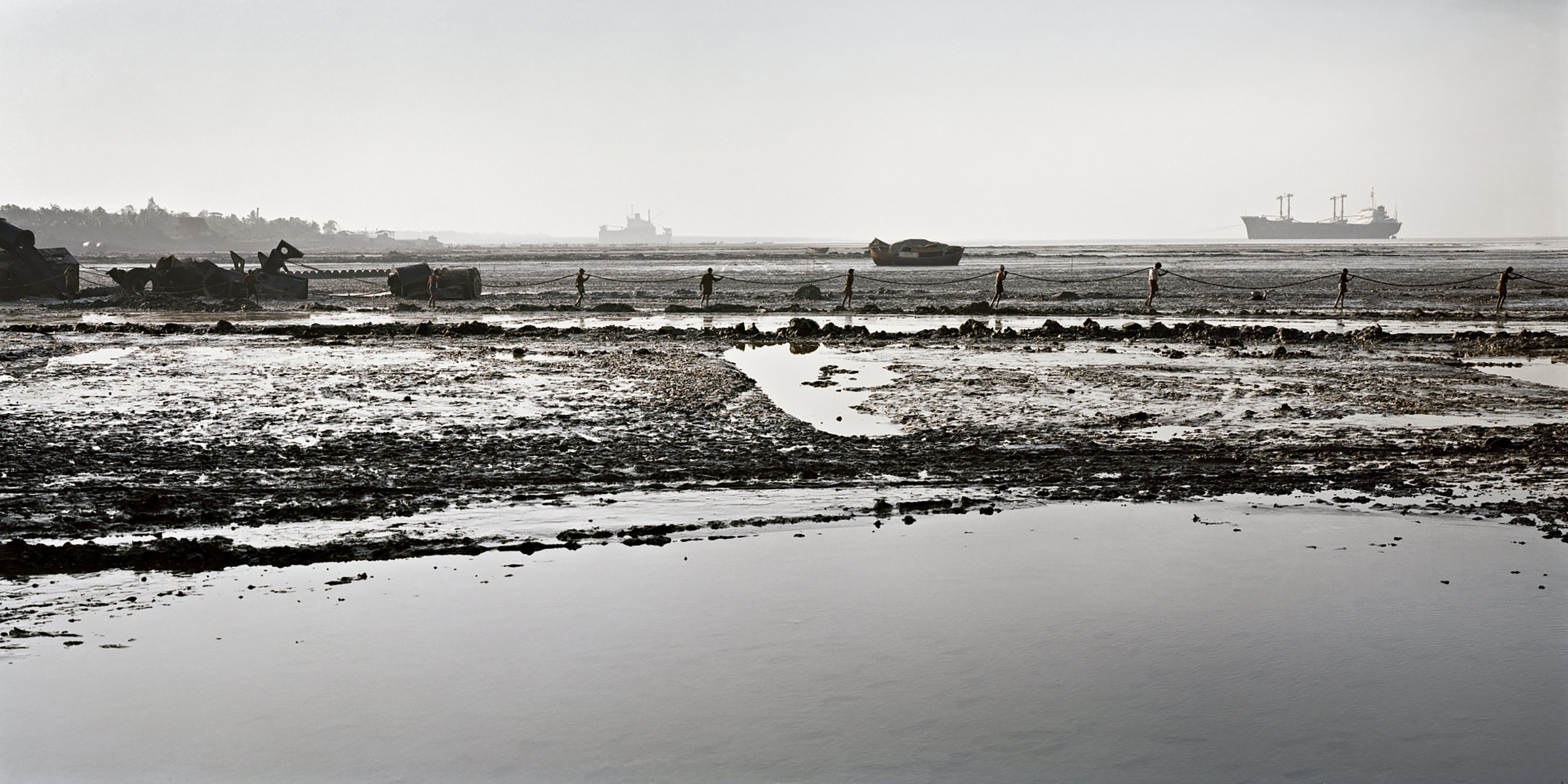
Gadani is the world’s third-largest ship-breaking facility, with 40 scrapping companies sprawled across 130 privately owned plots on six miles of tidal beachfront. “Gadani is the worst place to send a ship,” a veteran shipbreaking consultant told me. “It’s the one yard I’ve not been to. We aren’t allowed into Gadani.”
Videos from shipyards across the subcontinent give a hint of how hard the work can be. Against a stunning backdrop of clear waters and burnished sand, six thousand workers take apart around five million tons of scrap per year with cranes, chains, torches, wrenches, and their bare hands. The work exposes them, and their environment, to high levels of chemicals like mercury, asbestos, and lead, particularly when they deal with a ship as old as the Titan. Many have little to no equipment besides rags to protect themselves from the sparks and flames, and when things go wrong, nothing seems to change. In 2016, a large fire on the decommissioned oil tanker Aces killed at least twenty-nine people and burned dozens more. No regulatory action followed. “They close for six months after an incident, and then start up again,” the consultant said. “It just keeps happening.”
It isn’t clear who broke up the Titan, or how long it took. But she appears to have been beached on two plots, or subdivisions, of the beach for several months, getting smaller and smaller until little of her remained. The men who worked on her could not have been paid more than a few dollars a day in this sweatshop without walls, slowly, methodically, and dangerously picking apart some of humankind’s biggest creations until all that was left is a carcass.
By the fall of 2022, the Titan had undergone her final transformation. She is classified as dead: no longer a ship, a collection of parts sold off to build other, lesser machines.
She had passed from rust to dust. But the spirit of the thing—the fumes and fuel and fire that for half a century made her run—will live on forever: in the waters she sailed, in the people she saved, and in the bodies of the men who buried her and will someday too be buried.
Adapted from The Hidden Globe: How Wealth Hacks the World by Atossa Araxia Abrahamian. Copyright © 2024. Excerpted by permission of Riverhead Books, an imprint and division of Penguin Random House LLC, New York. All rights reserved. No part of this excerpt may be reproduced or reprinted without permission in writing from the publisher.