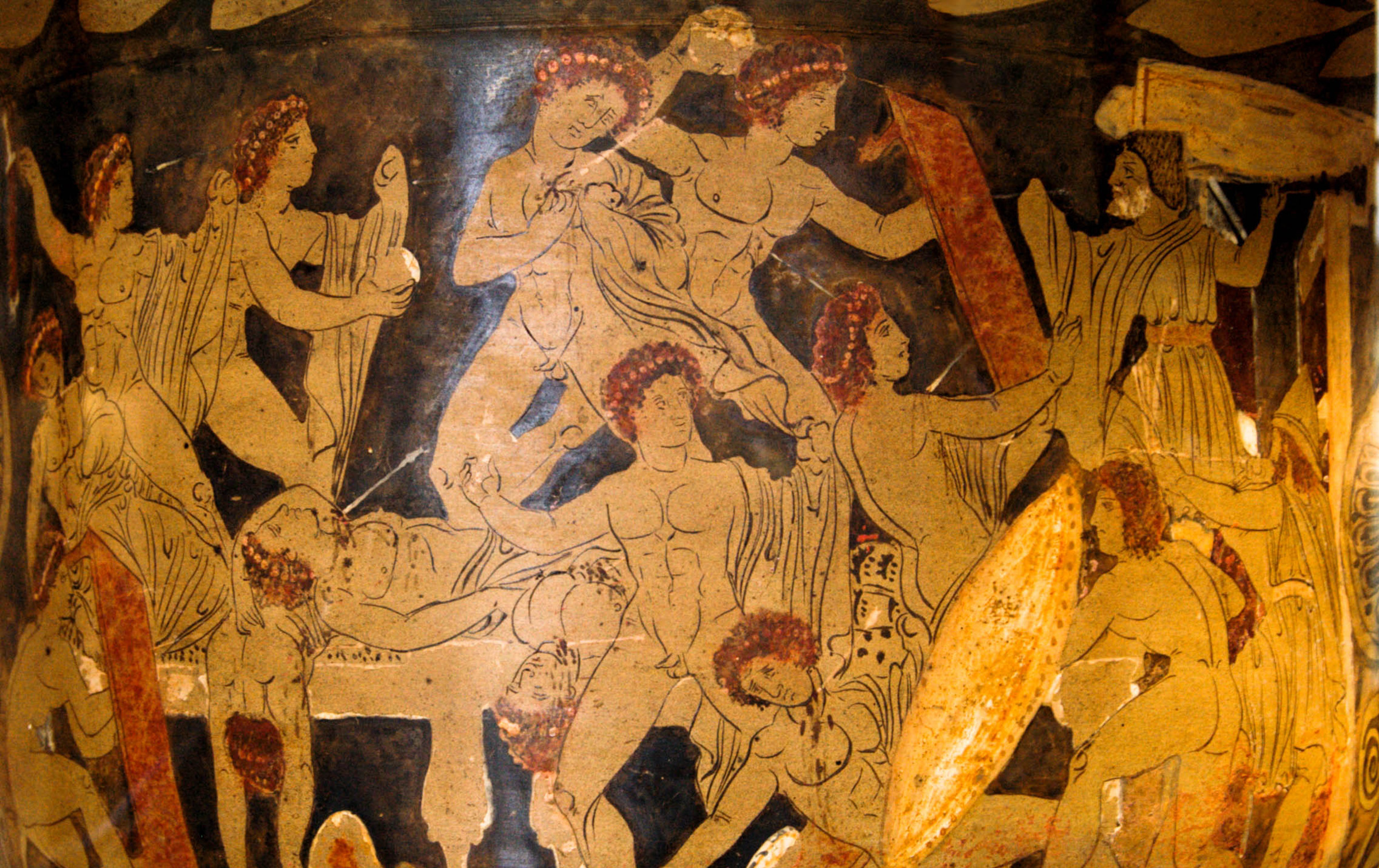
The Greek noun stasis derives from the verb “to stand,” giving rise to the English word for a “standstill” condition. To the Greeks, it denoted a “station” or a “position,” but also a political faction made up of those taking a “stand” or a conflict between such factions. In this last sense, it’s often translated—ironically, to the modern ear—as “civil war” or “revolution,” but neither word gives the right meaning; “class war” comes closer. Typically, stasis involved a clash between the more and the less well-off, since the former favored oligarchic regimes that better served their interests, the latter a more democratic diffusion of power. When both groups decided they must have control, passions could burn white-hot and lead to appalling violence.
The historian Thucydides gives a chilling account of one such stasis. During the Peloponnesian War, on the island of Corcyra (modern Corfu), a pro-Athenian, poorer faction squared off against pro-Spartan rich who had tried to seize power. With Athens supporting one side and Sparta the other, the two parties entered into a life-or-death struggle, each going to any lengths to attain victory. In a final orgy of killing, the commoners, having gotten the upper hand, began executing a group of the rich who had fled to a temple of Hera for sanctuary. Those trapped in the shrine, seeing their fate was sealed, began murdering one another and hanging themselves to avoid the worse fate that their enemies would have dealt them. The carnage continued, Thucydides says, for an entire week.
“Every form of death took place,” Thucydides writes of the Corcyra stasis. “Father killed son, and men were dragged from the altars or slain upon them, and some were even walled up inside the temple of Dionysus and died there.” He does not state how this second group of supplicants perished; one wonders whether they too killed one another, or whether those who’d imprisoned them stood guard for days while they slowly perished of thirst.
Thucydides used Corcyra to illustrate stasis generally, since he saw the affliction spreading widely throughout the Greek world. Stasis, he writes, was producing “every form of viciousness” across Hellas, leading to a perversion of moral values. He dramatizes the high cost of factional strife in the hopes that future generations might learn to avoid it. But the decades that followed the Peloponnesian War showed that the Greeks had learned nothing. Stasis continued to rage in Plato’s time. The worst stasis ever recorded (according to its chronicler, Diodorus) took place in 371 bc in the city of Argos.
This Argive stasis was known to the Greeks as the skutalismos, “the affair of the clubs,” because of the way the killings were carried out. It began, like the one at Corcyra, with the rich attempting to subvert democracy. Their plot was uncovered before it went into motion, and a captured plotter gave the names of thirty confederates, all leading men. These thirty were put to death, but the masses, consumed by fear and urged on by demagogues, lashed out at all those they regarded as oligarchs. The number of victims swelled, eventually reaching twelve hundred in Diodorus’ count, fifteen hundred in Plutarch’s. When the demagogues drew back from the slaughter, fearing that things had gone too far, they too became victims, for the mob would no longer tolerate lack of resolve.
One sickens to think of over a thousand men beaten to death with clubs, yet episodes nearly as bad were commonplace in this era. “Stasis was a vicious circle with no solution,” writes historian M.M. Austin about the fourth century bc. At Corcyra, the disaster of 427, so memorably described by Thucydides, was only the first of a series; further outbreaks of stasis took place in 411, 374, and 361. In the last of these episodes, the wealthy faction seized power in a false flag operation: Soldiers supporting the rich cut their own flesh with blades and made bruises by cupping, then rushed to the market proclaiming they’d been attacked. Citizens who were in on the plot seized weapons, calling out that the democrats were to blame. Before inquiries could be made, the soldiers had rounded up those on their list of enemies. The political order had been overturned yet again.
This final Corcyraean stasis is recounted by Aeneas of Stymphalus, also known as Aeneas Tacticus. In the Greek world surveyed by Aeneas, stasis lurks everywhere (except perhaps in Athens, a place Aeneas ignores). Conflict between the classes threatens at every turn to erupt into warfare. Tricks and subterfuges are constantly being devised or improved by both sides, so no one can ever feel safe. Even the quotidian has come to seem sinister: Lamps lit at night in private homes give rise to fears that insurgents outside the walls are receiving signals. It’s the nightmare world that Thucydides had decried in his meditation on the Corcyra stasis, seemingly normalized some six decades later.
Since the root cause of stasis was economic inequality, Aeneas urges financial measures as ways to preserve the peace. The debts of the poor must be reduced or even canceled, he writes, and welfare funds provided to those without means. Yet these measures must somehow avoid offending the rich, who own the debts and pay the bulk of the taxes. To learn the secret of threading this needle, Aeneas tells us, a different book is required: “The revenues from which this outlay may be funded are clearly laid out in my work On Finance,” he says. Since that work is entirely lost, or perhaps was never written, the cross-reference gives a modern reader an impression of hopelessness. One cannot imagine what magical resource Aeneas recommended, since no Greek city succeeded in finding one.
Excerpted from Plato and the Tyrant: The Fall of Greece’s Greatest Dynasty and the Making of a Philosophic Masterpiece. Copyright © 2025 by James Romm. Used with permission of the publisher, W.W. Norton & Company, Inc. All rights reserved.