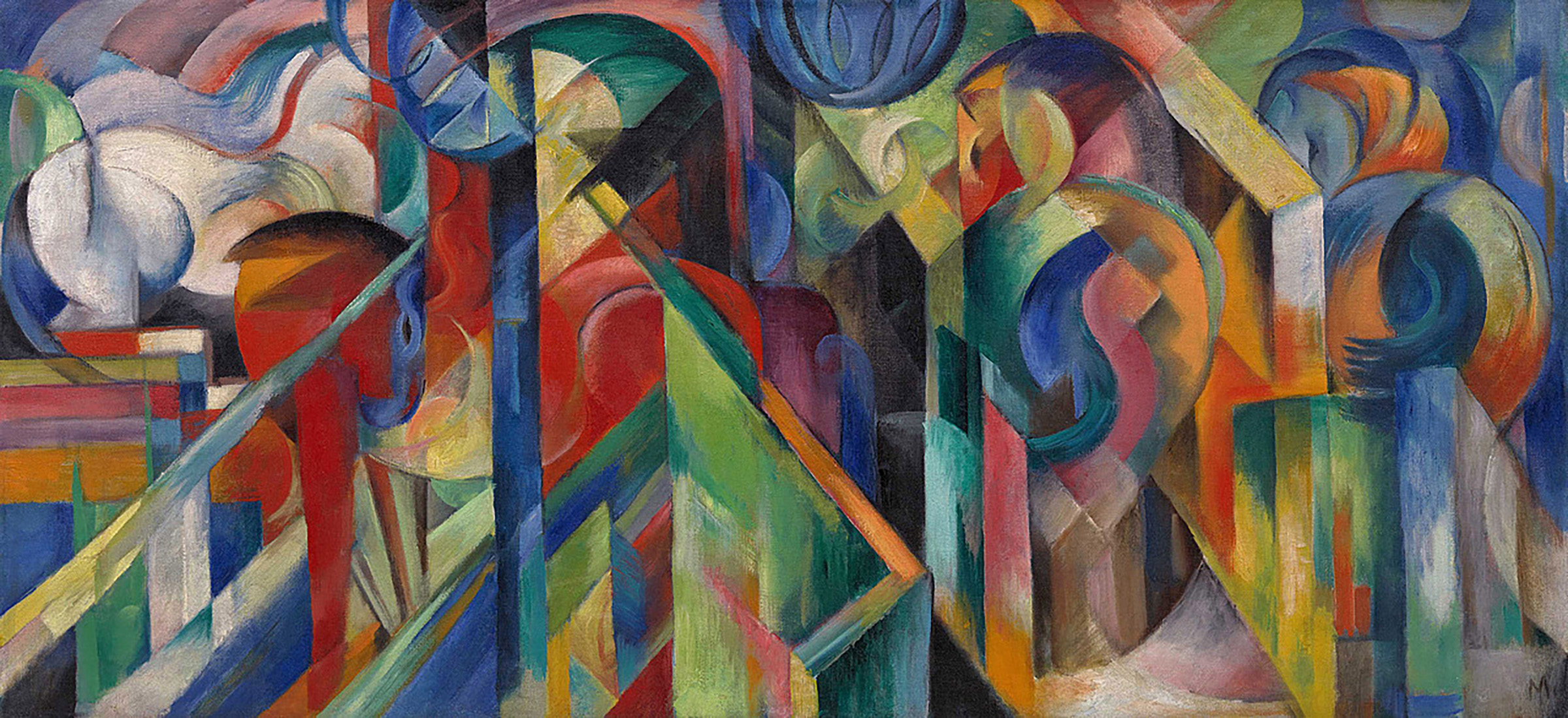
I bought a book a few years ago. I don’t remember why, certainly not for the cover or book design, which is why I often buy books. Sometimes a book just looks interesting, and then I want it because the look calls out to me. Often, the books that force me to buy them were designed in the late 1960s or early 1970s. Other times, a book is so badly designed that this, in itself, intrigues. That was the case with this book.
The book I bought is an English translation of letters written by the painter Franz Marc to his wife, Maria. It is a thin hardcover volume published by Peter Lang as part of the American University Studies series. The edition of the book that I’ve got has about six different fonts on the front cover. Some words are in italics and some words are not. The sizes of the fonts vary considerably as well. It’s as if a small child got into the final layout for the book just before it went to press and started changing things according to a game she was playing in her head.
The letters published in the book were originally written between September 1914 and March 1916. The letters ceased abruptly on March 4, 1916. This was the day Marc was hit in the head by a shell fragment at the Battle of Verdun. He survived the initial impact but didn’t live for much longer. He was thirty-six years old.
After Marc’s death, Maria Marc made a selection of his letters available to the publishing house Paul Cassirer in Berlin. This was in 1920. The volume was entitled Briefe, Aufzeichnungen, Aphorismen (Letters, Notes, and Aphorisms). This is the route by which personal letters, handwritten by a German soldier who died in the Battle of Verdun, made their way into general English-language publication. The preface to the original R. Piper edition of Marc’s letters opened with the following sentence: “Franz Marc’s Letters from the War belong to the treasures of twentieth-century German literature.” I didn’t know that when I first bought the book. I didn’t know that it was a treasure. Or maybe I did. Maybe I did somehow know that this was a treasure. I knew and didn’t know that I was holding a treasure.
Marc’s very first letter, written almost two years before he was to die, is dated “September 1 (1914), Autumn!” The first sentence reads, “Today I stood guard for the first time, with eighteen men; it was very moving, a wonderful autumn night full of stars.” The last letter, written on the day of his death, begins, “Dearest, Imagine, today I received a little letter from the people where I was quartered in Maxstadt (Lotharingia), which contained your birthday letter.” Near the end of his final letter, Marc wrote, “Don’t worry, I will come through, and I’m also fine as far as my health goes.” Several hours later he was dead.
The Battle of Verdun (though there were many extraordinarily surprising and terrible battles of World War I) is unique. People still study the battle in detail. They track the various troop movements and the intricate military details. They know the names of all the generals and lower-level military people involved. This requires a certain kind of patience, a certain kind of mindset. The word clinical is appropriate here, in both its positive and negative connotations. The clinical mindset is one I do not, myself, possess. I am to clinical as professional wrestler is to brain surgeon.
In fact, I suspect that the people obsessed with the details of the Battle of Verdun are trying to control something with their supposedly dispassionate attitude to the whole affair. Something about the battle is intolerable to them, to something within them. Some feeling, some root despair or fear, is being touched by the facts of the battle, its reality, its actual happening in the world. To study the battle is to encroach upon that fear and surround it, as it were, with the various analytical tools at one’s disposal.
Or is there also desire? Is it a mix of fear and desire? The person who studies the Battle of Verdun in a clinical manner has no idea what to do with this potent mix of fear and desire, and therefore these persons become studiers, even though probably what they really want, deep down, is to be in the battle, to be in the actual battle and to kill in the battle and to die in the battle, though, in some other sense, this is the last thing they want. They want and do not want. They take some pleasure in the distanced ability to study the battle and to participate in it that way, and this distance is also, at the same time, a kind of torture.
I don’t have the desire to understand and to encroach upon the battle in that way. But I often find myself thinking about the Battle of Verdun. My pulse quickens when the battle comes up in conversation, or on the radio, or in books. It is said that the commander of German forces at the time of the Battle of Verdun, a man named Erich Georg Sebastian Anton von Falkenhayn, went into the Battle of Verdun with the precise intention of creating a battle of attrition. That’s to say, he wasn’t looking either to win or to lose the battle. He was, instead, looking to create a scenario that would produce massive numbers of casualties. He was looking to make the French army bleed. Presumably, he understood that his own army would do some bleeding too. That is in the nature of battle. Falkenhayn hoped, surely, that because of his superior tactics, he would cause much more bleeding than he would suffer.
In his memoirs written after the war, Falkenhayn likened the battle to a pump. He thought of the Battle of Verdun as a pump that would bleed the French white. This is a strangely mechanical metaphor, a pump that sucks blood out of bodies. But that, purportedly, is what Falkenhayn imagined.
Falkenhayn did indeed create a pump for the bleeding of armies. But it was a pump so big that it bled three-quarters of a million human beings. One of the victims of Falkenhayn’s bleeding pump was the aforementioned Franz Marc. Marc was German and was, therefore, not one of the intended victims of Falkenhayn’s strategy. Marc was also a painter. He was a founding member of the well-known artist group Der Blaue Reiter (The Blue Rider). Der Blaue Reiter included, as members or affiliates, at one time or another, such artists as Wassily Kandinsky, August Macke, and Paul Klee. August Macke was also killed during the fighting of World War I. He was killed almost two years earlier than Marc, on September 26, 1914. The death of Macke was quite a blow to Marc. On October 23, 1914, Marc wrote to Maria from a town called Hagéville, which is in the Meurthe-et-Moselle department in northeastern France. “The death of August is so terrible for me,” Marc wrote, “how can I overcome it inwardly and take a position toward it—the latter quite literally; the naked fact will not enter my head.”
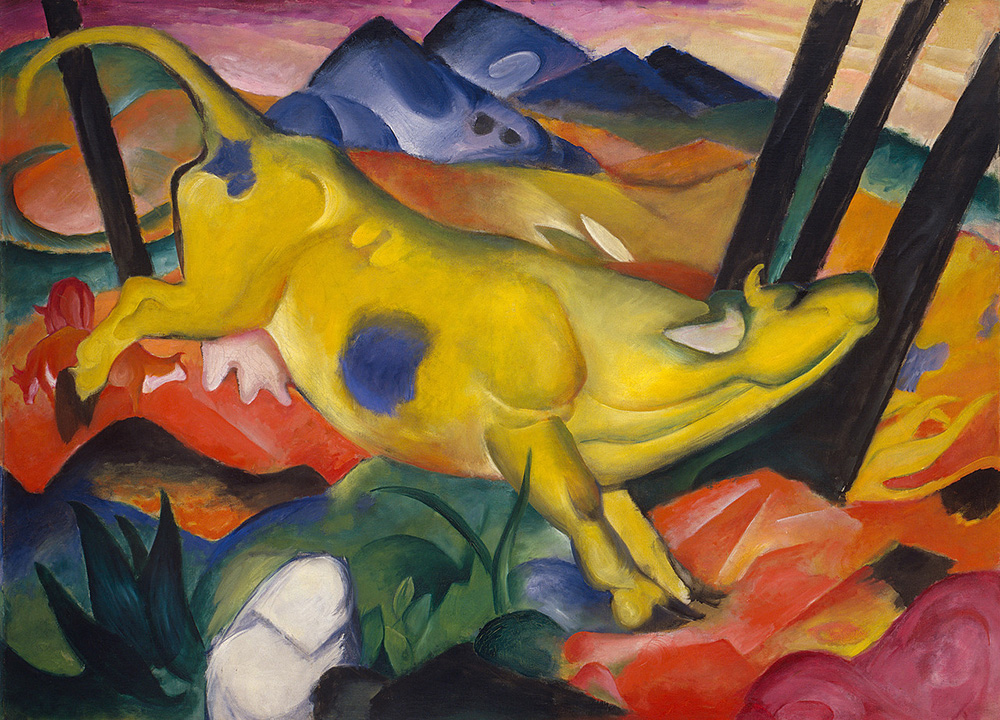
For many years, right up until the moment Marc began to produce works of genius, he was an artist clambering through the fog, trying to find his way in a murky wood. His hand was unsure. He had no sense of color. Literally, he seemed baffled in the face of color. His compositions lacked a sense of purpose or direction. It was terrible.
Then something happened. It happened around 1910. The seeds were there earlier, of course. But still, there was a hard break in the work from before 1910 to the work after. It is a mystery as to why Marc made the leap from artistic confusion to profound vision. There seems to be no reason, on the face of it. Suddenly, he found the lines between things. He saw the shapes. His animals began to emerge pure and true from the canvas. Color purified too. Red became red. Yellow became yellow. Blue became blue.
Color was the main thing. Such an explosion of color. Primary colors. Red stands out on the canvas, directly contrasting with a swath of blue. Many things were happening to Marc in those days. He was looking at the work of the post-Impressionists. He was looking at Gauguin and at Van Gogh. He was seeing the boldness of color in those artists, the willingness to put primary colors right there next to one another, in complete flouting of what the art academies taught. You don’t put contrasting colors right there on the canvas, right next to one another. But the Post-Impressionists were doing this. The Fauvists were doing this, those crazed animals. The new abstract painters were doing this.
Franz Marc looked at all of this color as if looking upon a revelation. It was a revelation to him. Marc wrote a letter to his friend and fellow painter August Macke in the early part of 1911. “In one short winter,” he writes to Macke, “I’ve become a completely different person.” Marc goes on to speak about art in the letter, about finding himself as an artist. Much of this has to do with color and the purity of composition that he’d learned in the previous year.
We can probably make a precise statement about Marc’s art. Putting together the testimony of the art he actually produced and what he wrote about his state of mind in those days, we can say that he became an artist in the winter of 1910–11. Something awoke in him, something came together. This means that, unbeknownst to himself, Marc had less than four years to work as a true artist. The true artist’s life, for Franz Marc, existed only from 1911 to 1914, since in 1914 he entered the war and was never able to paint again, though he did produce a small series of remarkable drawings in the field. And then he was killed at Verdun. He was a loser for most of his life, then a genius, and then dead.
The thing that woke up within Marc, the thing that gave him the confidence to paint as he did with color and boldness, the thing that allowed him to make his yellow cow and his red cow and his blue horses, this thing that came to life within Marc drove him to paint for only three years and then threw him into the war and then killed him.
Can we really say that? Can we say that something awoke within Franz Marc that made him an artist and that this same force compelled him into the war and led him to the Battle of Verdun where, as we know, he would meet death in the form of a shell fragment?
Can we even name this “thing” that “awoke” within Franz Marc? What is this “thing”? What is this “force”? It is hard to name. We do know, at the very least, that Franz Marc was interested, if not downright preoccupied, with the concept of “fate.” We know that his most famous painting was titled The Fate of the Animals. We know that in a letter to his wife Maria dated October 28, 1915, on the very eve, as it were, of the Battle of Verdun, a battle that would begin in but a few short months, Marc wrote to Maria that, “Fate, not the war is master over our bodies.” That’s to say, fate, or whatever gives fate, whatever is the power behind fate, that is the thing that masters war, that masters the historical events of the time, that masters our own destinies, and that masters even our own physical bodies.
Franz Marc says something else in the letter in which he talks about fate mastering our bodies. He writes to Maria that, “Danger does not exist, only destiny does.” The word in German here that means both “fate” and “destiny” is Schicksal. It is notable that the German philosopher Martin Heidegger, himself a soldier in World War I, though one who, unlike Franz Marc, served behind a desk and not out in the field and on the front lines, but who was, nevertheless, deeply affected and deeply disturbed by his experiences in World War I, was so disturbed that he would later choose to become a Nazi because of what he experienced in World War I. This same Martin Heidegger, this famous/infamous Nazi philosopher, wrote an important philosophical treatise known as Being and Time, in which one of the important terms is that of destiny, or fate, of Schicksal.
In that famous work, Heidegger links the word Schicksal to the German verb schicken, which can be translated as “to send.” Schicksal, then, according to Heidegger, is the “state of being sent.” Heidegger further links the word Schicksal to his term Geworfenheit, which is often translated, rather clumsily, into the English neologism “thrownness.” The point here, neologisms and German etymologies aside, is that fate and destiny are a matter of being carried along, as it were, by a framework not chosen by the individual. One does not “choose one’s fate,” as the common saying goes. Nor is fate a simple bowing down to the arbitrary nature of existence. Fate is not “fatalism.” According to Heidegger—and this thought seems in agreement with what Marc was trying to say in his letter to Maria—the operation of fate (Schicksal) is one in which an individual human being is thrown into a situation that determines him and then that individual must actively become an agent of that very determining. This can be a difficult concept to grasp. It’s the idea that to fully become what one is, one must choose the fate, the throwing in, that has already been chosen. One must grasp the situation in which one has already been grasped. One must will what has been willed. Be careful, of course, because this thought can make you a Nazi, if you happen to think that Nazism is a matter of fate. But the thought can also lead you to become what you always needed to be, whatever that is, which you’ll never know until you surrender to it, which is also to make it your own.
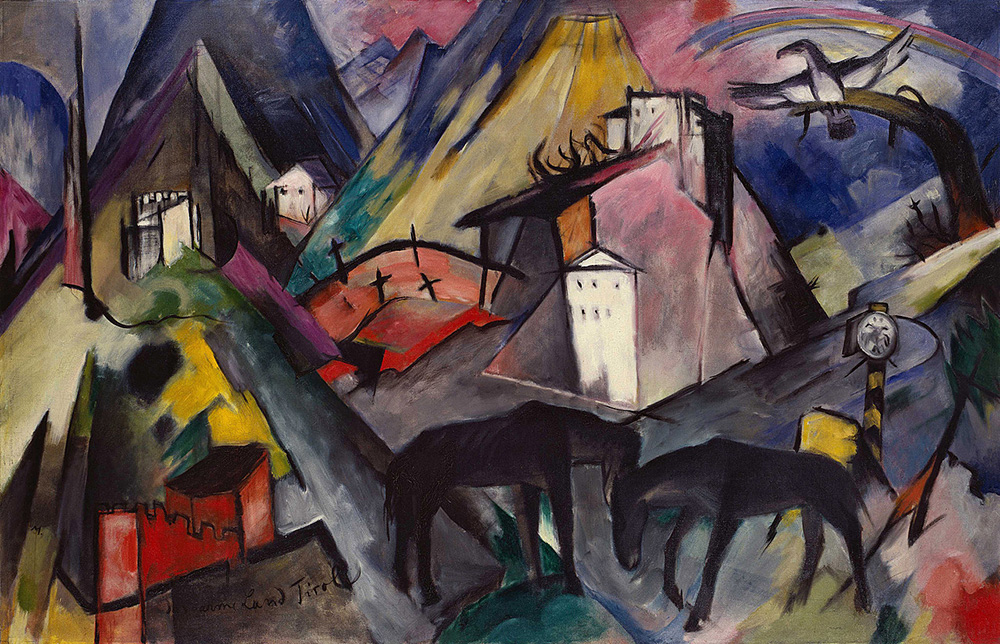
What is the point, Franz Marc might ask us, of looking at an image that renders in two dimensions what we can see in the world just by looking out at it with our own two eyes? This redoubling of the world on the canvas, Marc would say to us, is not only a rather silly thing to do, but also a measure of our stupidity and of our cowardice. The desire to have our world confirmed in the stupid reduplication of the way it looks exactly, this is the desire to bury our heads in the sand, Marc would say to us. It is the desire to hide, to hide in the surface because we are afraid of what the depths might reveal. It is the desire to say there is no distinction between essential and nonessential things.
Everything Franz Marc ever did with painting, everything he ever wrote, both before the Great War and then as a soldier in the Great War, was an attempt to affirm that there is a vast and mighty difference between things that are essential and things that are nonessential. “I cannot overcome,” Marc wrote to his wife, Maria, on December 2, 1915, “the insufficiencies and imperfections of life except by transposing the meaning of my life into the spiritual world, the world that is independent of the mortal body, that is, I must salvage it through abstraction. It is not really future life that I understand by the word spiritual—in that respect you misunderstand me … But by spiritual life I mean: to separate essential from nonessential things.”
What it means to become spiritual, to become geistig, Marc is trying to say, trying to tell his wife, Maria, trying to tell us, what it means to enter existence on the plane of what is geistig is to live essentially in the here and now, not to look toward another realm, to look toward heaven or to the afterlife. Marc is thinking, among other things no doubt, of those passages in the Gospel stories where Jesus says to people that the Kingdom of Heaven is not a place off somewhere in the distance, but that the Kingdom of God, the Kingdom of Heaven, is actually right here. Here it is. It is there, directly, within you.
What does it take to recognize the Kingdom of Heaven that is inside you? It takes, if nothing else, the willingness to purge what is nonessential, the willingness to let much that is nonessential drop away, to let it be burned away. “Every day,” Marc tells Maria later in that very same letter of December 2, 1915, “I throw more on the pile of the nonessential.” “The beautiful thing,” Marc continues, “in doing this is that the essential does not get smaller or narrower, but on the contrary more powerful and grand.”
This is why Marc can feel grateful for the Great War, even in all its horrors. The Great War is a kind of terrible vehicle for purification, for abstracting away all that is nonessential, for burning away all that is not geistig in its most essential sense. “The impossible situation,” Marc writes to Maria, meaning the very difficulty and the incredible tension and the extreme situations that the war has placed Marc under, “into which the war has pushed my personality has greatly clarified my being.”
Franz Marc’s being was clarified by two things. His being was clarified first by the remarkable annus mirabilis that he underwent as an artist during the winter of 1910–11, and then, beginning in 1914, his being was clarified a second time by the extreme conditions in which he lived his life and then finally lost his life during the two years he spent as a soldier in the Great War. Because of this specific history, it is simply impossible now to disentangle Marc the painter from Marc the soldier of the First World War, the soldier killed by shrapnel during the infamous, almost-unnameable Battle of Verdun.
The act of painting and the act of being in the war became, for Marc, experiences essentially fused together. They blurred into each other. They were outcomes of the same forces, the same history, the same causes, causes that are very difficult, at their deepest level, to access, causes that must be referenced with words like fate and Schicksal. To Franz Marc, the same destiny that gave him his annus mirabilis of the winter of 1910–11 was the same destiny that propelled him into World War I and to his eventual, personal fate during the Battle of Verdun, a fate that Marc seems freely to have accepted, though not especially to have sought out, and to have reckoned that death is of no great importance in the face of the greater forces and destinies at play.
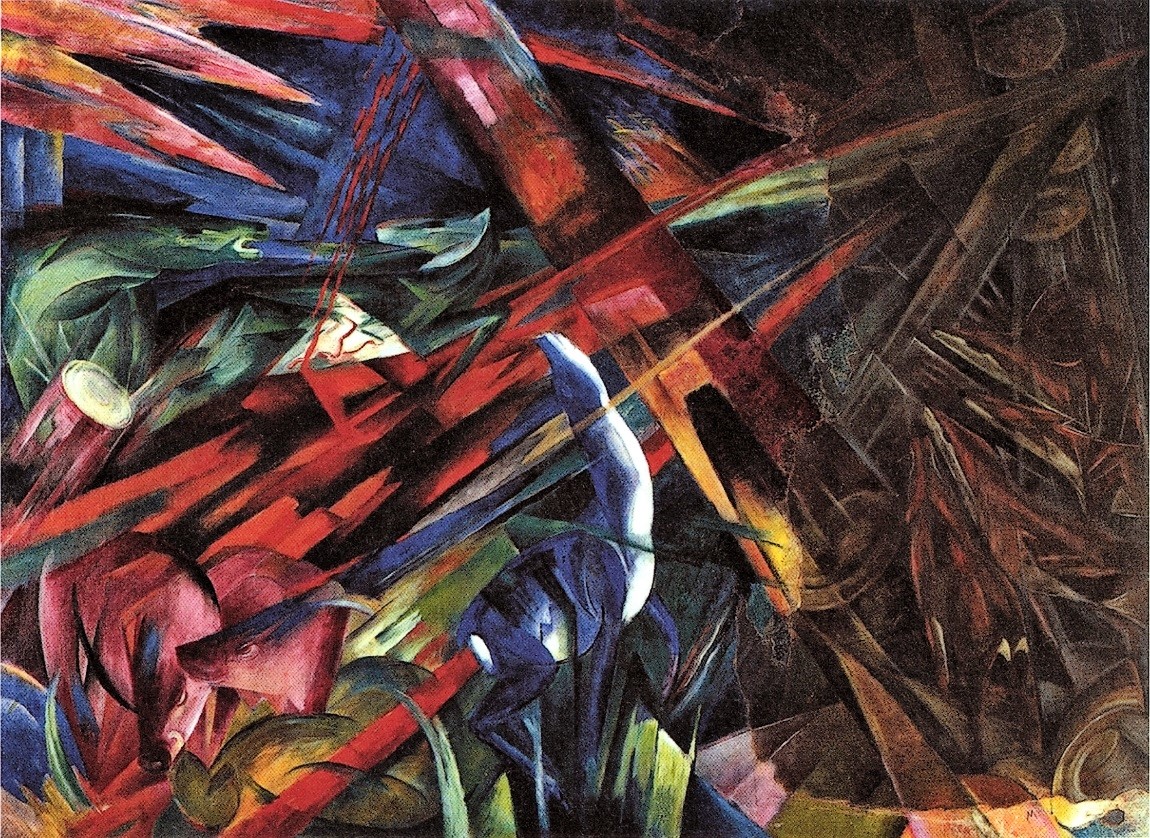
In the picture that Marc painted in 1913, the now-famous painting that is titled The Fate of the Animals, we are presented with a visual scene that is partially unseeable. What’s truly to be seen in the painting taxes our descriptive language. We are looking, in a sense, at a picture that does not want to be looked at, does not want to be seen at all. Or, to put it another way, we are looking at a picture that does not want to be seen but does want to be seen. That’s to say, when we look at The Fate of the Animals, we should be aware there are two kinds of seeing. There is the seeing that is just seeing—mere seeing, if you will—and there is the seeing that is really seeing, the seeing that is geistig.
At some point in the making of the painting, Franz Marc jotted the words, “And all being is flaming suffering” on the back side of the canvas. Today, as the painting hangs at the Kunstmuseum in Basel, it is impossible to see those words. At his purest moments, Marc might well have preferred it that way. The painting would be the painting, and that is it. Words only get in the way. The pure relationship between seeing and Seeing would be preserved. Those who understand the painting would understand the painting. Those who do not understand the painting are never going to understand the painting anyway. They are never going to make the jump from mere looking to the work of Geist, the work of Spirit that allows the painting truly to be seen. That’s how Marc might have considered the matter, had he sat down and tried to come up with a position on whether or not there ought to be words connected to the painting The Fate of the Animals.
On the other hand, Marc was a man of words, a man of discursive reason, a man who took it upon himself not just to write but often to write specifically about art and, moreover, to write about the very art that he created, the paintings that he created. He was not able to disentangle words from painting. It is appropriate, then, that Marc wrote words on the painting The Fate of the Animals. He wrote the words on the back of the painting, true, but they are there, physically, on the painting nonetheless. The painting is a painting of words almost as much as it is a painting of images. The words, “And all being is flaming suffering,” are part, now, of what the painting actually is. It is those words, just as it is the images of the animals in various states of distress and the shooting streaks of color and the giant tree and the tree that has been severed and shows its rings. The words “And all being is flaming suffering” are, it has been noted, taken from the Vedas. The Vedas are the ancient Hindu scriptures that make up the holy writings of that religion and are among the oldest surviving texts in any religion, going back to the beginnings of the second millennium bc.
If we are to take Franz Marc seriously as a man and as an artist—and we might as well endeavor to take him seriously if only for the reason that he took himself so seriously as an artist as to cast everything else in his life aside, to beggar himself, as it were, in his life leading up to the annus mirabilis of 1910–11, to alienate friends and family in his pursuit of what seemed to them a pointless goal for a not especially talented man, a man who, nevertheless, relentlessly drove himself forward toward the point where, in fact, in the annus mirabilis of 1910–11, Marc did break through to creating an art that conveys the same geistig qualities that he strove to produce in himself, that drove him to live life in a relentless and sometimes terrifying pursuit of what he understood to be purity and to be truth, and which finally placed Marc in the position of becoming a soldier in World War I, a soldier who performed his soldierly duties admirably and with the dignity that, for him, was tied up with the purpose of a man going through life not wanting simply to see and to hear and to eat and to piss and to fuck and to die, but to do all of those things, yes, to do every one of those things, but to do so as one taken up into another realm of being, as it were, of having one’s senses opened to the eternal that flitters at the edges of this pissing and eating and hearing, to open himself to the “utter thereness” that can strike a person as that person inhabits a body and is at the very same time aware and not aware of that inhabitation, lifted up and dropped back down at the very same time, you might say, seeing the unity of all being, of all living things while, at the very same time, being fully engaged with one’s own specific and particular being, completely penetrated by love, as it were, completely overwhelmed by the unspeakable beauty of there being any Being at all and at the same time absolutely committed, as it were, to being the one specific being that one is, to participating in the grand cosmic tragicomedy as this one specific being that one is fated to be and being willing, at the very same time, to throw this specificity away, valuing it not at all and valuing it absolutely, valuing it absolutely for the very reason that one values it not at all and vice versa and wanting to show, in whatever way that one can, in whatever small and insufficient way, that this tremendous truth is in fact true, that the truth of valuing and throwing away one’s precious subjectivity as the me-creature that one is is a truth that can be shared and shown, that the eyes of one’s fellow human being can be penetrated with this truth, which is beyond the physicality of vision but which tickles at its edges, and which can be hinted at and gestured toward and which, for Franz Marc, was the only true and honest reason for there to be any art at all, any art of any kind whatsoever, there is only this one reason for it to exist, that the point of art, its only point, is to awaken and communicate and to share between human beings the tremendous strangeness and the overwhelming oddness of actually being alive, actually and truly and really being alive right now, as it were, a realization that, when it is achieved, snaps you into the world perhaps for the first time ever, snaps you in with the unaccountably odd sensation, the deep realization, that one is both in the world but at the very same time not absolutely of the world, that one is both oneself, a firmly articulated bit of individualized there-stuff and at the same time that one is everything, that one is the totality and that each moment of one’s specific-being is part and parcel of the total-being, and that one can actually live in this mode, experience life and oneself in this mode, experience and surrender to these overwhelming truths and realizations and have one’s eyes opened, have them really and truly opened to what is really real, which is a truth and reality that is not beyond the real world, not outside of it, but is a truth that is hidden right there in plain sight, that is available for all to see should they allow themselves to see it, should they put away the fear and the smallness that trickles into the lives of all, that weighs them down and sinks them into the world as if it means nothing, as if it isn’t the strangest and most person-shattering fact simply to confront one’s presence as a here-being-right-now and this bracing aspect of living as a person truly alive and awake gets covered and suppressed and dampened down by the fear of life, the natural unwillingness to see the utter strangeness of this and every moment right now, a fear that leads, inevitably, into the suppression of life and the forgetting of life and the regularization of life and, finally, to the forgetting of the fact that one has even forgotten, to the meanness and the smallness and the cutting-up and the parceling-out of our day-to-day experience so that the magnitude, the sheer experiential magnitude of our actually being alive and actually being about-to-die at every moment is buffered so that we cover ourselves and others in a suppressing and muffled layer of everydayness that becomes a protective coating, as it were, by which we suppress the power and the magnitude of the real truth of our being-here-right-now, and it is the job of art, as Franz Marc saw it with every fiber of his being, it is the job of art to rip away the protective coating, to penetrate the layers of forgetting and to bring us back, kicking and screaming if need be, to the real reality of being this creature who is not only a mass of flesh but who is a geistig presence, a luminous cutting-through-space-and-time to open up this spot, right here and now, and to make this spot of what is otherwise only a being-in-potentia, as it were, to make this spot of being-in-potentia into being-this, and to paint that transformation, to paint the full truth of really seeing, of really and truly having one’s eyes open, this was the entire meaning and purpose of Franz Marc’s life and of his art, or, at least, so it seemed to him.
We can, if nothing else, take him seriously in this.
Adapted from The Fate of the Animals: On Horses, the Apocalypse, and Painting as Prophesy by Morgan Meis. © 2022. Published with permission of Slant Books and the author. No part of this excerpt may be reproduced or reprinted without prior written permission from the publisher.