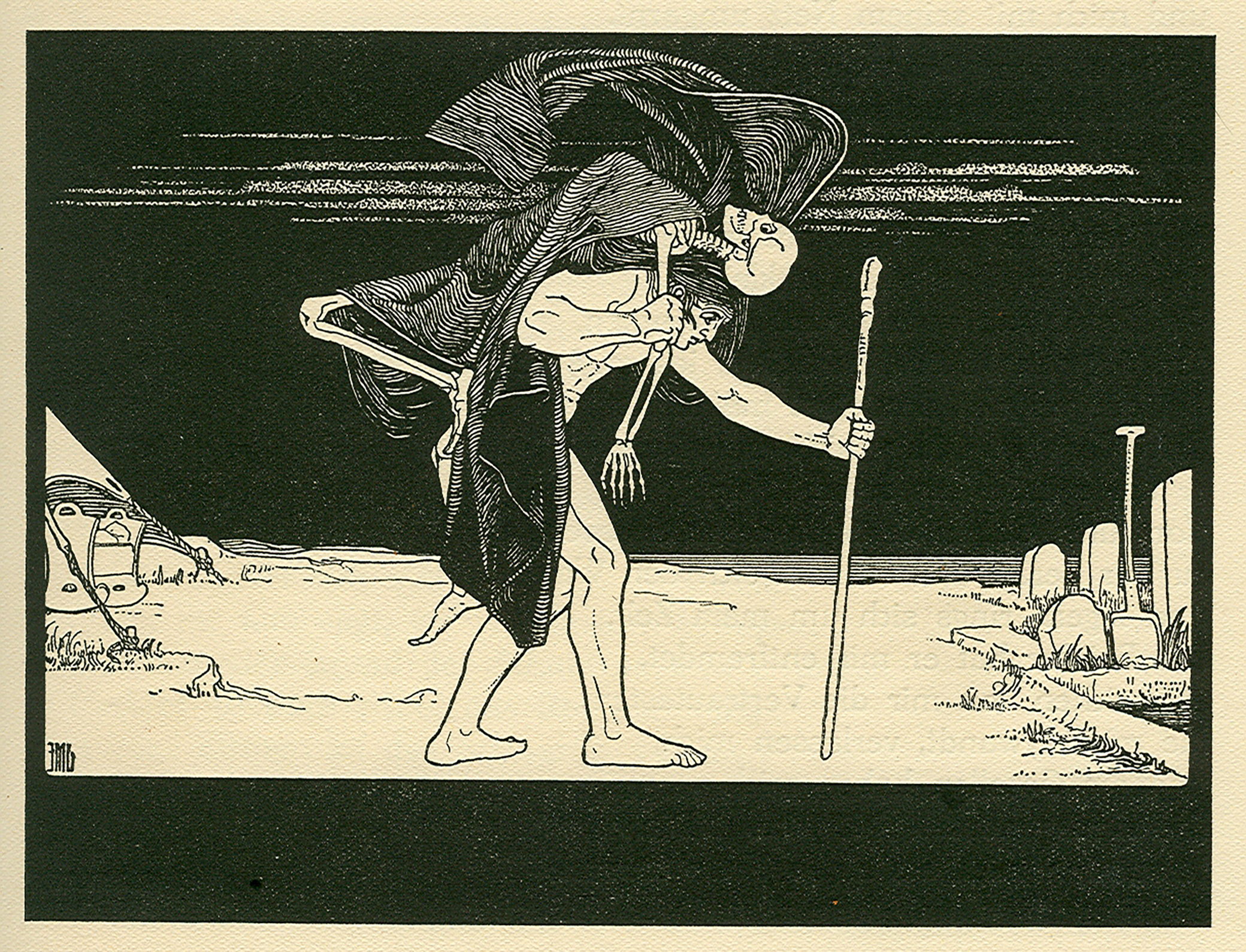
Dybbuk, by Ephraim Moshe Lilien, from the Book of Job in Die Bücher der Bibel, 1923. Wikimedia Commons.

When she died in 1975, Hannah Arendt, “the éminence grise of the éminences grises,” was one of the most visible survivors of the great intellectual migration that, decades before, had brought many of Europe’s leading minds streaming into New York Harbor. For American Jews, the refuge these people found in their country confirmed their patriotic sentiments and gave them, in the midst of a Jewish tragedy, the self-esteem they had always derived from Jewish achievement. These refugees flourished in the intellectual freedom that once prevailed in the U.S.; and the Nazi disaster—so calamitous for Europe—proved a boon for America’s libraries and museums, classrooms and studios, hospitals and laboratories. Even amid the constellation of virtuosi exiled by Hitler, Hannah Arendt stood out. With her heavy German accent, Coke-bottle glasses, and wreaths of cigarette smoke around her head, she became a most unlikely celebrity. “I was reminded of what Bernhardt must have been or Proust’s Berma, a magnificent stage diva,” said her friend Mary McCarthy. “What was theatrical in Hannah was a kind of spontaneous power of being seized by an idea, an emotion, a presentiment, whose vehicle her body then became, like the actor’s. And this power of being seized and worked upon, often with a start, widened eyes, ‘Ach!’ (before a picture, a work of architecture, some deed of infamy), set her apart from the rest of us like a high electrical charge.”
But Hannah Arendt died a pariah. “Few of the eulogies which traditionally follow upon the death of such a prominent figure appeared in the Jewish press,” wrote the scholar Ron Feldman. She had been “subjected to a modern form of excommunication from the Jewish community”—the victim, in the words of the Israeli historian Idith Zertal, of “a dybbuk-exorcising ritual.” This might have been a source of ironic satisfaction for a person who had often described precisely that character: the “pariah” who, rejecting assimilation, consciously chose the status of the outsider; who lived honestly, refusing to be anything other than what she was. Arendt adumbrated the pariah’s qualities, which she saw as the positive qualities of the Jews—“kindness, freedom from prejudice, sensitiveness to injustice,” “the ‘Jewish heart,’ humanity, humor, disinterested intelligence,” “fraternity”—the same qualities that had given certain Jews their vigor, wrote the historian Enzo Traverso: “The exclusion and marginality of the Jews, by forcing them to think against—against the state, against accepted ideas, against orthodoxies and domination—stimulated a creativity and generated a critical spirit of exceptional power and scope.” Arendt called them wirkliche Menschen, real people. “Her friends were not outcasts, but outsiders, sometimes by choice and sometimes by destiny,” wrote her biographer Elisabeth Young-Bruehl. “In the broadest sense, they were unassimilated.” Arendt said, “Social nonconformism is the sine qua non of intellectual achievement.”
In Franz Kafka, Heinrich Heine, Rahel Varnhagen, and Bernard Lazare, Arendt identified the “hidden tradition” of those who, said Zertal, “by their very existence and refusal to accept the world as it was, and their effort to transform it into something else, made it a better place.” Yet if some were born to pariahdom, Arendt, in a sense, had pariahdom thrust upon her: first by the Nazis, who forced her to leave Germany in 1933, at the age of twenty-seven, after she was imprisoned by the Gestapo; and then, in her maturity, by the Zionists.
The proximate cause of this second expulsion was a book published in 1963, Eichmann in Jerusalem: A Report on the Banality of Evil, which consisted of articles that originally appeared in The New Yorker. The articles, and then the book, unleashed one of the great literary scandals of the day—a scandal whose vehemence mystified the woman at its center. “There can be no reply to a good part of the discussion,” Arendt said, “because it all deals with a book that no one wrote.”
There were sincere scholarly objections. But in the press, the campaign against Hannah Arendt followed the time-tested Zionist playbook. Slander the opponent as an “antisemite” and a “self-hating Jew” or even, in Arendt’s case, as a “Nazi.” Divert the debate onto something irrelevant, usually employing a generous helping of personal innuendo. When Eichmann in Jerusalem was published, these techniques were brought to bear on Hannah Arendt, and the fervor with which they were deployed paid ironic homage to her stature as the Jewish world’s most prominent and most respected political philosopher.
The book’s message was lost in the fracas.
Its origins were in the kidnapping of Adolf Eichmann in a grubby suburb of Buenos Aires in May 1960. Known as the “architect of the Holocaust,” Eichmann had overseen the deportation of millions of European Jews, and his capture by Israeli agents was seen as a spectacular triumph in the campaign to bring the Nazis to justice. Full of cloak-and-dagger twists (an anesthetist disguised as a flight attendant, a tense refueling stop in Dakar), his abduction made headlines all over the world. When Israel announced that Eichmann would be tried, Arendt asked William Shawn, her editor at The New Yorker, if she could attend the trial, for intellectual reasons, but above all for personal reasons: She wanted to see a man who had wrought so much devastation on so many people’s lives—including her own.
It was her last chance to see such a monster up close.
Yet when she got to Jerusalem, she did not see a monster. Instead, she saw a man whose principal fascination was his lack of fascination—whose very ordinariness, obedience, and lack of imagination had turned him into a new kind of criminal. If someone who had played such a large role in the deaths of so many millions might be thought to have some “diabolical demonic profundity,” Arendt wrote, some “satanic greatness,” all she could see was a man with “rather modest mental gifts” who spoke and thought in clichés, who never killed a single person with his own hands, and who did not even particularly dislike the people he was dispatching to their deaths. This did not rhyme with her previous ideas of “radical evil.” Instead, this evil lacked so much as a compelling motive, an intention, as one might expect in a particularly perverse malefactor. Eichmann was “neither a monster nor a pathological sadist.” He was perfectly conventional. He was “a completely normal man,” said the psychiatrist who examined him. “More normal, at any rate, than I am after examining him.”
Full of unsettling questions about evil, woven through with the moral probing of a profoundly religious thinker—“It is hard to think of a twentieth-century philosopher whose work as often used concepts like soul and hell and redemption and blasphemy,” wrote the philosopher Susan Neiman—Eichmann in Jerusalem became a classic. Few who read it can forget the strangely vacuous, strangely absurd man at its center. It has long been popular on university syllabi because Eichmann’s personality is so eerily puzzling, and because the questions the book raises lend themselves to fruitful classroom discussions. What the book does not seem to lend itself to is the outburst that followed its publication, which went far beyond legitimate literary criticism—correcting facts, questioning interpretations—into full-fledged character assassination.
Mary McCarthy was among those who noticed the oddly repetitive nature of the language used to attack Arendt. It was, she said, as if it had come out of a “mimeographing machine.” The Anti-Defamation League sent out a nationwide circular urging rabbis to denounce Arendt from their pulpits during the high holy days, when they had the largest audiences of the year. “A group of lecturers—some flown in from Israel and England—toured the country decrying Arendt as a ‘self-hating Jew,’ the ‘Rosa Luxemburg of Nothingness,’” the Israeli dissident Amos Elon wrote. The Intermountain Jewish News of Colorado captured the mood with a headline: “Self-Hating Jewess Writes Pro-Eichmann Book.” In France, Le nouvel observateur wondered, “Est-elle nazie?” (Is she a Nazi?). A book about Arendt’s teenage affair with the philosopher Martin Heidegger appeared, which described her “as a silly bimbo sexually entrapped for life by her aging Nazi professor.”
In Israel, the book was not published in Hebrew until 2000—several years after the first translation of Mein Kampf.
Reading the book now, one is confronted with a mystery. Why this author? Why this book? Arendt herself hardly responded to the nasty attacks, quoting Anatole France’s saying about the pointlessness of replying to absurd allegations, “If I am accused of stealing the towers of Notre Dame, I leave the country.” Attacks on her book became attacks on her—“The image they had created was that of an ‘evil book’; now they had to prove it was written by an ‘evil person’”—and she agreed with an interviewer who said that the reaction was “an important political phenomenon in itself,” while still insisting that the attacks had nothing to do with her book. “Why can’t Johnny read?” she joked. Indeed, many of Arendt’s opponents boasted that they had not read the book. “It is a pity that you did not read the book before the present campaign of misrepresentation against it got under way from the side of the Jewish ‘establishment’ in Israel and America,” she wrote to the scholar Gershom Scholem. The charges, after all, didn’t make much sense: “As everybody soon knew and repeated, my ‘thesis’ was that the Jews had murdered themselves.”
Many attacks centered on a contention that the Nazi crimes were facilitated by the collaboration of certain Jewish organizations, the “Jewish councils.” These leaders were not responsible for the Holocaust, Arendt claimed, but without them, the murders of so many millions would have been considerably harder. The specific statistical claim remained contested even among sympathetic historians, but Arendt said that Jews stood a higher chance of surviving where such organizations did not exist. She did not assert that the councils intended to contribute to the Holocaust. She said that, as with Eichmann himself, intention—the motive that determines, in a court of law, the degree of criminal culpability—was irrelevant. Both legally and morally, this was a disturbing claim, and her analysis of this criminal innovation, like her analysis of the motiveless criminal, was an important contribution to the study of genocide, law, and philosophy. But the questions of culpability themselves could only with difficulty be attributed to Arendt, who dedicated no more than a dozen pages to them. They had long been controversial, and became even more so with the appearance, in 1961, of Raul Hilberg’s monumental Destruction of the European Jews. This book—which Arendt first rejected but then, in Eichmann, lavishly praised—showed in granular detail how the Holocaust actually worked: how the machinery of death over which Eichmann presided had functioned. It was a complex subject, and there was an important controversy about how that machinery had operated, but disagreements over this complicated historical question hardly explained the passion of the “stupendous barrage” to which Arendt was subjected.
The first Israeli notices had been sympathetic. “The Jerusalem Post printed a friendly report from its correspondent; Haaretz published long excerpts; and the Schocken publishing house asked for, and then canceled, an option on the Hebrew edition,” she wrote. It was canceled because, without Arendt’s realizing it, she had become the target of an elaborate smear campaign. In March 1963, when she was in Switzerland, an acquaintance at the Anti-Defamation League alerted her that something was stirring, that an attack was coming. Only a few days later, the first salvo went out “to all regional offices, national commissions, and national committees informing them of the article series in The New Yorker, and stating its fear that my ‘concept about Jewish participation in the Nazi holocaust…may plague Jews for years to come.’” The italics were hers. The ADL summed up the book in five sentences. It distributed this summary to “book reviewers and others when the volume appears.” She thought that “to anyone willing and able to read,” the summary would be laughable. But the accusations were taken up, frequently word for word, across the U.S.
While she was still in Switzerland, a high Israeli government official, Siegfried Moses, flew there from Israel to demand that she halt publication of the New Yorker articles in book form. “I was informed by reliable Israeli sources that Ben-Gurion himself had intervened,” she wrote. As the “controversy” unfolded, she saw her attackers rely on Israel’s “unflinching support, together with its consulates, embassies, and missions throughout the world,” along with “both the American and the World Jewish Congress…B’nai B’rith, with its powerful Anti-Defamation League and student organizations on all campuses,” and even on “four coordinated research institutes.” Moses, who had known Arendt for years, surely knew that she would refuse to pull the book. She warned him that disparaging her book in this way would stoke divisions among Jews far more than anything that she had written, as was confirmed a few days later when the psychologist Bruno Bettelheim—another prominent Hitler refugee, who had been imprisoned in both Dachau and Buchenwald—defended her in New York. “The Jewish community is up in arms,” a friend reported. “The result is psychological havoc. [Hillel House at the City College of New York] has had a meeting, with Bettelheim. After ten minutes everybody was screaming, calling each other liar and threatening libel suits. It was a kind of collective psychoanalysis.”
She got a telegram from William Shawn: “People in town seem to be discussing little else.” When she herself got back to New York, she expressed her bewilderment at the “smear campaign,” conducted “on the lowest level,” accusing her of saying “the exact opposite of what I did in fact write.” She found so much mail in her apartment, her biographer Young-Bruehl wrote, “that months were required to sort and answer it.” Then, shortly before the articles came out in book form, the man who prosecuted Eichmann for the Israeli state, Gideon Hausner, turned up in New York. Arendt had taken a dim view of Hausner during her stay in Jerusalem. In a letter to her mentor Karl Jaspers, she had described him as “unsympathetic, boring, constantly making mistakes” and then—ouch!—as “one of those people who don’t know any language.” Hausner came “at the [Israeli] government’s urging and for the express purpose of heating things up,” she said. “It is quite instructive to see what can be achieved by manipulating public opinion and how many people, often of a high intellectual level, can be manipulated.” He came to “answer Hannah Arendt’s bizarre defense of Eichmann,” according to the Daily News, and was joined at a meeting of Holocaust survivors by Nahum Goldmann, president of the World Zionist Organization. Goldmann told the audience that Hannah Arendt had accused European Jews of letting themselves be slaughtered by the Nazis and of displaying “cowardice and lack of will to resist.”
Big if true.
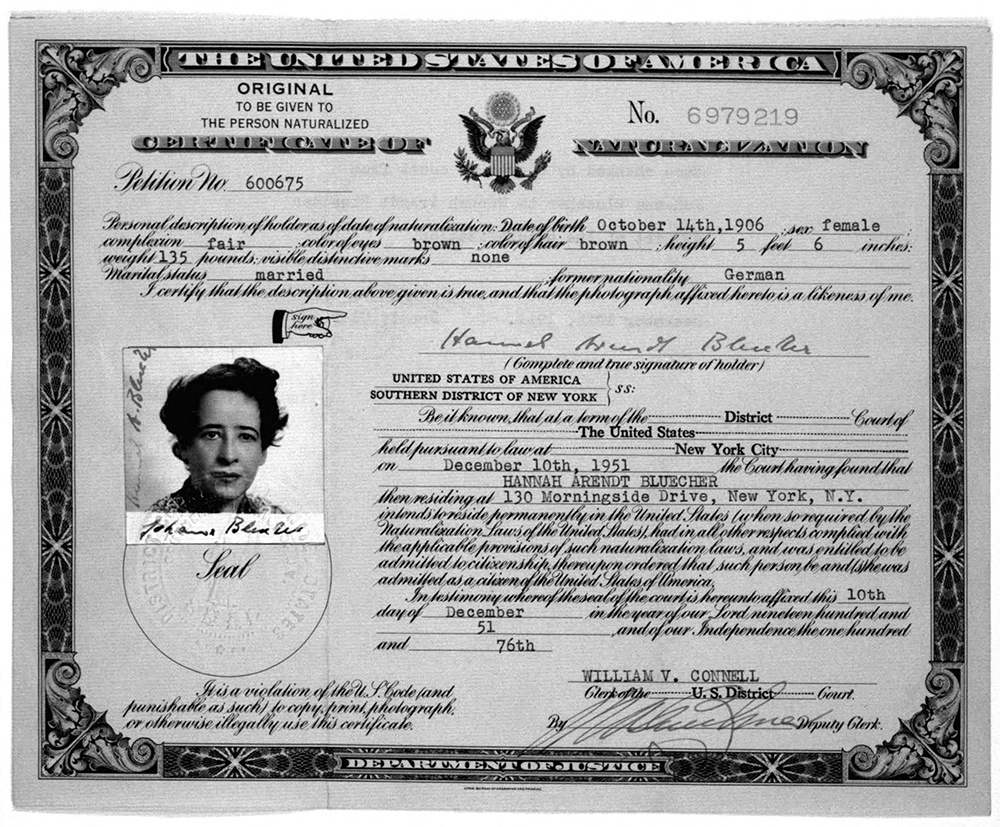
It was hard to believe that a German Jewish refugee, one whose reputation for gravitas had few equals, had spoken so flippantly. There had to be something else that had set off such a reaction, and readers acquainted with the history of Zionist involvement in the Holocaust will suspect what.
Arendt never defined herself as a Zionist. “I was very close friends with some of the leading people, especially the then-president [of the prewar German Zionists], Kurt Blumenfeld,” she said in an interview in 1964. “But I was not a Zionist. Nor did they try to make me a Zionist. At least I was influenced by it in a certain sense; namely in the criticism, in the self-criticism that the Zionists developed among the Jewish people. I was influenced by it, I was impressed by it, but politically I had nothing to do with it.” Neither had she defined herself as an anti-Zionist. When she fled Germany in 1933 and arrived in Paris, she worked at Youth Aliyah, an organization arranging for refugee children to immigrate to Palestine. Youth Aliyah was associated with what was known as “cultural” or “spiritual center” Zionism, a movement that crystallized in a group known as Brit Shalom, the “covenant of peace.” Its most prominent spokespeople included the philosopher Martin Buber, the educator Judah Magnes, and the founder of Hadassah, Henrietta Szold. This wing was associated with other apparently liberal movements, including the kibbutzim and the Hebrew University. Many members of Brit Shalom opposed the partition of Palestine and advocated for a binational or one-state solution—hoping that in an independent, democratic Palestine, a new kind of Jewish culture could develop, including the Hebrew language.
It was during her work with Youth Aliyah that Arendt penned her most Zionist-tinged writings. Though she herself never expressed any intention to emigrate, she refers to Palestine as “our country,” and to Jews in Palestine in the first-person plural. She mentions the “Arab determination to expel the Jewish ‘invaders.’” She writes that “organized Jewish labor fought and won a relentless battle against cheap Arab labor,” without adding that this victory came through implementing racial apartheid. She describes “the old-time Arab fellahin” as “a kind of relic, unfit for and superfluous to the new modernized structure of the country”—an ungenerous way, at the very least, to characterize a colonized population. She accepted propaganda about Palestine before colonization. “The primitive Arab economy assumed a ghostlike appearance,” she wrote, “and its backwardness and inefficiency seemed to await a catastrophe to sweep it away.”
Yet these comments, with their frustrating lack of understanding of the Arab position, appeared mainly in articles she wrote toward the beginning of the war. After Germany invaded France on May 10, 1940, she was detained as an “enemy alien” at the Vélodrome d’Hiver, in Paris, the place from where so many would later be deported to Auschwitz. On May 23, she and other women were taken by bus across Paris: “along the banks of the Seine, past the Louvre, to the Gare de Lyon; it was a wrenching journey for those who had lived in Paris for years and expected never to see it again; sorrowful and fearful, many wept.” They were brought to a camp at Gurs, near the Spanish border. On June 25, France was defeated, and in the resulting mayhem Arendt and some other women managed to escape the camp. “None of us could ‘describe’ what lay in store for those who remained behind,” she wrote. “All that we could do was to tell them what we expected would happen—the camp would be handed over to the victorious Germans. (About two hundred women of a total of seven thousand left.)” As she had predicted, many of her fellow inmates were later deported from France and subsequently murdered by the Nazis.
Following this harrowing escape, she rejoined her husband, Heinrich Blücher, whom she ran into by chance on a street in Montauban. They were lucky to make it to the U.S., where they arrived with twenty-five dollars in their pockets. She found work at a German-language magazine called Aufbau. In these early months, her main cause was the creation of a Jewish army, a cause promoted by an organization called the Committee for a Jewish Army. Arendt, wrote Young-Bruehl, was “unaware that the committee was the creation of three Palestinian Jews of the extremist Revisionist party”: the group that was carrying out terrorist attacks in Palestine. Her involvement ended when she learned this, but her real break with Zionism came soon thereafter. In May 1942, a meeting in New York was held, known as the Biltmore Conference, from which the extremists emerged triumphant. It was the death knell for the non-state Zionism that Arendt had supported. Biltmore marked the moment when, she said, “the Jewish minority had granted minority rights to the Arab majority.” In 1944, after another meeting in which the American Zionists did not even mention the Arabs in their communiqué, the Arabs were left with “the choice between voluntary emigration or second-class citizenship,” Arendt wrote in an essay, “Zionism Reconsidered.”
This essay, rejected by the Jewish magazine Commentary as “anti-Semitic” and published in The Menorah Journal in 1945, denounced Zionist nationalism and chauvinism as tendencies that could only lead to war. Arendt predicted that even if the Zionists “won” this inevitable war, such a victory would bring the Jews of Palestine neither peace nor security. “The ‘victorious’ Jews would live surrounded by an entirely hostile Arab population, secluded inside ever-threatened borders, absorbed with physical self-defense to a degree that would submerge all other interests and activities,” she foresaw. Hopes for cultural revival would be dashed. “Social experiments would have to be discarded as impractical luxuries; political thought would center around military strategy,” and “the Palestinian Jews would degenerate into one of those small warrior tribes about whose possibilities and importance history has amply informed us since the days of Sparta.”
Because of their history, Arendt wrote, the Jews had not developed practical political skills, and she saw this lack of “reality” mirrored in Palestine. “They escaped to Palestine as one might wish to escape to the moon, to a region beyond the wickedness of the world,” she wrote.
“What upsets me in your anti-Zionist arguments, more than their content, which is open to argument, is the tone of your discussion,” Gershom Scholem replied.
This focus on her tone, rather than on the unanswerable content of her words, would come to pervade the Eichmann affair as well. Yet though Arendt was indeed an increasingly harsh critic of Zionism, she had not moved squarely into the anti-Zionist camp. She still favored a “Jewish homeland,” but insisted on a distinction that was quickly becoming too hard to explain: “This goal must never be sacrificed to the pseudo-sovereignty of a Jewish state.”
As the Zionist colony moved close to statehood, Arendt was increasingly shocked by its reliance on terrorism. In September 1948, five months after Israel’s declaration of statehood, Count Folke Bernadotte, a United Nations diplomat, the grandson of the king of Sweden—and a man who had rescued tens of thousands of Jews from Central Europe—was assassinated in West Jerusalem. The point was presumably to send a message that the new state would defend its interests ruthlessly, and would not be bound by any outside rules. “The murderers have not been caught and the members of the Stern gang, whom the Israeli government had rounded up during the first days after the attentat, took advantage of their sojourn in prison to demonstrate to the world that even the police of the state of Israel sympathized with the terrorists and was prepared to fraternize with them,” Arendt wrote. Bernadotte’s assassin, Yehoshua Cohen, became a close friend and bodyguard to David Ben-Gurion. Ten years after the murder, Dag Hammarskjöld, a Swede like Count Bernadotte, visited Israel in his capacity as the secretary-general of the United Nations. At dinner, Ben-Gurion placed Hammarskjöld next to Cohen. Hammarskjöld afterward asked a companion who the man was. This, he was told, was the man who murdered Bernadotte.
“What scum,” the secretary-general replied. “I shall never come here again.”
A couple of months later, Arendt wrote an open letter published in The New York Times. It was signed by a host of prominent Jews, including Albert Einstein, and referred to the massacre of civilians at Deir Yassin in April 1948, a centerpiece of the ethnic cleansing campaign that had begun even before the birth of the Israeli state. She denounced the “Freedom Party” as “closely akin in its organization, methods, political philosophy, and social appeal to the Nazi and Fascist parties.”
It was an uncomfortable fact, lavishly documented, that Nazis and Zionists shared a view that the Jews could never be fully integrated into European societies. First among the reasons for this consensus was a racial idea of the Jews, the same idea that the Reform Jews, the Orthodox, and many others had so strenuously rejected from the nineteenth century onward. This belief was reflected in an insistence that—for the good of both Jews and Europeans—the Jews needed to leave Europe. “Race struggle is primary,” wrote the proto-Zionist Moses Hess in 1862. Herzl’s lieutenant Max Nordau said in 1903 that Zionism “is not a question of religion but exclusively of race, and there is no one with whom I am in greater agreement on this position than M. Drumont,” the principal antisemite in France. In 1919, the Nazi theorist Alfred Rosenberg, sentenced to hang for crimes against humanity at the Nuremberg trials, wrote that “Zionism must be vigorously supported in order to encourage a significant number of German Jews to leave for Palestine.” Soon after the Nazis came to power, Chaim Weizmann, the leader of British Zionism, was forced to warn a colleague to curb his enthusiasm: not to be so open in expressing their common toleration of Nazism. With the rise of Nazism, the Zionists instantly saw a chance. “It is in our interests to use Hitler,” Ben-Gurion said, “for the building of our country.” Berl Katznelson, his lieutenant, saw Hitler as “an opportunity to flourish like none we have ever had or will ever have.” To accusations that Ben-Gurion was indifferent to the fates of Jews under the Nazis, Ben-Gurion agreed. In January 1933, the month Hitler came to power, he said that “Zionism…is not primarily engaged in saving individuals” and that, in the event of “a conflict of interest between saving individual Jews and the good of the Zionist enterprise, we shall say the enterprise comes first.” This was, among other things, a shocking reversal of the Jewish religious and ethical tradition. After the Kristallnacht pogrom of 1938, he said, “Were I to know that all German Jewish children could be rescued by transferring them to England and only half by transfer to Palestine, I would opt for the latter, because our concern is not only the personal interest of these children, but the historic interest of the Jewish people.” If half the Jewish children in Germany died, it would be fine—if it advanced the Zionist cause. This was not so far off from the view of Chaim Weizmann, who in 1937 said, “The old ones will pass; they will bear their fate or they will not. They are dust, economic and moral dust in a cruel world…Two millions, and perhaps less; She’erith Hapletah—only a remnant shall survive.” Individuals—“economic and moral dust”—made no difference. Only Zionism mattered.

After the war, survivors who sought refuge in Israel were mocked as “sheep to the slaughter”; derided as sabonim, soap, from the rumor that the Nazis turned murdered Jews into bars of soap; condemned to poor and marginal lives; blamed, even during the war, for having brought the disaster on themselves. After the war, with stunning callousness, Ben-Gurion asked of the six million, “What is there to understand? They died and that’s it.”
That was not it.
“By means of Auschwitz—which has become over the years Israel’s main reference in its relations with a world defined repeatedly as anti-Semitic and forever hostile—Israel rendered itself immune to criticism, and impervious to a rational dialogue with the world around,” wrote the Israeli historian Idith Zertal in 2009.
The Eichmann trial was Ben-Gurion’s attempt to capture the Holocaust for Israel, and it was this operation that Arendt’s book threatened to explode. By focusing on other questions, Israel’s propagandists distracted from Arendt’s radioactive words about Zionism. Almost none of the masses of critics or journalists who covered the controversy seem to have realized that neither the subtitle (“the banality of evil”) nor Arendt’s purported thesis (“that the Jews had murdered themselves”) would have made Eichmann in Jerusalem worth spending years attacking. It was worth attacking because of what it said about Zionism.
Arendt opens with a description of the trial as theater. “The proceedings happen on a stage before an audience, with the usher’s marvelous shout at the beginning of each session producing the effect of the rising curtain.” She writes of “the show trial David Ben-Gurion, prime minister of Israel, had in mind when he decided to have Eichmann kidnapped in Argentina.” She described how the trial, Ben-Gurion’s last great national project, was designed as a spectacle: how he allowed “the prosecutor to give press-conferences and interviews for television during the trial (the American program, sponsored by the Glickman Corporation, is constantly interrupted—business as usual—by real-estate advertising)”; how he had given interviews before the trial to outline its “lessons,” the main lesson of which was Zionism. “The Jews in the Diaspora were to remember how Judaism, ‘four-thousand years old, with its spiritual creations and its ethical strivings, its Messianic aspirations,’ had always faced ‘a hostile world,’ how the Jews had degenerated until they went to their death like sheep, and how only the establishment of a Jewish state had enabled Jews to hit back.” She showed how he attempted to connect “Nazis and some Arab rulers”—while significantly failing to mention “present-day West Germany,” where hundreds of Nazis still served in influential positions. The reason, Arendt suspected, was that Germany “has paid $737 million in reparation to Israel during the last ten years; these payments will soon come to an end, and Israel is now trying to negotiate a long- term loan from West Germany.”
As the trial unfolded, it emerged that Eichmann was enthusiastic about Zionism. A superior in the SS had insisted that he read Herzl’s Der Judenstaat, “the famous Zionist classic, which converted Eichmann promptly and forever to Zionism,” Arendt wrote. “This seems to have been the first serious book he ever read and it made a lasting impression on him.” Eichmann became obsessed with the “political solution,” Zionism, rather than the later “physical solution,” extermination. Eichmann was so sympathetic to Herzl that “he seems to have protested against desecrators of Herzl’s grave in Vienna,” she wrote—and, hauntingly, “there are reports of his presence in civilian clothes at the commemoration of the thirty-fifth anniversary of Herzl’s death.” Eichmann’s zest for Zionism led him to acquire “a smattering of Hebrew, which enabled him to read haltingly a Yiddish newspaper—not a very difficult accomplishment, since Yiddish, basically an old German dialect written in Hebrew letters, can be understood by any German-speaking person who has mastered a few dozen Hebrew words.” Eichmann even read a second book, Adolf Böhm’s History of Zionism: “a considerable achievement for a man who, by his own account, had always been utterly reluctant to read anything except newspapers.” In sum: “His schooling in Jewish affairs was almost entirely concerned with Zionism.”
His personal contacts were with Zionists, and he admired in them their “idealism”: meaning their commitment to an idea above anything else. An “idealist” was “prepared to sacrifice for his idea everything and, especially, everybody.” This sympathy for Zionists had led him to work with a certain Hungarian leader:
The greatest “idealist” Eichmann ever encountered among the Jews was Dr. Rudolf Kastner, with whom he negotiated during the Jewish deportations from Hungary and with whom he came to an agreement that he, Eichmann, would permit the “illegal” departure of a few thousand Jews to Palestine (the trains were in fact guarded by German police) in exchange for “quiet and order” in the camps from which hundreds of thousands were shipped to Auschwitz. The few thousand saved by the agreement, prominent Jews and members of the Zionist youth organizations, were, in Eichmann’s words, “the best biological material.” Dr. Kastner, as Eichmann understood it, had sacrificed his fellow-Jews to his “idea,” and this was as it should be.
The book is sprinkled with illustrations of an ideological sympathy that bled into collaboration. The Zionists had even invited Eichmann to visit Palestine, where he had just enough time to climb Mount Carmel before being deported by the British authorities. He went from there to Cairo, where he met the Zionist intelligence officer Feivel Polkes, who had just come from a meeting with the Gestapo in Berlin. In their meeting at Café Groppi, Eichmann and Polkes discussed forcing emigrating Jews to settle exclusively in Palestine, and Polkes assured him that the Zionists “were favorably disposed to the extreme German policy.”
Arendt is too canny to reduce the story of the trial and the Holocaust to this mutual understanding. “The true distinction was not between Zionists and non-Zionists but between organized and unorganized people,” she writes. Yet when Eichmann in Jerusalem is read through the lens of Zionist collaboration, it becomes a shocking, explosive, damning document, and one can only agree with the Zionists who felt it was an attack on the very foundations of Zionism. “There was and is a strong link between the Establishment in Israel and the leadership which was in charge of Europe during the war,” a sympathetic correspondent wrote. The book strongly hints at this, and the outrage over Arendt’s blaming of Jewish organizations for cooperating with the Nazis—a matter of record—becomes more understandable if one sees that the Zionists read this as her blaming Zionist organizations for cooperating with the Nazis: a cooperation Eichmann described as “of course the very cornerstone” of his work.
“To a Jew this role of the Jewish leaders in the destruction of their own people is undoubtedly the darkest chapter of the whole dark story,” she writes.
In some ways, Arendt held moderate views. She acknowledged Israel’s right to bring Eichmann to trial; recognized the justness of the death sentence; and even agreed, in a letter to Gershom Scholem, that the book is “very pro-Israel.” This phrase may mean that the book was in favor of the Israeli state’s rights in this case, or it might reflect her long-standing concern that a defeat for Israel “would be perhaps the final catastrophe for the whole Jewish people.” She said that “any real catastrophe in Israel would affect me more deeply than almost anything else” as late as October 1967—but she had said exactly the same thing in 1946, when expressing her fear that Zionists would provoke a war: “I do not know—nor do I even want to know—what would happen to Jews all over the world and to Jewish history in the future should we meet with a catastrophe in Palestine.” By this, she means a catastrophe that would wipe out Jews in Palestine, not one that would affect a regime that, at the time of writing, did not exist.
But—like her distinction between “cultural” Zionism and “state” Zionism—such nuances were too complex in the context of a vitriolic public debate. In writing to Gershom Scholem, she might have been attempting to patch things up with someone with whom she did not wish to quarrel. His letter had accused her of lacking ahavat Israel, love of Israel. The term here means love of the Jewish people, not love of the State of Israel, another nuance that was hard to communicate in the context of a smear campaign. To this charge, she pleaded guilty: “I have never in my life ‘loved’ any people or collective—neither the German people, nor the French, nor the American, nor the working class or anything of that sort. I indeed love ‘only’ my friends and the only kind of love I know of and believe in is the love of persons.”
Adapted from Anti-Zionism: A Jewish History, by Benjamin Moser. Published by Doubleday. Copyright © 2026 by Benjamin Moser. All rights reserved.