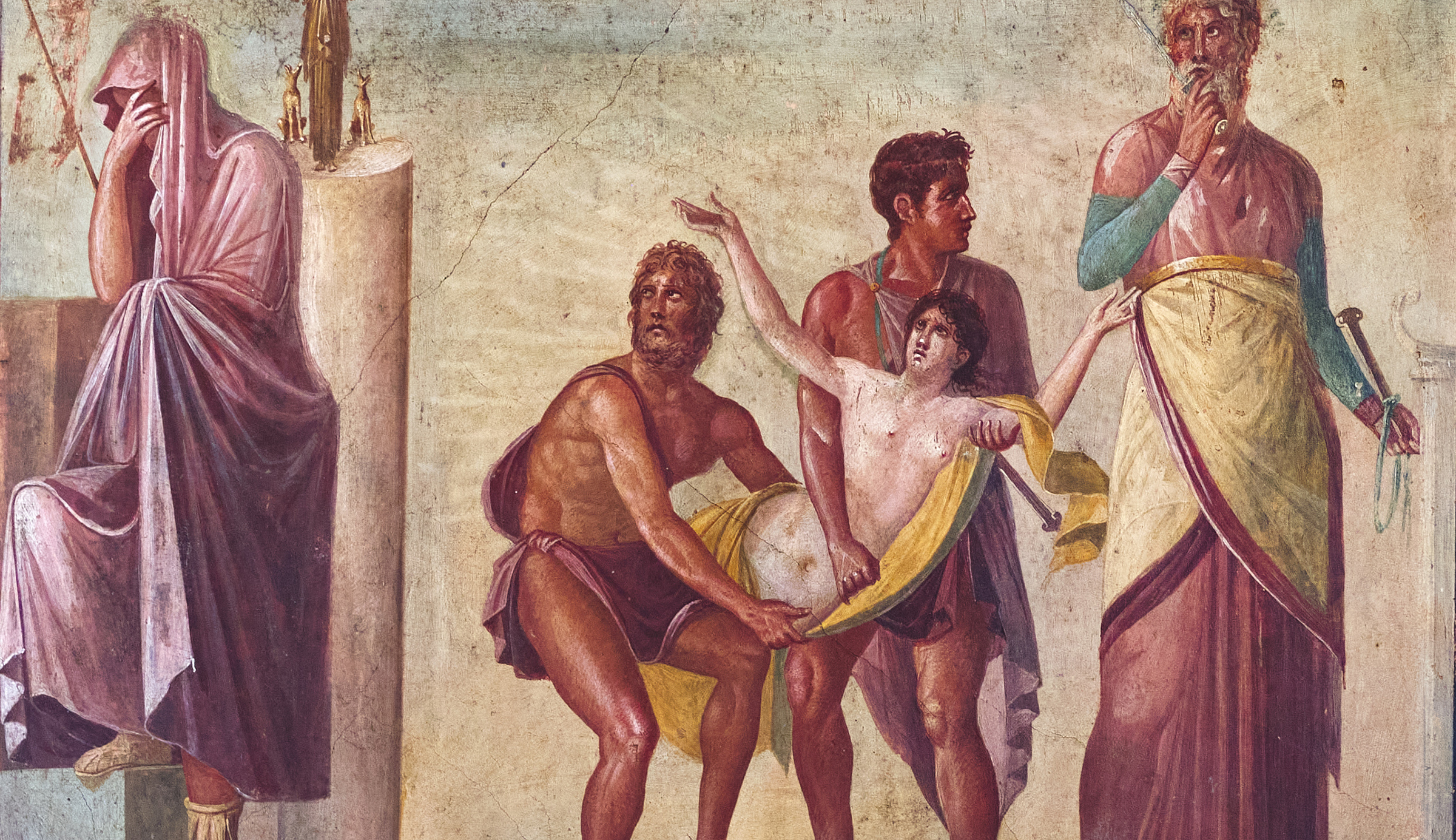
Imagine you have just condemned your own daughter to death. It’s an impossible decision no one in their right mind could easily make. You’re not a cruel, heartless monster. But you had to do it. And you did. Now, as your daughter is carried off, an artist memorializes the occasion. How to capture your unbearable inner conflict? The full spectrum and intensity of your feelings? Your rage and agitation, your shame, your agony, your sorrow and despair, your overwhelming tears, the dark cloud of grief that hangs over you, your retrospective regret and nauseating introspection, your anticipation of the imminent violence, your attempt to maintain composure, your churning sense of betrayal, your love, your numbing desire to be altogether elsewhere?
In the fourth century bc, the ancient Greek artist Timanthes reputedly painted just such a scene. His subject was drawn from Euripides’ tragedy Iphigenia in Aulis, in which King Agamemnon receives a prophecy that only by sacrificing his daughter Iphigenia could his stalled Greek army set sail to battle the Trojans. At first, he refuses even to consider such a cruel act. But in the face of growing pressure, he sends for Iphigenia under the pretense of an arranged marriage to Achilles. Then he changes his mind again. And so Euripides’s play begins with Agamemnon wavering in the dark, sealing and unsealing a secret letter warning his daughter to stay away. When the letter is eventually discovered and deemed traitorous, Agamemnon is forced to go through with the sacrifice, and Iphigenia volunteers her own death.
Timanthes’ original work is long lost, but a Pompeiian wall painting from several centuries later preserves what is thought to be a similar scene. In the bright glare from a large south-facing window on the second story of the National Archaeological Museum of Naples, it is evident that the Pompeiian painting itself is preserved remarkably well. In it, two young soldiers carry Iphigenia off as her father, Agamemnon, stands to the side with his back turned to the scene and as though to the incoming Neapolitan sunlight. His face is completely covered by his hand.
Such gestures of aversion can take on a variety of forms: a turned face, covered eyes, an averted glance. Such gestures respond to all sorts of demons: the disgusting, the terrifying, the shameful, agonizing, pitiful, unbearable. They expose a whole world of vexations. They answer to the afflictions of others and govern our encounters with death. They fortify yet also put on display the permeability of the self. We weep, and in turning and wiping away our tears, we visibly conceal our expressions of grief.
In the face of gross suffering, we might turn or cover our eyes—deliberately or instinctively, slowly or quickly, fully or imperfectly, even sometimes while secretly continuing to look. This is the gesture of tragedy. We turn away, and yet the thing we turn away from remains in our memory along with our act of turning. It is a mode of inwardness or self-absorption, introspection or despair. It can imply the denial of recognition. Yet it can also be a marker of relation or respect or even, paradoxically, a most profound and uncomfortable mode of attention.
Gestures of aversion demand yet resist investigation. They can communicate shame or disgust or despair but also emotional reticence or ambivalence or spiritual blindness or atmospheric darkness. They communicate that words have failed. Roman rhetoricians such as Cicero and Quintilian celebrated Timanthes’ painting and upheld it as analogous to the rhetorical technique of silence. Why cover Agamemnon’s face? Because it was the only way the artist could express the emotional extremity of a father’s grief. The paintbrush was otherwise inadequate to the task.
Moving through each of the different figures in the painting, this is how Quintilian describes Timanthes’ technique:
Having depicted, in his Sacrifice of Iphigenia, Calchas sad, Ulysses even sadder, and given Menelaus the most complete expression of grief that his art could produce, he found he had used up all his means of representing emotion and could discover no way of adequately portraying her father’s face; so he covered his head in a veil, and left it to the imagination of the spectators.
Quintilian’s interpretation drew on those rhetoricians before him, but it also resonated well beyond. A twelfth-century Byzantine priest commenting on Homer’s Iliad used Timanthes to explain why Homer had to depict Priam wrapped in his cloak and covered in dung, since the father’s grief for his son was so “excessive” that no “proper expression” would suffice: Anyone in such pain not only “thinks it unworthy to be looked at, but he also does not want to look, having chosen a life of darkness.”
A fifteenth-century Italian humanist would recapitulate how Timanthes had left more for the beholder to “imagine about the grief than he could see with the eye.” And a sixteenth-century Spanish novelist would allude to Timanthes while passing silently over his novella’s scene of exceptional grief, “for to depict such sadness, not even the trick used by the famous painter would do.”
Visual artists emulated the technique too: Nicolas Poussin, for instance, portrayed the varieties of grief in his 1627 Death of Germanicus. And viewers of the work took note. One eighteenth-century critic suggested that Poussin had given this gesture to Germanicus’ wife precisely because her grief “surpassed that of the others.” He must have “despaired of portraying” such grief and so used “a bit of ingenuity,” even though he was hardly “the inventor of this trait of poetry.”
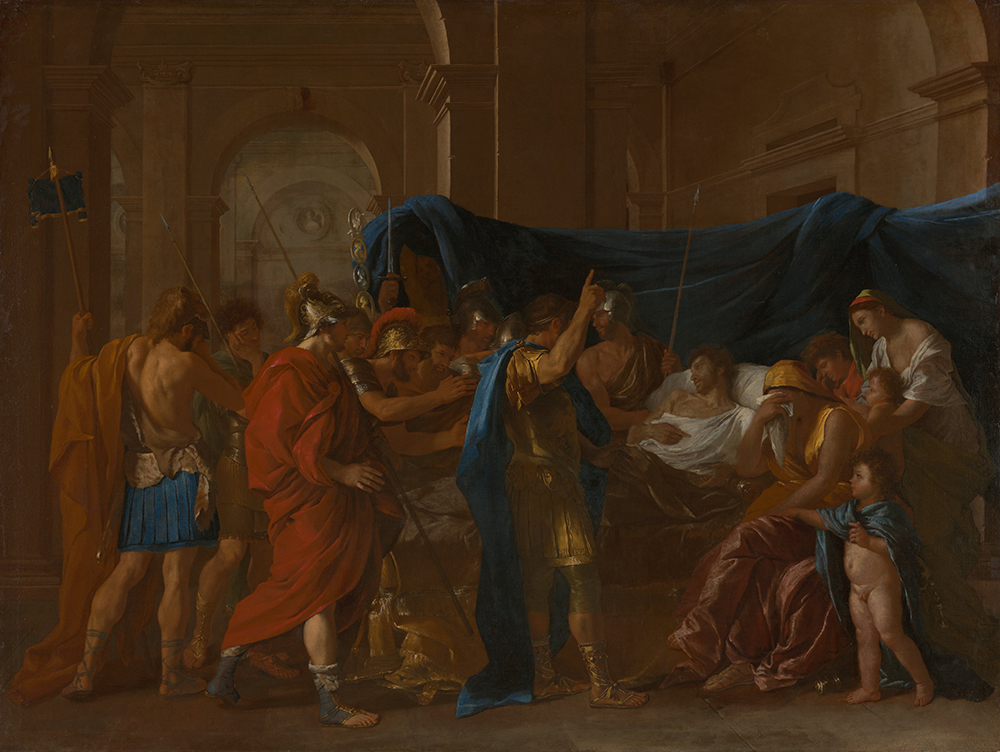
Indeed, Poussin’s Timanthetic gesture is one mere link in a chain that would end up, for instance, on Margaret Strother’s canvases in her 2006 Tel Aviv exhibit “The Virtue of Timanthes,” featuring a series of abstracted mourners with covered faces. Strother’s paintings took direct inspiration from the gestures in Poussin’s Death of Germanicus and Jacques-Louis David’s 1787 Death of Socrates, but also from contemporary and local experiences of grief in the face of injustice and suffering.
Together these responses demonstrate how Agamemnon’s gesture poses an enthralling problem of perspective. Viewers, critics, and artists emulating this celebrated painting have been drawn to this image in trying to imagine not only what Agamemnon might be feeling, but also how his gesture communicates something about us.
Why this gesture? What makes it so unique? What qualities do its variants share categorically? What makes these variants worthy of attention? Gestures of aversion might seem like a mode of avoidance, disinterest, eschewal. Sometimes, that is precisely what these gestures do. But we would be mistaken to think that is all they do. Often they enact a mode of vacillation between aversion and attraction, between an impulsive turn inward and a calculated turn outward, between art and life.
Gesture is a way of bearing oneself (from Latin gerere, “to bear, to carry”), and this is a gesture of the unbearable at its most extreme. It is a gesture through which those inner turbulences outwardly erupt while remaining invisible. You can see the gesture, but you can’t see the expression behind it. It is inscrutable, indeterminate, suggestive.
As it does with the silent characters in Greek tragedy, the obscurity of the gesture has a way of resonating. When we encounter obscurity in others, it demands something of us. Just what it demands, I’m not sure. How we face the world—with all its beauty, but also and especially its afflictions—is among the greatest of questions we negotiate as human beings. Sympathy, compassion, pity: These words offer one kind of answer. Encountering a scene of suffering, we might observe and move toward it. We might consider the feelings of those who suffer and imagine ourselves into the scene. We pay attention (from Latin ad-, “toward,” and tendere, “to stretch”), and we notice the pain and inequality and injustices in the world around us.
From Aristotle to eighteenth-century moral philosophers such as David Hume and Adam Smith, this sentimental mode of relation becomes the very basis for moral evaluation and judgment. Whether a reflexive inclination or a socially imposed obligation, it becomes the foundation of ethical responsibility and action. It is a dispositional way of looking.
And to this day, calls for compassion implicitly become calls against indifference, calls against looking away. Compassion alone, however, is also always limited and inadequate. Even as I align myself with the feelings of my suffering fellow, that alignment is necessarily presumptive, incomplete, ineffectual, and fleeting. As a spectator, I teeter on the condescending edge of mere curiosity, for I am still safe even as I watch or contemplate the other in their peril. I turn them into an asymmetrical object of my visual attention.
Hume and Smith were themselves also interested in the limits of sympathy, and we could turn to any number of other thinkers to consider the implications of those limits. One of the most cogent and disruptive responses to the sentimental politics of compassion was articulated by Hannah Arendt in her 1963 book, On Revolution.
Her antagonist is Jean-Jacques Rousseau, a contemporary of Hume and Smith for whom compassion is “the most natural human reaction to the suffering of others, and therefore the foundation of all authentic ‘natural’ human intercourse.” Why, then, if compassion and sympathy are so innate, do we turn our backs on the suffering of our fellow human beings? For Rousseau, we do so only under the influence of reason. This logic requires Rousseau to tear the soul into two separate parts and foreclose “the silent dialogue of the mind with itself which we call thinking.”
For Arendt, this is disastrous. Thinking, not feeling, ought to be the basis for political morality. Not spectatorship, but introspection. Not sentimentality, but solidarity. Worse still, we have a real tendency to direct our sympathies unevenly, and as we strive to satisfy the “natural” human craving for compassion, we risk reproducing cycles of suffering. Pity, as Arendt puts it, “grows into an all devouring passion” that feeds on affliction and seems “to kill human dignity with a more deadly certainty than misery itself.” It is “taken as the spring of virtue” and yet “has proved to possess a greater capacity for cruelty than cruelty itself.”
This foundational and virtuous principle of ethical responsibility that we call compassion or pity might seem like a refusal to avert one’s gaze. It might seem like the opposite of indifference. In fact, the performance of compassion can also be the very mechanism of withdrawal. As Lauren Berlant puts it, compassion is the “capacity not to turn one’s head away,” but that is not all it is. It is also the embracing of the “obligation to remember what one has seen and, in response to that haunting, to become involved in a story of rescue or amelioration: to take a sad song and make it better.” Steadfast observation alone doesn’t cut it.
Turning away has had its proponents. The medieval Christian tradition of contemptus mundi, for example, urged the turning away from this world in order to turn toward God and find salvation in the heavenly. This principle was the foundation for ascetic and monastic life in the Middle Ages. It oriented the theology of Saint Augustine and many other church fathers. Flash forward to the nineteenth century, which saw new forms of subjectivity articulated in the fragmentation of attention, not just understood as a perspectival stretching toward something, but as “a process of selection” that by necessity becomes an “activity of exclusion.”
Friedrich Nietzsche gave it a more nihilistic twist: Given the limits to our attention, if we lacked the ability to forget or repress, there would be “no happiness, no cheerfulness.” We would be incapacitated by utter depression. We need to be forgetful. It’s impossible to take in all the world’s suffering at once. Reclusion or forgetfulness or some form of withdrawal becomes essential.
In the twentieth century, a “radically secularized version of contemptus mundi” can even be discerned in Theodor Adorno’s cultural criticism, as a mode of political detachment and retreat in response to the disillusionment of postwar, late capitalist society. Jürgen Habermas called it a “strategy of hibernation.” In Minima Moralia, for instance, Adorno writes that in a world that had witnessed the horrors of Auschwitz, even “little pleasures, expressions of life that seemed exempt from the responsibility of thought,” turn into “a callous refusal to see.” There is no longer beauty “except in the gaze falling on horror, withstanding it, and in an alleviated consciousness of negativity holding fast to the possibility of what is better.”
For an intellectual like Adorno, “inviolable isolation is now the only way of showing some measure of solidarity.” Hannah Arendt’s answer is amor mundi, or “love of the world,” a practice drawn primarily from her reading of Saint Augustine and his notion of caritas as the disinterested love of God. For Arendt, amor mundi is a mode of reconciliation, a way of approaching the world “as it is.”
But even this form of love entails a degree of turning away. In one sense, she turns away in thought, a withdrawal into the solitary life of the mind. Related to this mode of withdrawal, Arendt has often been charged with the offense of callous and unsympathetic coldness. To respond to atrocity without sympathy, to respond by turning away even into thought, can seem heartless.
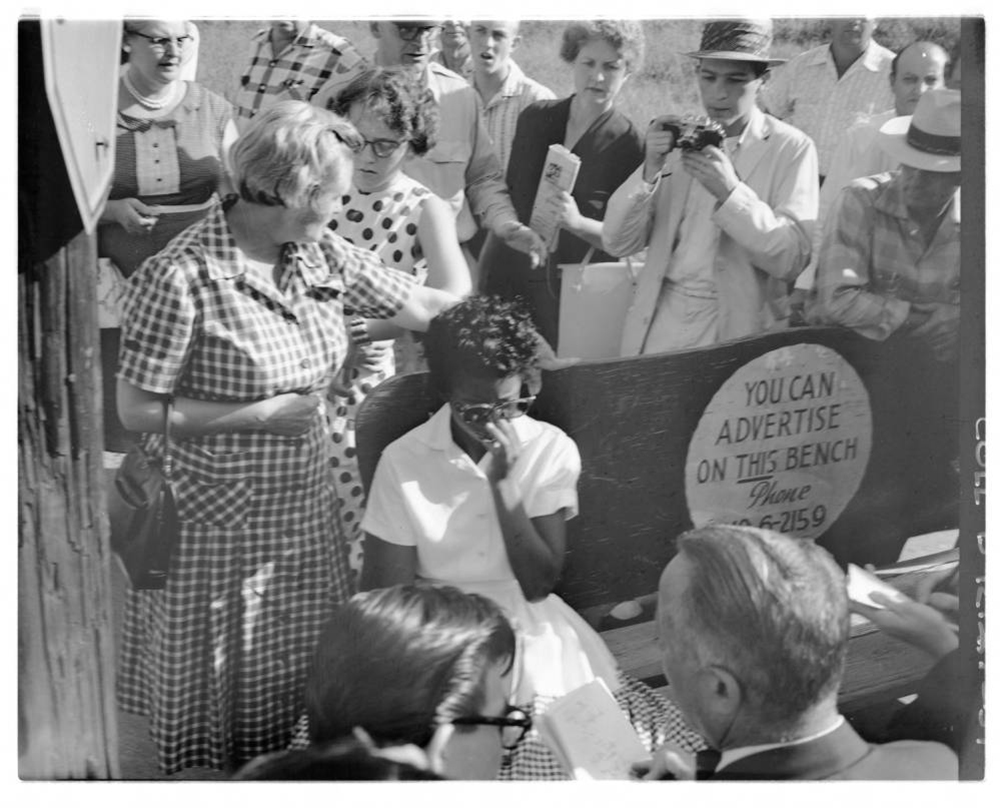
Arendt’s critics saw this coldness exemplified especially in her publication of Eichmann in Jerusalem in 1963 and, a few years earlier, in her notorious 1959 essay, “Reflections on Little Rock,” in which she argues against the Supreme Court’s decision to desegregate schools in the South for the unfair burden it placed on Black children. In what would seem like a misguided effort at sympathy, Arendt explains that her reflection was provoked by the widely circulated image of Elizabeth Eckford persecuted by a mob outside Central High School in Little Rock, Arkansas, on September 4, 1957. “I think no one will find it easy to forget,” declares Arendt of the photograph.

This is a photograph that provoked an epiphanic reshaping of American citizenship: “After that moment,” writes classicist and political scientist Danielle Allen, “there could be no turning back.” In seeing this photograph, Arendt proceeds to imagine herself into Black motherhood and the difficulty of sending one’s own child into such a treacherous situation. This hazardous attempt at sympathy is based partly on her own identity as a Jew, she explains, but also on her reading of Eckford’s face and the way it “bore eloquent witness to the obvious fact that she was not precisely happy.”
Her effort to read the testimony of Eckford’s face is a profound failure. As Fred Moten argues,
Arendt’s “reflection” is a form of seeing that renders Eckford unseen. In her attention to the photograph, Arendt performs a kind of overlooking: Arendt does not see what she sees and so the photograph is a speaker through which Arendt’s own voice is projected. This is to say that Arendt understands Eckford to bear mute, however eloquent, witness…to what Arendt already knows. Perhaps this is because Eckford’s eyes are obscured by shadow and by sunglasses, which could be mistaken for a blindfold; on the other hand, perhaps this is because Eckford’s eyes are hidden…in having been trained on something else.
What Moten notices is that Eckford’s comportment and her obscured eyes are a mode of evasion and resistance, but they also—as a kind of visible silence—seem to give Arendt the idea that the meaning of Eckford’s expression is plainly “obvious.”
When Arendt sees herself through Eckford’s obscured face, as Moten puts it, “Eckford, and her seeing, and her choosing not to see, remain unseen.” Photographs of the day show the National Guardsmen turning her away from the school’s entrance. Even the hostile crowd in that famous photograph gives Eckford no choice but to turn her back to them and keep walking. And then, moments later, captured in an uncirculated photograph by a fellow Little Rock student, she finally sits on the bus bench and briefly raises her hand to her face.
In 1965, the novelist Ralph Ellison—whose protagonist in Invisible Man says of himself, “I am invisible, understand, simply because people refuse to see me”—received a letter from Hannah Arendt. In the letter, Arendt acknowledges that Ellison’s insights had made her realize the error in her reflection: “You are entirely right,” she writes, “it is precisely this ‘ideal of sacrifice’ which I didn’t understand.”
She had recently read Ellison’s interview in Robert Penn Warren’s Who Speaks for the Negro? where he critiqued her essay and argued, among other things, for the moral importance of “understanding.” Such understanding requires “an alertness to human complexity” and to the “nuances of human relationships.” It is, in other words, a way of seeing or attending to others. And this alertness is, for Ellison, a lesson “that tragedy has always sought to teach us,” but also a defining feature “of the American Negro experience”:
I believe that one of the important clues to the meaning of that experience lies in the idea, the ideal of sacrifice. Hannah Arendt’s failure to grasp the importance of this ideal among Southern Negroes caused her to fly way off into left field in her “Reflections on Little Rock,” in which she charged Negro parents with exploiting their children during the struggle to integrate the schools. But she has absolutely no conception of what goes on in the minds of Negro parents when they send their kids through those lines of hostile people.
Tragedy is the model Ellison uses to articulate the “idea” of sacrifice converted into an “ideal of sacrifice,” as the principle by which a Black child, for instance, faces “those lines of hostile people.” It is also the lesson Arendt had missed in her attempt at sympathy.
Ellison knew well the corpus of Greek tragedy. So I wonder whether, in speaking of parental sacrifice, he might have been thinking specifically of Iphigenia as a daughter sacrificed by her wavering father. The daughter of his mother’s closest friend was named Iphigenia. She was like a sister to him. To be named after Agamemnon’s daughter is the very idealization of sacrifice. Understanding another’s sacrifice—standing before it or stretching toward it, even at some distance, even through an image or a photograph—enters us into a relation with real ethical consequences.
“Let the atrocious images haunt us,” writes Susan Sontag. They are an “invitation to pay attention.” They say: “This is what human beings are capable of doing…Don’t forget.” There are limits, of course, to what a photograph itself can do. The rest is up to us. How we respond. How we are haunted. How we remember. And how we act. These ways of responding so often take the form of turning. As we worry about the effect of our vacillations—a worry often inflected with guilt and narcissism—how easily we forget that those with whom we are moved into ethical relation do not necessarily “seek our gaze.”
“We who have never experienced anything like what they went through,” Sontag writes of war in the final pages of Regarding the Pain of Others, “don’t understand. We don’t get it. We truly can’t imagine what it was like.” When we try to face the world, even the metaphors we use are physical. To understand is to stand before something and grasp it. “I get it,” we say. And then we might still forget. Or maybe we never got it in the first place.
So, how to face the world? In Edna St. Vincent Millay’s 1949 poem, “An Ancient Gesture,” the distinction between feeling and gesture plays out as a distinction between Ulysses, who wipes his tears away “but only as a gesture, a gesture which implied / To the assembled throng that he was much too moved to speak,” and the woman he learned this gesture from, Penelope, “who really cried.”
When we turn away, we blur the boundary between sorrow and displays of sorrow. The gesture is nonetheless always an action. An action is something that can always bear the question “why?” I can thus ask you why you knocked over that cup of tea. And you can answer, “I did so accidentally because I saw something run past the window and it startled me.” So too could I ask you why you turned your head away and covered your face. And you might respond, “Because I was shocked to see a man get brutally stabbed, and I had to look away.” In this sense, the gesture is an instinctual kind of response, something akin to a flinch or a reflex, something we cannot easily attribute to the will or to reason. But it nonetheless remains an action. There is also a scenario in which you could candidly respond to my same question by explaining that you turned away because you were consumed by thought (à la Rousseau) or believed it was the right thing to do.
Say you are no longer watching a stabbing take place but instead have come across the victim lying dead amid a crowd of gawkers. Why do you turn away? Because to do so signals that you have respect for the victim, that you, in the words of sculptor Étienne-Maurice Falconet, possess “some decency or dignity.” Or perhaps you feel shame for having initially joined the gawkers, and so you perform your shame in this way. Or maybe you knew the victim and feel grief, putting your face in your hands, covering your tears. Or you are repulsed by the sight of blood. Or you give your best attempt at an answer, which nevertheless is inadequate to the complexity of your feelings. Without sufficient context, I can just as easily misunderstand your grief as shame, or your shame as disgust.
Cicero tried to distinguish the theatrical use of gestures by stage actors, who merely imitate feelings, from the proper use of gestures that ought to be deployed by orators as they deliver the truth with true feelings. According to Cicero, orators must really feel the emotions behind their speeches and strive to express these emotions inherently through voice, countenance, and gesture. But Cicero also felt that orators had neglected this technique, leaving gesture to the domain of artists and thespians.
It is in the domain of the aesthetic—in art and poetry and even philosophy (when we treat it as such)—that the gesture’s ethical difficulty becomes most unsettled and most unsettling. It is in this domain that one person’s turning becomes entangled with another’s: Eckford’s forced turn away from the school’s entrance thus turns, through Will Counts’ widely distributed photographs, into Arendt’s inadvertent refusal to see.
Photographs make a claim to proximity and realness. But as Eduardo Cadava suggests in his reading of Walter Benjamin, photography might “claim to overcome this distance—to reduce, that is, the distance between people and events, or people and places—but only enables it to install a greater distance.”
Susan Sontag invites us to compare our shuddering responses, on the one hand, to a sixteenth-century etching of a man’s head gruesomely mauled by a dragon and, on the other, to a photograph of a World War I veteran who suffered a gunshot wound to the face:
An invented horror can be quite overwhelming….But there is shame as well as shock in looking at the close-up of a real horror. Perhaps the only people with the right to look at images of suffering of this extreme order are those who could do something to alleviate it—say the surgeons at the military hospital…The rest of us are voyeurs, whether or not we mean to be.
The distinction between the “invented horror” of the etching and the “real horror” of the photograph somehow determines our response to the representation of facial mutilation and also ethically determines whether we have the right to look based on whether we are in a position to intervene.
Both images have the power to overwhelm us, to cause us to shudder, to provoke us to turn away. Both can be intolerable and unwatchable for different reasons. But the photograph’s claim to proximity and realness blurs the boundary between “the intolerable in the image” and the “intolerability of the image.” At the same time, it also blurs the boundary between the prohibition on seeing (you should not see this, hence shame) and the unbearability of watching (I cannot stand to watch this, hence shock or horror).
With these distinctions, the intolerability and unwatchability of an image can end up seeming like a choice, in which the “gruesome,” for Sontag, invites us to be either shameful spectators or “cowards, unable to look.” This is a choice underscored by a long history of representing torment as spectacle, as “something being watched (or ignored) by other people.” With its claim to proximity, a photograph of violence and suffering takes that long tradition of spectatorship and places a certain burden back on the viewer: It provokes us to look, to question our looking, and to look away. As Roland Barthes wrote in Camera Lucida, “In order to see a photograph well, it is best to look away or close your eyes.”
If we encounter a photograph that makes us shudder and turn away as a coward or in shame or in helplessness or out of respect, or even, like Barthes, to see the image better in our minds, then what can we make of an encounter with a gesture of aversion performed within a work of art?
Take, for example, one of Susan Meiselas’ photographs of the Nicaraguan conflict in 1979, which Teju Cole writes about in an essay titled “What Does It Mean to Look at This?” In the photograph, a group of neighbors stand before something horrific, which we cannot see. Meiselas’ caption indicates that it is corpses of protestors burning in the street. (I shudder writing this.) In the photograph, one of the neighbors covers her mouth as though in shock, another covers her nose as though to mitigate the smell of burning flesh, another turns away, covering her mouth and nose, another looks on directly, and another covers her face with both hands. Together they stage the varieties of response to the real event. These responses are the object of Meiselas’ documentary lens. But like the photograph itself, these varieties of response also mediate that other event—the burning of bodies—that the lens does not directly capture. For Cole, these gestures “indicate a certain distance,” and this distance creates “a space for spectators to enter.”
Like Timanthes did with Agamemnon millennia earlier, Meiselas captures a series of adjacent gestures that provoke the imagination of the viewer in a way fundamentally different from seeing a photograph of the burned bodies. The neighbors’ gestures, in other words, close the distance that Cadava assigns to the photographic medium. They also, perhaps, allow us to approach a scene we might otherwise be liable to turn away from. They deflect some of the intensity of the demons we might wish not to see. But we see the scene now all the more intimately, our imaginations provoked by the gestures of those who therein cannot bear to look.
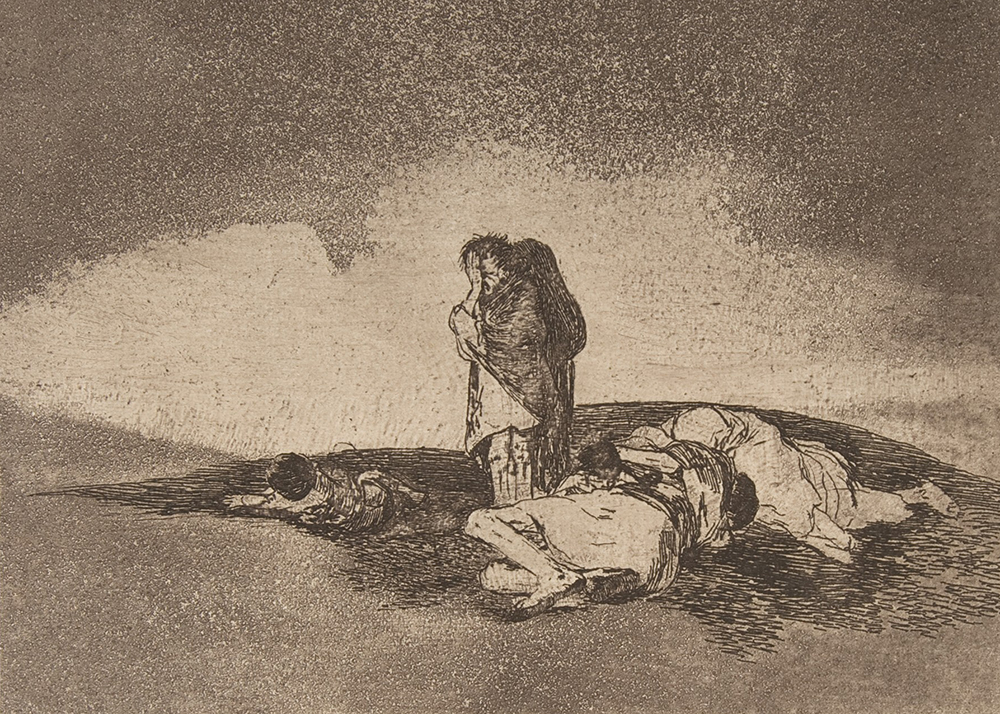
Consider another example: Francisco Goya’s series of prints, The Disasters of War (1810–1820), a keystone work that captures the brutality of modern warfare. The prints invite the viewer to look at the horrors, but they also often insist, as Sontag notes, on “the difficulty of doing just that.” In the print that bears the caption “There is no one to help them” (No hay quien los socorra), a figure stands on a mound above several corpses and covers his face with a hand. What sets this print apart is the way it suggests that no one—least of all, you, the reader, safe at home or in a library, sitting before your copy of Los desastres de la guerra—can help. Even to stand there amid the corpses is to be helplessly absent. And that absent presence can be represented only with a covered face, perhaps in grief, perhaps because the sight of the corpses is unbearable, perhaps to signify an extension of the shadow of darkness that is beginning to encapsulate the figure. It is a gesture of isolation and solitude. A gesture that says, “Take me away from here.” That says, “There is no one here to help us.”
Adapted from Turning Away: The Poetics of an Ancient Gesture, by Benjamin A. Saltzman. Published by The University of Chicago Press. Copyright © 2026 by Benjamin A. Saltzman. All rights reserved.