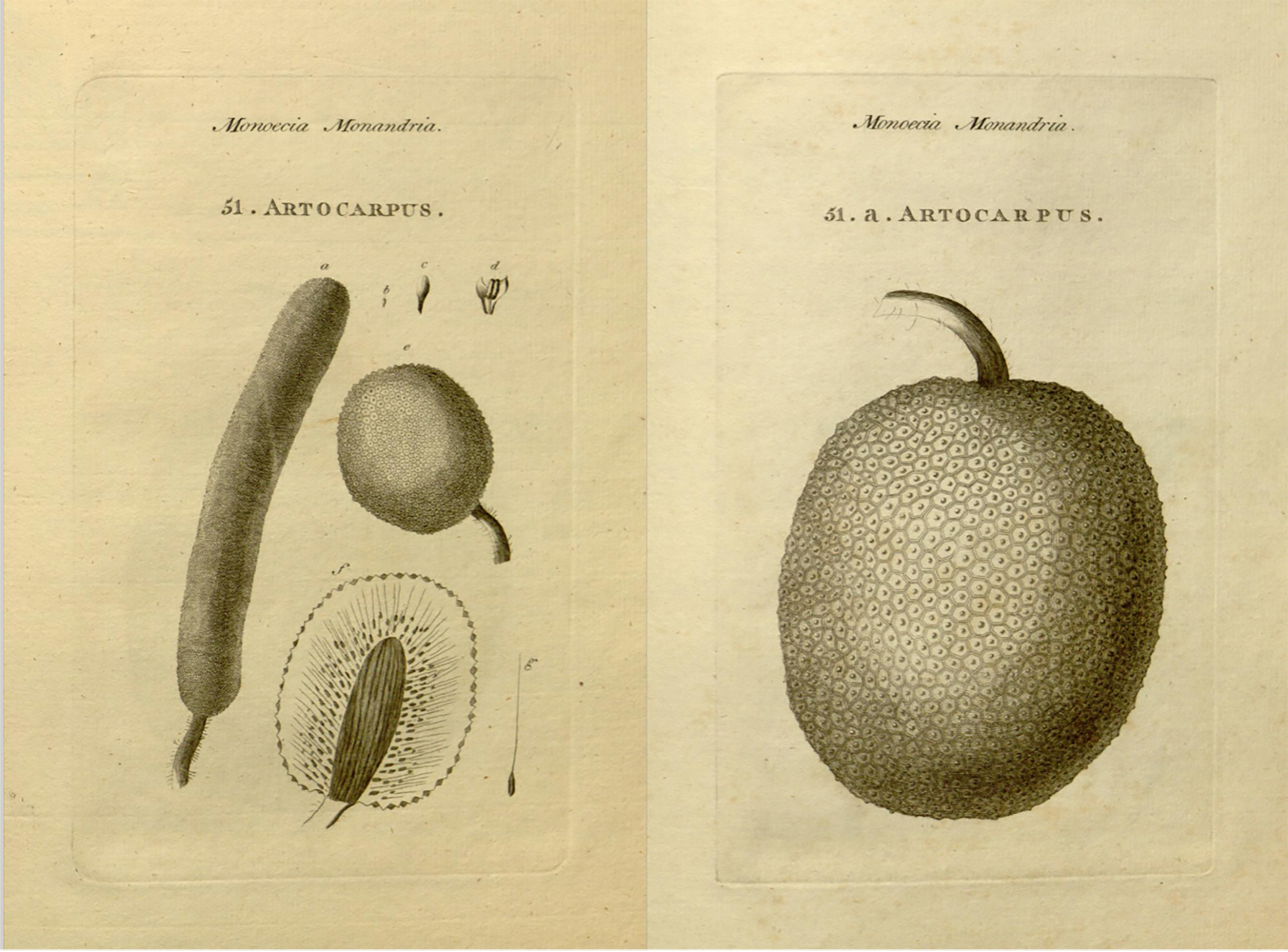
Illustrations of breadfruit from Characteres Generum Plantarum, by Johann Reinhold Forster and George Forster, 1775. Internet Archive.
“Today, George Forster’s name is often spelled ‘Georg,’ following German convention,” Andrea Wulf writes in the author’s note that prefaces The Traveler: One Man’s Quest for Humanity from the South Seas to Revolutionary Paris, from which this essay has been adapted. Wulf favors the anglicized spelling, “as this was how his family predominantly wrote his name, along with many of his contemporaries.” In both the English and German editions, Wulf notes, he appeared as “George Forster” on the cover of his first book, A Voyage Round the World, published in 1777.
“I would be far more useful to the world if I were to embark on another great voyage,” the German naturalist George Forster told a friend in November 1783. Weren’t there enough people who could sort, classify and regurgitate what had already been discovered? But if he couldn’t travel to distant continents and islands, he could explore them with his mind and imagination—and in Kassel in early 1784 he published his groundbreaking About the Breadfruit. In what was ostensibly a botanical treatise, he illustrated how the tendrils of botany reached into culture, ethnography, history, linguistics and human migration. A brilliant and original piece of scholarship, About the Breadfruit reveals Forster’s visionary thinking, the work of a man way ahead of his time.
Forster had first encountered the breadfruit a decade before, while traveling as an assistant to his father, the naturalist Johann Reinhold Forster, aboard the HMS Resolution, during Cook’s second voyage. It was a tropical fruit that grew on large trees on many of the South Pacific islands they had visited. He had enjoyed the dishes made with the abundant breadfruit—roasted on hot stones or fermented into a dough that was baked like bread—but he had also noticed that they had been seedless. With no seeds, the breadfruit trees on Tahiti, Tonga, Tanna, and Malakula (as he explained in his essay), could only be propagated by cuttings from suckers that grow off the tree’s roots. During the many months they had spent in the region, Forster had not seen a single wild breadfruit tree—all of them had been planted by humans.
That made him wonder where breadfruit trees originated and how they had arrived on the islands. Searching the University of Göttingen’s vast library, Forster discovered several botanical volumes that contained descriptions of wild specimens with seeds and small fruits with little flesh from Indonesia and the Philippines. If Tahiti, Tonga, Tanna, and Malakula had no indigenous breadfruit trees with seeds, the only explanation was that they must have been exported from Southeast Asia, traveling thousands of miles across the ocean to the South Pacific islands. For Forster this proved two things. First, the sophistication of the islanders’ agricultural methods—as there was apparently no seedless variety in Southeast Asia, they must have bred and transformed the originally small fruit into the large nourishing crop he had tasted. Just as cereals and fruits had been domesticated through selective breeding in Europe, so the South Pacific islanders had used cuttings from trees with larger fruits to facilitate the slow changes over the centuries—“bit by bit.”
His second conclusion was even more striking, for the history and movement of the breadfruit enabled Forster to develop a surprising understanding of Polynesian migration. The breadfruit’s journey, and its cultivation from a small fruit with spiky skin, seeds and little flesh, to the larger seedless variety found in Tahiti, Tanna, and the other islands, was proof that the Polynesians had migrated east from Southeast Asia across the Pacific—a theory confirmed more than 200 years later by DNA and archaeological studies. As people had boarded their canoes to travel to distant islands, they had packed their most valuable crops and animals. “The breadfruit tree,” Forster wrote, “could only have been brought eastward by humans.”
About the Breadfruit also illustrates how differently Forster thought from other scientists and explorers of his day. During Cook’s 1768 HMS Endeavour voyage, naturalist Joseph Banks had also taken note of breadfruit trees but his interest was economic. Struck by the ease of cultivation and rich harvests—“breadfruit is procured with no more trouble than that of climbing a tree,” he had written in his journal during the Endeavour’s stay in Tahiti—Banks lobbied both George III and Parliament to send an expedition to the South Pacific to transfer breadfruit tree seedlings from Tahiti to the West Indies in order to feed the slaves on British sugar plantations. Where Banks saw a nutritious high-yielding food plant that could fuel the engine of the British Empire, Georg Forster saw evidence of Polynesian migration.
The kernel of Forster’s theory of Polynesian migration was already in A Voyage Round the World, where he had looked at the different languages spoken in the South Pacific. First, he had noticed that almost all the languages the Resolution crew had encountered were variations or dialects of one language—with the noticeable exception of those spoken in Vanuatu and New Caledonia. Often only a letter or a sound was different. The Tahitian word for “to sit” is noho and in Tonga it is nofo, while “woman” is vahine in Tahiti, wahine in Māori and fefine in Tonga. Or the sound for k in Māori and Tongan words doesn’t exist in the corresponding Tahitian terms where it’s replaced with a glottal stop—for example, “canoe” is vaka in Tonga, waka in Māori and va’a in Tahiti. Similarly, at the Marquesas Islands, George noted, “their language [was] much nearer the Tahitian, than any other dialect in the South Sea, with this difference, that they could not pronounce the r.” This affinity, he was certain, demonstrated that the different islanders “must have had one common origin, perhaps in the mother country, from whence both these colonies issued.”
He had not been the first to notice language similarities. During the Endeavour voyage, when Tupaia had communicated with the Māori, Cook and Banks had also realized that languages across vast distances were related. “This is a sufficient proof that both they [the Tahitians] and the New Zealanders have had one origin or source,” Cook had written in his logbook in March 1770, “but where this is, even time perhaps may never discover.” He had left it at that, and neither Cook nor Banks pursued these speculations any further. During the years on the Resolution, Forster had most certainly discussed these ideas with Cook, but his systematic investigation into the spread of languages and the breadfruit tree turned these initial insights into an original and bold analysis of Polynesian migration.
In 1778, Johann Reinhold Forster had published “A Comparative Table of the Various Languages in the Isles of the South Sea” in his Observations Made During a Voyage Round the World, which his son had translated into German. As its title reveals, it was a list of words that the Forsters had collected during the Resolution voyage. Not only did it include vocabulary from the South Pacific islands they had visited but also Malay words—a language spoken in Indonesia. When the Forsters had noticed the presence of Malay words in the Polynesian languages, they had worked out that the farther east an island was situated, the fewer Malay words its language contained. This meant that islands such as Tahiti or Easter Island, which were far farther east from Indonesia, must have been colonized later than western islands such as Tonga, where they had identified more Malay terms. Why? They deduced that Polynesian and Malay must have originally developed from one language, meaning that when Polynesians arrived at the western Polynesian islands their language had begun to separate and change. As the Polynesian settlers then moved farther east over the centuries, more of the original Malay words disappeared, or changed so radically that they were no longer recognizable.
Even their deities revealed this migration. George Forster wrote that Māori gods are “so correspondent to those of the Tahitians, that their system of polytheism must be of very ancient date, and seems to derive its origin from their common ancestors.” Wherever they had stopped on their voyage, George had looked for similarities or differences. There were two distinctive groups of people in the South Pacific, he realized, different in appearance, language, and culture. The people in Vanuatu and New Caledonia had darker skin and spoke languages unlike those in the Society Islands, Tonga, the Marquesas, Easter Island, and New Zealand. “They appear to be of a race totally distinct of these,” he wrote about the islanders from Vanuatu, but “the natives on some parts of New Guinea and Papua seem to correspond in many particulars with what we have observed.” It was possible that the islanders from Vanuatu and New Caledonia might be related to those of Papua New Guinea.
Today it’s thought that around 45,000 to 50,000 years ago, when Australia, Tasmania, and Papua New Guinea formed a single landmass known as Sahul, the first humans—descendants of people who had migrated from Africa through Southeast Asia—reached and settled in what is now Papua New Guinea and later in the Bismarck Archipelago. These early inhabitants and their descendants lived there for tens of thousands of years before the next great movement of people.
Roughly 3,500 years ago (1500 bc), there was a second, different wave of migration, this time from Southeast Asia, pushing eastward across the Pacific. Long before the earliest European expeditions, the ancestors of today’s Polynesians set out from regions that include present-day Taiwan, the Philippines, and Indonesia. They sailed vast distances in outrigger or double-hulled canoes loaded with hogs, chickens, root vegetables, coconuts, bananas, and breadfruit seedlings. Masterful navigators, they used stars, birds, disruption in ocean swells, cloud formations, and wind patterns as their guides as they crossed the Pacific. Today their progress across such vast distances can be tracked through DNA, but also through crops and agricultural methods such as the domestication of dogs, chickens, and pigs—as well as through archaeological records, including the spread of uniquely ornamented Lapita pottery.
Exact dates are disputed, but it’s believed that they first settled between 3,400 and 3,200 years ago (1400 bc and 1200 bc) in parts of coastal Papua New Guinea, the Bismarck Archipelago, and then the Solomon Islands. Soon after, around 3,000 years ago (1000 bc), they moved southeast to Vanuatu and New Caledonia—islands that had not previously been inhabited—where they later came into contact with and were joined by descendants from the first migration wave who were living in the Bismarck and Solomon Islands. Over generations, these communities blended and differed both in appearance and culture from those who had continued to sail east.
The eastward expansion brought the Polynesian ancestors to Fiji between 3,100 and 3,000 years ago (1100 bc and 1000 bc), and then on to Samoa and Tonga, where they arrived around two hundred years later (900 bc and 800 bc). Migration then paused for almost two millennia, before navigators set out again, reaching the Tahitian, Cook, and Marquesas Islands around 1,000 years ago. Then, in a final push, they sailed to Hawaii, Easter Island, and New Zealand. Several centuries before Columbus and Magellan embarked on their voyages in the fifteenth and sixteenth centuries, Polynesian ancestors sailed some 2,500 miles through storms and unknown waters and arrived in New Zealand around 700 to 800 years ago (1200 to 1300).
The differences George Forster observed in the people of Vanuatu and New Caledonia, compared to those on more easterly islands, was the result of intermingling between descendants of the first migration wave and later Polynesian settlers. George could not have known the complex details of these migration patterns, but more than two centuries ago he worked out the broad outlines by studying the diaspora of Polynesian languages and the history of the breadfruit tree. He could only guess their reasons—“oppression by their own people, or foreign conquerors, or superstitious legends, or some other cause”—but he was convinced that these great ancient navigators and their families had set out to find new islands to colonize and had not drifted there by accident. “I cast a glance at a map of that part of the world,” he wrote in About the Breadfruit, “I survey the vast Pacific Ocean, and find that the most distant, solitary, and scattered islands are not only inhabited by people, but occupied by the very same people. I confess, I cannot convince myself that a storm, or a series of similar coincidences, is sufficient to satisfactorily explain this widespread dispersion of one and the same people across such a vast ocean from New Zealand to Easter Island.”
The people of the South Pacific, George realized, were connected rather than separated by the ocean. (This connectedness was beautifully evoked by the Tongan historian Epeli Hau’ofa in the late twentieth century when he talked of “Oceania” instead of remote South Pacific islands. It was a “sea of islands,” not islands in a far sea but a large interconnected world where people sailed, mingled, and belonged, not constrained by boundaries of land.) Where others saw tiny islands spread across the vastness of the Pacific, George Forster brought them together with the threads of migrations. It would take more than two hundred years for the world to catch up with him.
From The Traveler: One Man’s Quest for Humanity from the South Seas to Revolutionary Paris. Copyright © 2026 by Andrea Wulf. Published by Alfred A. Knopf, a division of Penguin Random House, LLC, 2026. Reprinted by permission of the author and Alfred A. Knopf.