Is it only the mouth and belly which are injured by hunger and thirst? Men’s minds are also injured by them.
—Mencius, 300 BCIt’s What’s for Dinner
To be an ethical eater, one can no longer betray a deep ignorance about the workings of nature.
By Scott Korb

Most honest discussions that bring together food and animals are really, at bottom, about suffering and killing and death, topics that we all know have a way of making people feel bad. This is especially true, I’ve found, if those people are young college students whose lives have been relatively unburdened by the kinds of suffering and death—and the increasingly regular thoughts about such things—that go along with honest living in the world.
Each semester for the past five years, I’ve set out to discuss the suffering and killing and deaths of animals as part of a freshman-level food-writing course I call “Setting a Fine Table,” so named for a favorite line from
M.F.K. Fisher. Fisher is the American food writer whose work, which I first read after a few too many years as a vegetarian and then a vegan, suggested how I might return to taking real pleasure in food again. Step one involved admitting I’d been wrong about the supposed pleasure (and joyful pain) I’d been taking all those years in refusing so much of what’s out there to eat. No matter what I thought about how pure and good my diet was as a vegan, how Fisher ate was always better, whether in her youth, when she watched Old Mary the cook “make butter in a great churn between her mountainous knees,” or as an adult, when she took an entire day to eat three or four tangerines, whose sections, resting on the radiator, grew “plumper, hot and full.” She saved the best part of the fruit—the kiss—for her husband Al.
Over time my regimen around food had become a kind of devotional, ascetic practice; I never saved anything for anybody. And though it had the stink of puritanism, there was nothing at all evangelical about it. In fact, refusing meat and dairy and eggs, three meals a day, became a way of distancing myself from those around me, sort of the way abstaining from sex keeps you from the person you love. This approach wasn’t ever intended as a model or lesson for others on how to live better; rather, it offered me my own version of the best of all possible worlds—population, one.
Reading Fisher’s The Gastronomical Me, I was reminded in language no less religious, however, that “There is a communion of more than our bodies when bread is broken and wine drunk.” The eater lives in the world with others. I took another important lesson in my last days as a vegan from Fisher’s fellow midcentury New Yorker mainstay A.J. Liebling, whose criticism of my approach to food cut just a little sharper: “No ascetic,” he once wrote, “can be considered reliably sane.” Fisher’s ideas about communion—or better, commensality—and Liebling’s barb about sanity have stuck with me over the years and continue to shape a class in which I’m hoping to score a few points for honest living, which, if we’re talking about eating, means living with full awareness of our place in the food chain.
Even as I’ve become far less puritanical when it comes to what I eat, I’ve also become far less agnostic when it comes to what I teach. Nowadays, where meat is concerned, we’re mainly asked by conscientious food writers simply to look at where our food comes from. It’s somewhat hard to fault anyone who looks at life on a factory farm, sees cows knee-deep in shit or chickens with their beaks snipped off, and then turns his back on meat forever. In my classroom, however, I want to ask something more. I’m not satisfied with simply understanding where our food comes from—especially if where most of it comes from today is so horrifying. It’s just as important that my students understand where they come from—or, that is, where we come from in our thoughts about ourselves and in our relations with the world around us. When it comes to what we eat, these relations have their origin in the evolutionary bargain we struck with both plants and animals that we call domestication. And so, with a long view, I hope my students can come to see that where our food comes from and where we come from happen to be the very same place.
I begin my class with an essay by David Foster Wallace, who in 2003 took an assignment from Gourmet magazine to cover the annual Maine Lobster Festival. In the piece, “Consider the Lobster,” which borrows its title from M.F.K. Fisher’s masterpiece Consider the Oyster, Wallace wonders what “all right” might even mean in the context of boiling “a sentient creature alive just for our gustatory pleasure.” In his usual way—though in a way that was alarmingly unusual for Gourmet and is often a great challenge for my students—Wallace offers endless parenthetical clarifications and hand-wringing details: “The basic scenario is that we come in from the store and make our little preparations like getting the kettle filled and boiling, and then we lift the lobsters out of the bag or whatever retail container they came home in…whereupon some uncomfortable things start to happen.” And then comes one uncomfortable thing after another, all of which lead us to conclude, with Wallace, that “The lobster acts as if it’s in terrible pain.”
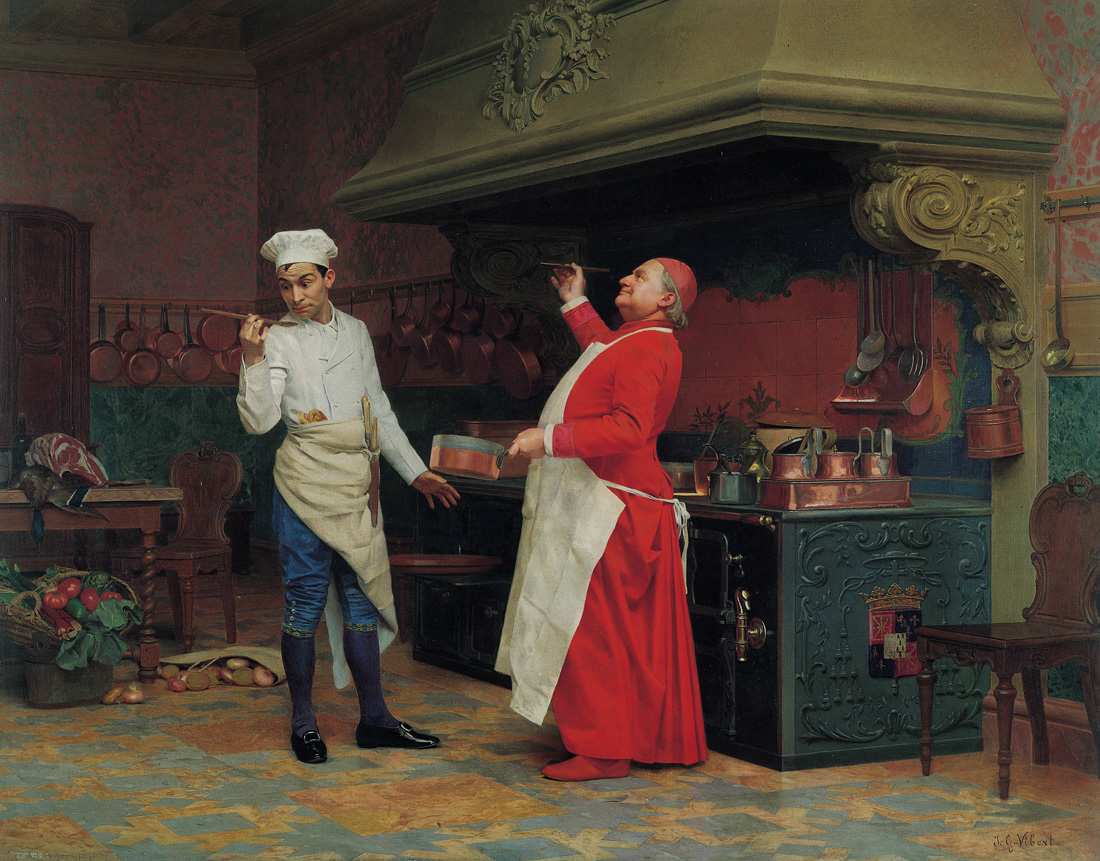
The Marvelous Sauce, by Jehan Georges Vibert, c. 1890. Albright-Knox Art Gallery, Buffalo, New York.
I pair Wallace with the grande dame of Southern cooking, Edna Lewis, writing in 1976 about the butchering of family hogs in Depression-era Virginia. Lewis’ take on the rituals and recipes developed around small-town American hog killing is just as insightful and just as much fun as Wallace’s appraisal of “the massed inconvenience and aesthetic compromise of real democracy”—an ugly reality he locates within the Maine Lobster Festival’s Main Eating Tent. The slaughter itself, however, Lewis copes with in just five words: “after each hog was killed.” In the early days of snout-to-tail American kitchens, long before Americans felt the need even to say such things, we learn from Lewis, for example, that children “would blow the [hog] bladders up with straws cut from reeds and hang them in the house to dry.” These dried pig bladders would later be used to help celebrate the birth of the baby Jesus. Death followed by new life all over again.
We then read food expert
Michael Pollan, America’s most well-known omnivore, who in a 2002 essay, “An Animal’s Place,” argues convincingly that “What’s wrong with animal agriculture—with eating animals—is the practice, not the principle.” An animal’s place, in other words, is first on the farm and then, so long as that farm was nice, on the dinner plate. During one class, we watch a video about deer hunting and processing; it shows carcasses that are first skinned, and then run through bandsaws, butchered under the edges of boning knives, and extruded from meat grinders on their way to becoming venison steaks and sausages. One lesson here is that, as with most other mammals we eat, deer undergo a name change while under the knife. We follow the hunting-and-butchering footage with more moving pictures, the 2005 DreamWorks film Madagascar, a fun-for-all-ages cartoon about talking zoo animals. Madagascar, believe it or not, aspires to present a vegetarian utopia to rival those imagined in the books of Genesis and Isaiah, parts of which we also read. The students always seem wonderfully startled to learn that Adam and Eve were, at first, vegetarians.
We continue with novelist Jonathan Safran Foer, who in the 2009 book Eating Animals is writing against meat in the context of becoming a new father. “Feeding my child,” he writes, “is not like feeding myself: it matters more.” I ask the class what he might mean by “matters.” They don’t usually have a good answer—nor, I think, does the author. From Foer we finish with South African Nobel laureate J.M. Coetzee, another vegetarian fiction writer whose novel Elizabeth Costello takes shape, in large part, as a series of academic lectures delivered by the main character, Coetzee’s alter ego, on the campus of an imaginary American college. In addressing her audience “on the subject of animals,” Elizabeth Costello compares the effect on us of ignoring our nation’s factory farms and abattoirs with the profound sin of everyday Germans and Poles of the Third Reich “who did and did not know of the atrocities around them.” What students don’t always get—Who does he think he is?!, they sometimes snarl—is that Coetzee is making a different comparison here (though only slightly) than the one famously made by his fellow Nobel laureate Isaac Bashevis Singer in a 1965 story, “The Letter Writer,” about the character Herman Gombiner, a Holocaust survivor who views animal slaughter as the “eternal Treblinka.” (As you might expect, Singer was, like Coetzee and both of their protagonists, an ethical vegetarian.) And for his part, Coetzee does refer to modern animal farms—factory farms—as “an enterprise of degradation, cruelty, and killing which rivals anything that the Third Reich was capable of, indeed dwarfs it, in that ours is an enterprise without end.” Coetzee seems to take for granted the respective brutality of those in charge of concentration camps and factory farms; what shocks him, and what should shock us, I hope, is the complete lack of sympathy it requires to ignore what goes on all around us.
At some early point in the class, often at first blush, someone raises the most basic complaint about our relationship to animals. It’s usually an already committed vegetarian who says, “Who do we think we are?” This I have come to expect. And this I like. After all, few of us have been taught to think of college—or the workplace, the supermarket, or the kitchen—as a place to ask ourselves with any real curiosity the ageless question of who we think we are or, indeed, what sustains us. This question feels like a good start.
What I find disheartening is that after nearly a month of reading and writing and talking about who we think we are, and perhaps who we’ve always been, relative to animals—and let’s not forget we are relatives—it’s not uncommon for someone to ask this very same question with the very same exasperation again on the last day: “Who do we think we are?” When it comes to examining honest living, I often worry in this class that we’re people who get nowhere. We’re stuck wishing we were still in Eden.
In the beginning, so it goes, we were all vegetarians, even the animals. What sustained us were all the green plants. It says it right there in Genesis. God said, “See, I have given you every plant yielding seed that is upon the face of all the earth and every tree with seed in its fruit; you shall have them for food. And to every beast of the earth, and to every bird of the air, and to everything that creeps on the earth, everything that has the breath of life, I have given every green plant for food.” And it was so. It’s only paradise, and only God’s creation, if there’s no suffering whatsoever.
The Fall, which cracked the door to a world of sin and suffering, eventually leads to the Great Flood and
the very first food laws. When all of those once-vegetarian lions and tigers make it off the tight quarters of Noah’s ark, God creates a different order, one delivered as a blessing meant to inspire in animals the “fear and dread” of humanity. God blessed Noah and his sons, and said to them, “Be fruitful and multiply and fill the earth. The fear and dread of you shall rest on every animal of the earth, and on every bird of the air, on everything that creeps on the ground, and on all the fish of the sea; into your hands they are delivered. Every moving thing that lives shall be food for you, and just as I gave you the green plants, I give you everything.”
What the ancient myth-makers behind Genesis understood better than we often do is that ours is not a perfect world. Nor, they believed, was such a perfect world possible without a divine intervention as cosmic and dramatic as God’s original creation. Utopias are the dreams of prophets, and prophets dream big of what God, in all His mystery and majesty, will do at the end of time, not what humanity, in all our meekness and fear and shame and pride, is merely capable of today. Following Genesis, Isaiah’s eighth-century-bc prophecy once again establishes a world without suffering. Only now we’re asked to look forward to a time where our implements of war will be turned into gardening tools—“they shall beat their swords into plowshares”—so we can grow more and more green plants to feed our vegetarian wolves and leopards, bears and lions, asps and adders. And of course, our long-lost vegetarian selves.
But we’re not there yet. And, honest to God, we’ll never get there again. Explaining our essential imperfection in this world is a part of religious storytelling that runs through Adam and Eve, Cain and Abel, Abraham and Moses, and even the long-suffering Job. It’s also what stands behind the work of the Hebrew prophets, who were intent on reforming their own world by way of an endless, even hopeless, grasping for the Kingdom of God. And if it’s possible to strip away whatever religious dogmas that have adhered to our mythologies over the centuries and go right to the lessons of our great myths, discussions about our basic imperfection and essential imperfectability might go a long way in shaping a better kitchen.
We must remember that when it comes to our relationship with animals, managing their supposed fear and dread of us—presumably to mitigate both their suffering and our guilt—is not a new proposition. We’ve been doing it, or so we have always imagined, since the beginning. If humanity was understood to inspire fear and dread in animals as we hear in Genesis, we must also have been understood to be capable of recognizing those emotions. This recognition—or, better, this reckoning—is the very basis of the compassion that makes us human and should shape our relationship with animals. On the other hand, there’s no place for compassion in a utopia like Isaiah’s; there’s simply no need for it. And if we believe that the best humanity is capable of is deeply felt compassion—a tenet shared by the great religions of the world and our great secularists alike—then there’s no place for humanity in a utopia. The choice is clear: we either live in the world we have, or we build a lonesome world where we don’t belong.
Nowadays, our sense that animals fear us and the notion we have that some may actually dread their deaths, like many of us do, goes a long way to support arguments against eating them. This is particularly true because modern factory farming—which had no premodern counterpart—enacts a kind of brutality against animals that one can call properly sinful. Think Perdue and Tyson, Cargill and ConAgra, who all produce food that is magically and marvelously inexpensive. Eating from these modern farms requires living without the sympathy we learned in the aftermath of the Deluge—after forty days and nights living cooped up with that whole world of animals. It requires allowing ourselves to believe we still eat of Eden, a mythical world devoid of fear or dread, without remembering that in the beginning there was also no death. Today we must remember: animals in factory farms—99 percent of the animals we eat, according to Jonathan Safran Foer—live horrible lives and die horrific deaths.
When we come face to face with so many of the animals we eat, it seems impossible not to ask again and yet again, Who do we think we are? After finishing up with Coetzee in my class, most of the students agree it doesn’t matter who we think we are: who we should be are vegetarians. That not all of us are says nothing about the rightness of the cause, only that most of us are too weak and too stuck in our ways to stop eating animals. But this is basically where we started, a place not so different than where I once lived as a self-important vegan—above the fray, away from sin and the pain of the world, or so I thought. Today this is absolutely no place I ever want to end up in. That place I used to live in doesn’t really exist.
Ever since the publication of The Botany of Desire a decade ago, Michael Pollan has been offering us a way out of Eden that has the added bonus of providing a cure for what he calls the disease of human self-importance. He typically begins in the garden, and from there he asks us to imagine the world from the plants’ or the animals’ point of view. It’s a literary conceit, he’ll admit, but corn and potatoes and apples, pigs and sheep and cows, have domesticated us as much as we’ve domesticated them—corn most successfully of all. We spread the genes of the various species we live with because they “want” us to. And yet most eaters continue to imagine themselves at the center of the world.
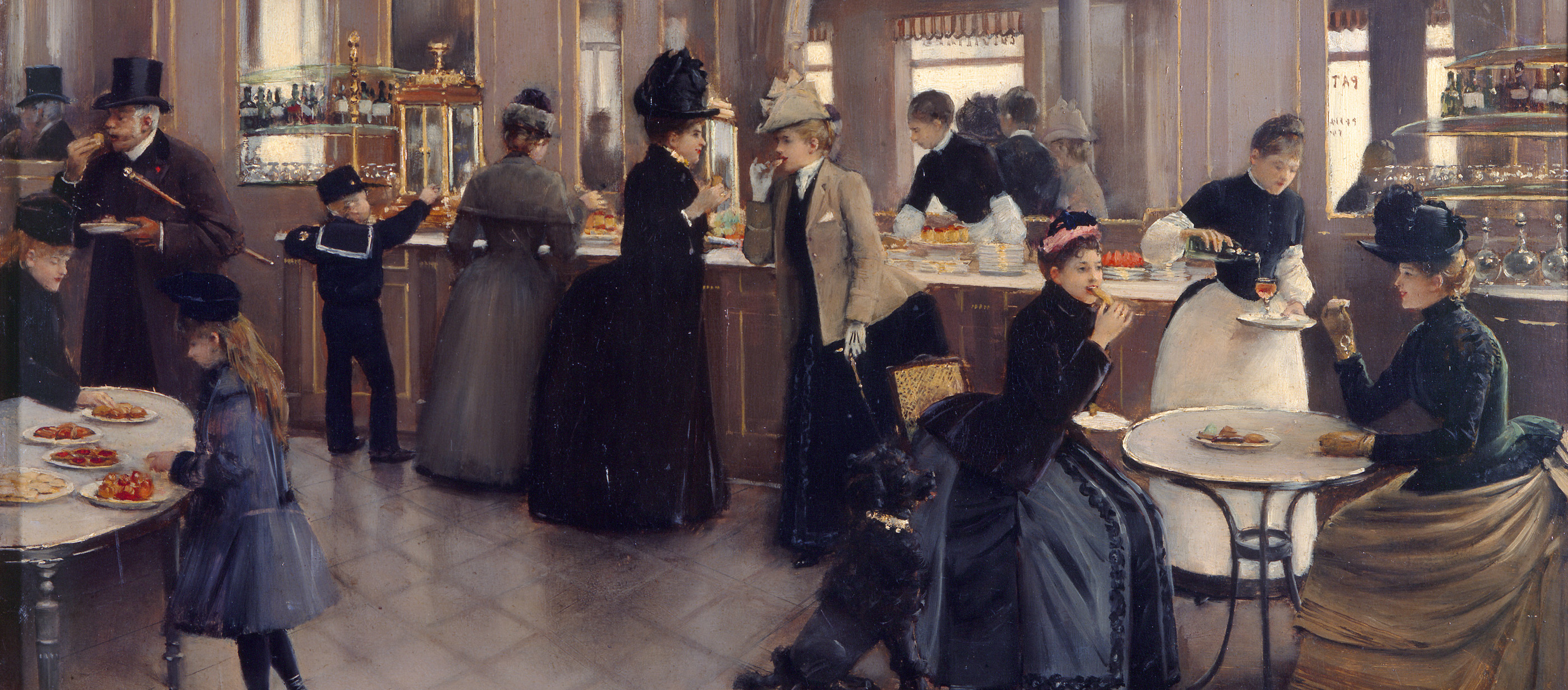
The Patisserie Gloppe, by Jean Beraud, 1889. Musée Carnavalet, Paris.
In much of his work, Pollan explains that the radical misreading of our relationship to the animals we eat is largely the fault of René Descartes, the father of modern philosophy, who saw animals as senseless, soulless automatons, far removed from the human who knows his own mind. Today, we agree to eat industrial meat because we remain “children of Descartes”; factory farms are as Cartesian as operations get. But, for Pollan—and I hope for us—Descartes ought to matter much, much less in all of this than
Charles Darwin, the father of evolutionary biology. He taught us that humans have developed alongside animals, domesticating certain species, and today Darwin’s ideas suggest that we have been domesticated by those same species along the way. In other words, who we are has only a little to do with what we think—Cartesian reason being just one tool among many in the natural world—and much more to do with how we’ve evolved in the world we have, the world we share with the thousands and thousands of animals that have evolved with us, strange as it is to say, to become food.
When it comes to animals, if we believe Darwin as Pollan insists we must, it’s hard to see domestication as anything but the working out of “Darwinian trial and error.” Pollan continues in his 2006 book The Omnivore’s Dilemma:
Domestication took place when a handful of especially opportunistic species discovered…that they were more likely to survive and prosper in alliance with humans than on their own. Humans provided the animals with food and protection in exchange for which the animals provided the humans their milk, eggs, and—yes—their flesh. Both parties were transformed by the new relationship: The animals grew tame and lost their ability to fend for themselves in the wild…And the humans traded their hunter-gatherer ways for the settled lives of agriculturalists.
There are farms today that allow domesticated animals to exercise their creatureliness. There are markets where we can buy these meats—and yes, it’s true and perhaps painful, at a somewhat greater cost than factory-raised animals. And we should. To argue after Darwin that domesticated animals would prefer to be “liberated” from these farms—to use the language of animal philosophers—is, as Pollan argues, “to betray a deep ignorance about the workings of nature” (emphasis mine). So goes Pollan’s drubbing of utilitarian philosopher Peter Singer, author of the 1975 classic Animal Liberation, and the other animal-rights activists, who while hating Descartes for his misunderstanding of animals, can’t seem to get a good grasp on Darwin. And to fail to understand Darwin is to misunderstand the natural world. It’s a failure of imagination in a world that requires real, sometimes troubling, sympathy.
When the stomach is full, it is easy to talk of fasting.
—St. Jerome, 395Still, I think we need to get to the point where talking about animals no longer makes anyone feel cornered—the nowhere place my students often end up, trapped in a system they feel they shouldn’t be a part of. M.F.K. Fisher, who knew the real cost of meat and sagely advised readers about “saving your meat money for a few days, and making a party of it,” took the long view in this regard. She found nothing at all nagging and nothing at all wrong with the fact that “For centuries men have eaten the flesh of other creatures not only to nourish their own bodies but to give more strength to their weary spirits.” And yet, even in today’s world, which is dominated by industrial agriculture, an enterprise where everything is deeply wrong, we must preserve the possibilities for feeding ourselves and each other in ways that nourish and strengthen the world we share with plants and animals alike. After spending time on a Virginia hog farm with Edna Lewis, it seems clear that deep and proper participation with plants and animals means raising them well and then living well by eating them. Plants and animals need us as much as we need plants and animals. Indeed, in this world dominated by industrial agriculture, the lives and needs of animals could not be more desperate. Ethical vegetarianism requires that we allow ourselves to believe we still eat of Eden, that we belong to Eden, and that Eden did once and still can exist. Indeed, this is, perhaps, what the ethical vegetarian shares with those of us who eat industrial meat without giving it much thought. For the vegetarian and your average meat eater alike—for all my students who both come and go convinced that vegetarianism offers deliverance from a world of sin and death—there’s some magic involved, and not a little sentimentality, complete with the escapism that magicians and myth-makers have always provided.
The fact remains, though, that there is no world devoid of fear or dread or death. And here, for once, Darwin and Genesis agree. Who ever said eating wouldn’t hurt?